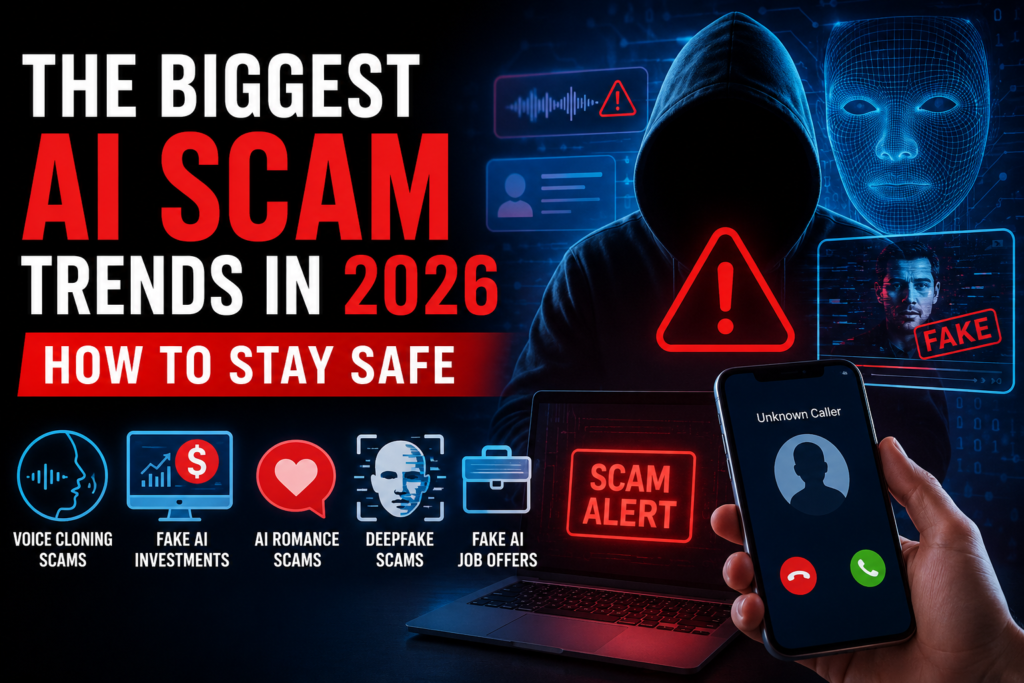
AI Scams 2026 are becoming one of the biggest cybersecurity threats worldwide. Artificial intelligence is changing the way we work, shop, and communicate. However, scammers are also using AI to create convincing fraud, including voice cloning, deepfake videos, phishing emails, and fake investment platforms. Understanding these AI scams in 2026 can help you protect your money and personal information before it’s too late.
Why AI Scams Are Increasing in 2026
Artificial intelligence has become cheaper, faster, and easier to access than ever before. Today, anyone with an internet connection can use AI tools to create realistic voices, images, videos, and text.
Unfortunately, scammers are taking advantage of these technologies.
Moreover, AI allows criminals to target thousands of people at the same time. Instead of writing every message manually, they can generate personalized emails, fake customer support chats, and convincing social media messages within seconds.
Another reason is that many people still believe they can easily spot a scam. However, modern AI has become so realistic that even experienced internet users can be fooled.
Therefore, understanding these scams is no longer optional—it’s an essential digital skill.
1. AI Scams 2026: Voice Cloning Scams
Imagine answering your phone and hearing the voice of your son, daughter, or close friend asking for urgent financial help.
The voice sounds real.
The emotions sound real.
Everything feels genuine.
However, the person speaking may actually be an AI-generated copy.
Voice cloning technology can recreate someone’s voice using only a short audio clip taken from social media videos, podcasts, or voice messages.
Scammers often create panic by claiming there’s been an accident, an arrest, or another emergency. Their goal is to pressure victims into sending money immediately without verifying the situation.
How to Stay Safe
- Never send money based on a single phone call.
- Hang up and contact the person directly using a trusted phone number.
- Create a family “safe word” that only close relatives know.
- Stay calm and verify the story before taking any action.
2. AI Scams 2026: Deepfake Video Scams
Deepfake technology has improved dramatically over the past few years. Today, AI can generate videos that make celebrities, business leaders, or public figures appear to say things they never actually said.
For example, you might see a famous investor promoting a new cryptocurrency platform or a company CEO announcing a special giveaway.
At first glance, the video may look completely authentic.
However, appearances can be misleading.
Moreover, scammers often use fake interviews, edited livestreams, and AI-generated news clips to gain people’s trust.
Warning Signs
- Unrealistic investment promises.
- Requests to send cryptocurrency.
- Videos shared by unofficial social media accounts.
- Strange facial movements or unnatural lip synchronization.
How to Stay Safe
Always verify important announcements through the company’s official website or verified social media pages. Never invest money based solely on a video you found online.
3. AI Scams 2026: AI Phishing Emails
Phishing emails are becoming far more dangerous because AI can now write messages that sound natural and professional.
In the past, scam emails often contained poor grammar and obvious spelling mistakes.
Today, that’s no longer the case.
Instead, AI can generate polished emails that appear to come from your bank, online store, employer, or favorite technology company.
Furthermore, these emails often include personal details collected from previous data breaches or public social media profiles.
As a result, they feel much more convincing.
Common Warning Signs
- Urgent requests to verify your account.
- Unexpected password reset emails.
- Links that don’t match the official website.
- Requests for banking information or verification codes.
How to Stay Safe
Rather than clicking links inside emails, type the company’s official website directly into your browser.
In addition, enable two-factor authentication whenever possible. Even if someone steals your password, they’ll have a much harder time accessing your account.
3. AI Scams 2026: Fake Investment Platforms
Artificial intelligence has created a new wave of investment scams.
Scammers build professional-looking websites, generate fake customer reviews, and even create AI videos featuring well-known financial experts.
These platforms often promise guaranteed daily profits with little or no risk.
Unfortunately, investing doesn’t work that way.
If an investment claims to double your money in a few weeks, it’s almost certainly a scam.
Moreover, many fake investment websites disappear as soon as enough people deposit money.
How to Stay Safe
- Research every investment platform carefully.
- Look for official company registration.
- Read independent reviews.
- Never trust guaranteed profit claims.
Remember, legitimate investments always involve some level of risk.
5. AI Scams 2026: Shopping Website Scams
Online shopping has become more convenient than ever.
However, scammers are now using AI to build fake online stores that look almost identical to legitimate websites.
These stores often advertise expensive products at unbelievably low prices.
Furthermore, AI-generated product photos and customer reviews make the websites appear trustworthy.
After payment, customers either receive counterfeit products—or nothing at all.
How to Stay Safe
- Shop only from trusted retailers.
- Check customer reviews on independent websites.
- Look for secure payment methods.
- Avoid deals that seem too good to be true.
6. AI Scams 2026: Job Offer Scams
Finding a new job has become easier thanks to AI. Unfortunately, scammers are also using AI to target job seekers with fake opportunities.
These scams usually begin with an email, LinkedIn message, or text offering a high-paying remote position. At first, everything looks professional. The company has a polished website, a detailed job description, and even an AI-powered chatbot that answers your questions instantly.
However, there is one problem.
The company doesn’t actually exist.
After gaining your trust, the scammers may ask you to pay for training, purchase equipment, or share personal documents such as your passport, driver’s license, or bank details.
Moreover, some fake employers send malware disguised as employment contracts or onboarding documents.
How to Stay Safe
- Research every company before applying.
- Visit the official company website directly.
- Never pay money to get a job.
- Be careful when sharing personal documents.
- If an offer sounds too good to be true, verify it carefully.
Remember, legitimate employers pay employees—not the other way around.
7. AI Scams 2026: Romance Scams
Romance scams have existed for years, but artificial intelligence has made them even more convincing.
Today, scammers use AI-generated profile photos, realistic conversations, and even voice cloning to build emotional relationships with victims.
They often spend weeks or even months earning someone’s trust.
Eventually, an emergency appears.
They suddenly need money for medical bills, travel expenses, or family problems.
As a result, many victims send thousands of dollars before realizing the relationship was completely fake.
Warning Signs
- They avoid video calls.
- They always have an excuse for not meeting.
- They quickly express strong romantic feelings.
- They ask for financial help.
How to Stay Safe
Take your time before trusting someone online.
Furthermore, reverse-search profile photos whenever possible. If the same picture appears on multiple websites under different names, it’s a major warning sign.
Most importantly, never send money to someone you have never met in person.
8. AI Scams 2026: Customer Support Scams
Many scammers now create fake customer support accounts using AI.
For example, you might search for help with your bank, PayPal account, Microsoft subscription, or cryptocurrency wallet.
Instead of contacting the official company, you accidentally reach a scammer.
These fake support agents often sound professional because AI helps them generate convincing responses instantly.
Their goal is simple.
They want your passwords, verification codes, or remote access to your computer.
How to Stay Safe
- Contact companies only through their official websites.
- Never share one-time verification codes.
- Never install remote access software unless you are absolutely sure who you are talking to.
- If someone pressures you to act immediately, end the conversation.
Good customer support helps you solve problems.
Scammers create new problems.
9. AI Scams 2026: QR Code Scams
QR codes are everywhere today.
We use them in restaurants, parking lots, online payments, and public transport.
Unfortunately, scammers have started replacing legitimate QR codes with fake ones.
Once scanned, the fake code may send you to a fraudulent website designed to steal your passwords, payment information, or cryptocurrency.
Moreover, AI makes these fake websites look almost identical to legitimate ones.
Many people never notice the difference.
How to Stay Safe
- Check where the QR code came from.
- Preview the website before opening it.
- Avoid scanning damaged or suspicious QR stickers placed over existing ones.
- Never enter sensitive information unless you’re sure the website is genuine.
A simple five-second check can prevent a costly mistake.
10. AI Scams 2026: Shopping Website Scams
Online shopping continues to grow every year.
However, scammers are using AI to launch fake online stores faster than ever.
These websites often feature professional product descriptions, realistic customer reviews, and AI-generated product images.
At first glance, everything looks legitimate.
Prices are usually much lower than normal to attract buyers quickly.
After placing an order, victims either receive counterfeit products or nothing at all.
In many cases, the website disappears within days.
How to Stay Safe
- Compare prices with trusted retailers.
- Read reviews from independent sources.
- Check the website’s contact information.
- Use secure payment methods such as credit cards instead of bank transfers.
- Avoid websites with unbelievable discounts.
Saving a few dollars isn’t worth risking your personal or financial information.
Expert Tips to Protect Yourself From AI Scams
While AI scams are becoming more advanced, protecting yourself doesn’t have to be complicated.
Start by slowing down whenever someone creates urgency. Scammers want you to make emotional decisions before you have time to think.
Moreover, enable two-factor authentication on your important accounts. This simple step adds another layer of security, even if your password is stolen.
Keep your devices updated, use strong and unique passwords, and avoid clicking suspicious links from emails or text messages.
Most importantly, trust your instincts. If something feels unusual, take a moment to verify it before sharing personal information or sending money.
A few minutes of caution can save you from months of stress and financial loss.
While AI scams are becoming more advanced, protecting yourself doesn’t have to be complicated.
Start by slowing down whenever someone creates urgency. Scammers want you to make emotional decisions before you have time to think.
Moreover, enable two-factor authentication on your important accounts. This simple step adds another layer of security, even if your password is stolen.
Keep your devices updated, use strong and unique passwords, and avoid clicking suspicious links from emails or text messages.
Most importantly, trust your instincts. If something feels unusual, take a moment to verify it before sharing personal information or sending money.
Frequently Asked Questions (FAQ)
Frequently Asked Questions (FAQ)
Yes. Modern AI tools can clone a person’s voice using only a short audio sample. That’s why it’s important to verify unexpected phone calls, especially if someone asks for money or sensitive information.
How can I tell if a video is AI-generated?
Look for unusual facial movements, unnatural lip synchronization, inconsistent lighting, or strange eye movements. However, some deepfake videos are extremely realistic. Therefore, always verify important claims through official sources.
What is the most common AI scam in 2026?
Voice cloning, AI phishing emails, fake investment platforms, and AI-powered job scams are among the fastest-growing threats in 2026. However, new scams continue to appear as AI technology evolves.
How can I protect myself from AI scams?
The best protection is staying informed. Always verify unexpected requests, enable two-factor authentication, use strong passwords, avoid clicking suspicious links, and never send money without confirming the person’s identity.
Final Thoughts
Artificial intelligence is one of the most exciting technologies of our time. It helps businesses grow, saves time, and makes everyday tasks easier.
However, like every powerful technology, AI can also be used for harmful purposes.
Scammers are becoming smarter every year. Instead of relying on obvious tricks, they now use realistic voices, fake videos, professional emails, and convincing websites to gain people’s trust.
Fortunately, you don’t need to become a cybersecurity expert to stay safe.
By slowing down, verifying information, and thinking before you click, you can avoid most AI scams.
Moreover, sharing this knowledge with your family and friends can help protect them as well. The more people understand how these scams work, the harder it becomes for criminals to succeed.
Remember, technology will continue to evolve. Therefore, staying informed is one of the best investments you can make for your digital safety.
Stay One Step Ahead
AI scams will continue to change in the coming years. We regularly publish practical guides about artificial intelligence, cybersecurity, online privacy, and personal finance to help you stay informed.
If you found this guide helpful, explore our other articles and bookmark FintechPlusHub for more trusted AI and technology insights.
Conclusion
AI is changing the world, and unfortunately, scammers are changing with it.
The good news is that awareness remains your strongest defense. Learning how these scams work today can save you from serious financial loss tomorrow.
Stay curious. Stay cautious. Most importantly, never let urgency replace common sense.
Your safety starts with one simple habit: always verify before you trust.