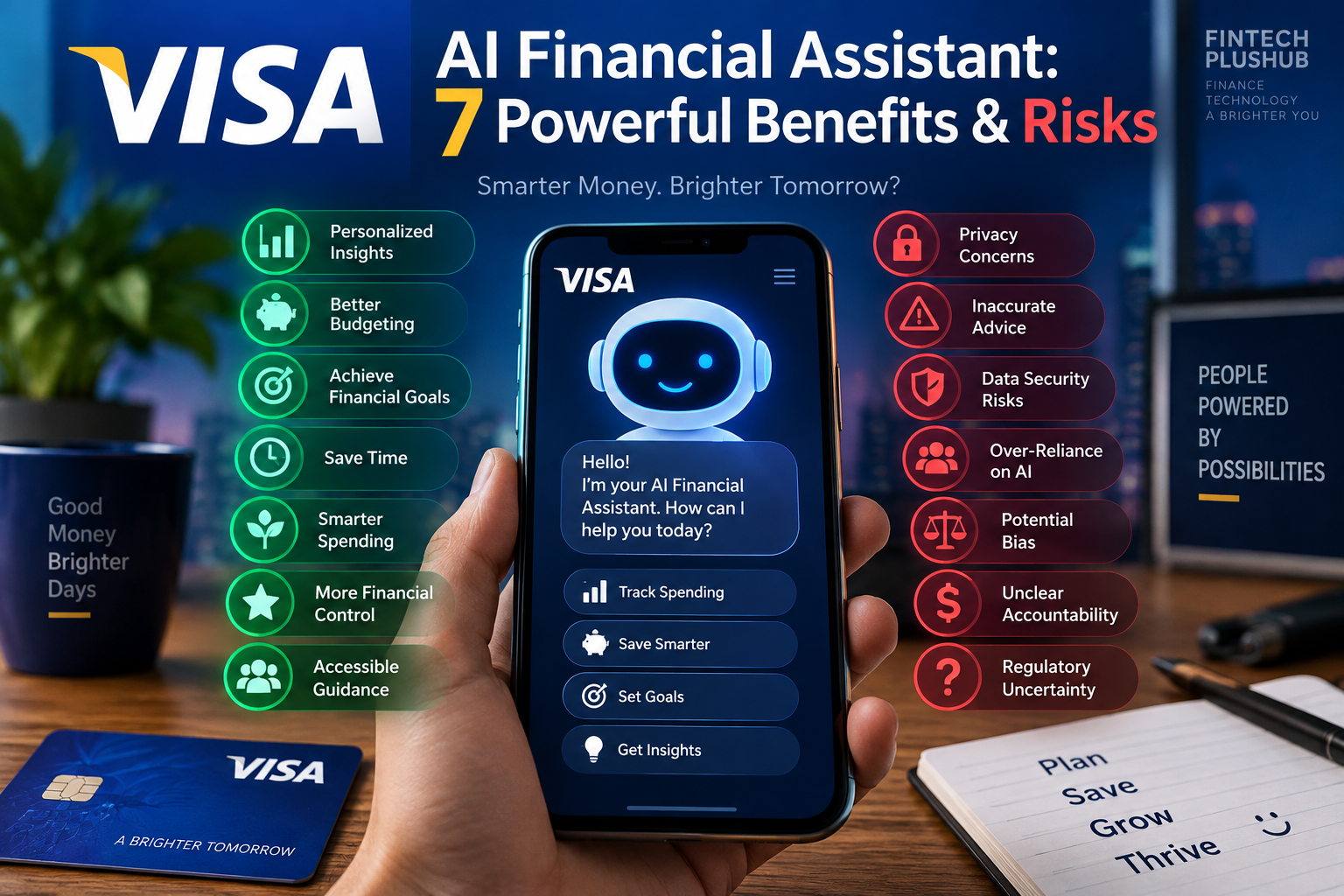
Visa AI Financial Assistant: What You Need to Know
Artificial intelligence is moving deeper into personal finance, and Visa’s latest move could bring it directly into the banking app you already use.
Visa has introduced Visa AI Financial Assistant, a conversational AI service designed for financial institutions. Instead of simply displaying transactions and balances, participating banking apps could use the assistant to explain spending, answer questions about a customer’s financial activity, provide personalized insights, and help with certain account actions.
The important part for consumers is that this is not a separate budgeting chatbot you download. Visa is designing it to work inside participating banks’ existing apps.
Visa says U.S. financial institutions will be able to pilot the service beginning in August 2026, with a global rollout planned afterward.
So, what can Visa AI Financial Assistant actually do, and should consumers trust AI with this much financial context?
What Is Visa AI Financial Assistant?
Visa AI Financial Assistant is an AI-powered financial guidance service that banks can integrate into their mobile banking experiences.
Think of it as a conversational layer between you and your financial data.
As AI becomes more involved in everyday money decisions, AI financial agents are changing how consumers manage their finances.The Best AI Financial Agents 2026 for Smarter Finance
Instead of manually scrolling through transactions to understand where your money went, you could potentially ask questions in normal language.
For example:
- Why was my spending higher this month?
- How has my spending changed recently?
- What subscriptions am I paying for?
- Does my bank offer a savings account that could help with my goal?
The assistant can use a cardholder’s financial activity to provide more personalized responses rather than relying only on general financial information.
Visa says financial institutions can also offer the service under their own branding. That means some customers may eventually interact with the technology without seeing a separate “Visa AI” app.
How Does Visa AI Financial Assistant Work?
The system combines several sources of information to make its responses more relevant.
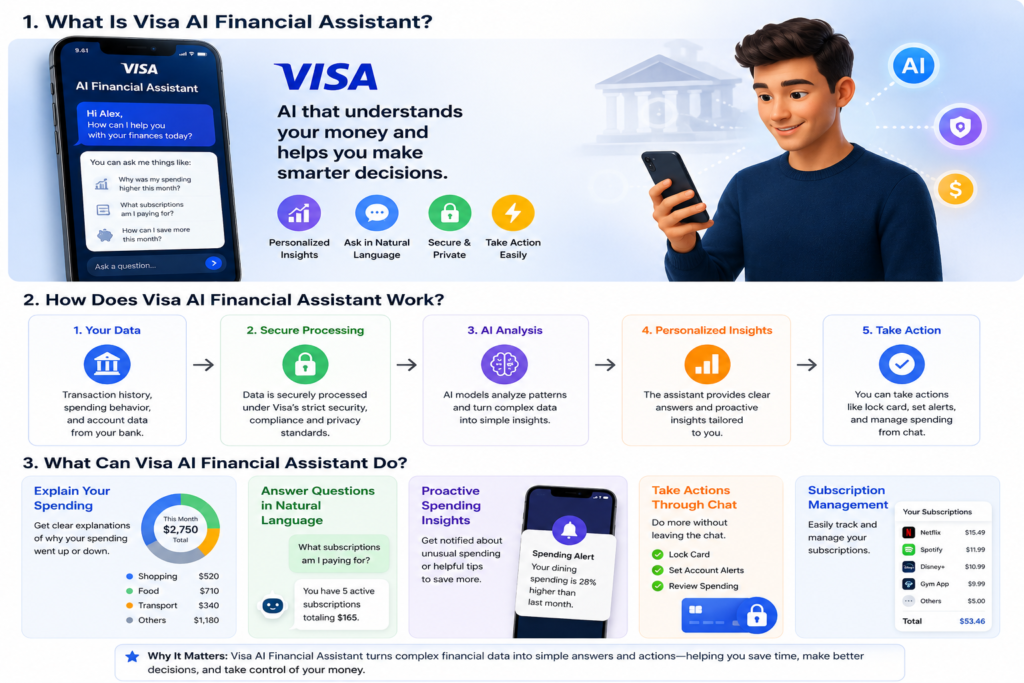
According to Visa, the assistant can draw on cardholder behavior, real-time information and data held by the financial institution.https://usa.visa.com/about-visa/newsroom/press-releases.releaseId.22576.html?utm_source=chatgpt.com
Visa also says the service is informed by insights from its global payment network, which processes more than 300 billion transactions annually.
The assistant is powered by Visa’s Data & AI Platform, which provides financial institutions access to AI models designed for financial services.
Behind the scenes, the assistant is powered by Visa’s Data & AI Platform, or DAP. The platform provides access to multiple AI models that Visa says are evaluated for security, accuracy, compliance and performance.
For the consumer, however, the experience should be much simpler.
You ask a financial question inside your bank’s app, and the AI interprets your financial activity to provide a relevant response.
That difference matters.
A general-purpose AI chatbot may know a lot about budgeting, but it usually does not automatically understand your actual spending history. An AI system integrated into a banking environment potentially has much more financial context.
What Can Visa AI Financial Assistant Do?
The initial version focuses mainly on understanding spending and simplifying everyday banking.
1. Explain Your Spending
One of its most useful features could be automatic spending insights.
Visa says the assistant can proactively surface meaningful monthly spending changes.
Imagine that your monthly spending jumps from $2,300 to $2,750.
Instead of manually comparing dozens of transactions, the assistant could help identify the categories responsible for the increase.
That turns a banking app from a transaction history into something closer to a financial analysis tool.
2. Answer Questions About Your Money
Users will also be able to ask questions using everyday language.
That could remove some of the friction from personal finance.
Rather than navigating through several menus or exporting transaction data, you could simply ask about your recent financial activity.
This is where conversational AI could become genuinely useful: not because it replaces financial expertise, but because it makes your own financial information easier to understand.
3. Help You Take Banking Actions
Visa is going beyond financial explanations.
The initial rollout is expected to support certain actions directly through the conversation, including:
- locking a card
- setting account alerts
- reviewing spending information
Future enhancements are also planned around subscription management.
This is an important distinction.
Many AI finance tools mainly provide recommendations. Visa is moving toward an assistant that can connect insight with action inside a banking environment.
A Simple Example: How It Could Help With a Budget
Suppose someone earns $4,000 per month and normally spends:
| Category | Normal Month | This Month |
|---|---|---|
| Housing | $1,400 | $1,400 |
| Food | $550 | $710 |
| Transport | $300 | $340 |
| Subscriptions | $120 | $165 |
| Shopping | $350 | $520 |
| Other | $500 | $510 |
| Total | $3,220 | $3,645 |
Spending increased by $425.
A traditional banking app gives you the transactions and leaves the investigation mostly to you.
An effective financial AI assistant could theoretically identify that most of the increase came from food, subscriptions and shopping, then make that pattern easier to understand.
That is where this technology has more potential than another generic AI chatbot.
The value is not simply generating financial advice. It is connecting the advice to the consumer’s actual financial activity.
Visa AI Financial Assistant vs Traditional Banking Apps
| Feature | Traditional Banking App | Visa AI Financial Assistant |
|---|---|---|
| View transactions | Yes | Yes |
| Check balances | Yes | Through participating bank |
| Natural-language questions | Usually limited | Yes |
| Personalized spending explanations | Limited | Designed for this |
| Proactive spending insights | Varies | Yes |
| Take actions through conversation | Usually no | Certain actions supported |
| Uses financial activity for AI responses | Usually limited | Yes |
| Subscription-related assistance | Varies | More functionality planned |
The bigger shift is therefore not simply “banks adding chatbots.”
Banking apps have traditionally been places where customers see what happened.
AI could increasingly make them places where customers ask why it happened and what they can do next.
Is Visa AI Financial Assistant Safe?
This is probably the most important question.
Financial AI is fundamentally different from asking a chatbot to recommend a movie or summarize an article. The information involved can include highly sensitive spending and account data.
Visa says AI Financial Assistant operates under its AI and data-governance standards and is designed for secure banking environments with security, compliance and fraud protections.
That is encouraging, but consumers should still distinguish between security and perfect AI accuracy.
An AI system can operate in a secure environment and still misunderstand a question, incorrectly categorize a transaction or produce a recommendation that is not appropriate for a particular person.
Consumers should therefore treat AI-generated financial guidance as assistance rather than unquestionable financial advice.
Before making an important financial decision, verify the underlying transactions, fees, account terms and other relevant information yourself.
What About Financial Privacy?
Personalization creates a trade-off.
The more accurately an AI system understands your financial activity, the more useful its answers can become. But providing that level of personalization also means financial data plays a larger role in generating those answers.
Visa says the assistant combines cardholder behavior, real-time data and financial-institution data.
That makes several questions worth asking whenever your bank eventually offers a financial AI assistant:
- What information can the assistant access?
- Is enrollment optional?
- Can you disable the feature?
- How long is conversational data retained?
- Which actions require additional authentication?
- How are incorrect AI responses handled?
The answers may depend partly on the participating financial institution and how it implements the service.
Privacy policies and consent screens may not be exciting, but with financial AI they deserve more attention than usual.
Can Visa AI Financial Assistant Replace a Financial Advisor?
No—and consumers should not expect it to.
There is a major difference between helping someone understand spending patterns and providing comprehensive financial planning.
AI may be useful for everyday questions such as:
“Why did I spend more this month?”
That is very different from questions involving retirement planning, taxes, estate planning or complicated investment decisions.
A qualified professional can consider factors that a spending assistant may not fully understand, including long-term goals, family circumstances, tax consequences and individual risk tolerance.
The better way to think about Visa’s assistant is as a potential financial navigation tool, not a replacement for professional financial advice.
Who Could Benefit Most?
Visa AI Financial Assistant could be particularly useful for people who have financial data but struggle to turn it into useful information.
That includes consumers who:
- rarely review their transaction history
- want to understand spending patterns quickly
- manage several recurring subscriptions
- find traditional banking menus confusing
- want simple explanations of financial activity
- prefer asking questions instead of searching through an app
For disciplined users already tracking every expense in a dedicated budgeting system, the benefit may initially be smaller.
The real test will be whether the assistant consistently produces insights that consumers could not easily discover themselves.
When Will Visa AI Financial Assistant Be Available?
Visa announced the service in July 2026 and says it will be available to U.S. financial institutions for pilot programs beginning in August 2026.
That does not mean every Visa cardholder in the United States automatically receives the feature in August.
Banks and other participating financial institutions need to implement the service.
Visa says a broader global rollout is planned afterward, but it has not announced a specific worldwide consumer availability date.
Consumers should therefore watch announcements from their own banks rather than expecting a separate Visa AI Financial Assistant download.
Why This Matters Beyond Visa
The most interesting part of this announcement may be what it says about the future of banking.
For years, digital banking primarily moved existing financial services onto smartphones.
AI introduces a different possibility.
Instead of asking:
“Where is my transaction history?”
customers could ask:
“Why am I spending more?”
And instead of navigating to another section afterward, the same conversation could potentially help them take action.
That creates a progression:
Financial data → AI interpretation → personalized insight → financial action
If banks can make that process accurate, transparent and secure, AI assistants could become a normal interface for everyday banking.
But if recommendations are unreliable or consumers do not understand how their data is being used, the same convenience could create new problems.
The Bottom Line
Visa AI Financial Assistant could make everyday banking more conversational and personalized by helping consumers understand their actual financial activity and take certain actions from within participating banking apps.
Its biggest advantage is context. Unlike a generic chatbot offering generic budgeting advice, a banking AI assistant can potentially understand the financial activity behind the question.
But that advantage is also why privacy, accuracy and user control matter so much.
The technology is still entering its early U.S. pilot stage in August 2026. The important questions now are not only how intelligent the assistant becomes, but which banks adopt it, what data consumers allow it to use, and whether its recommendations are useful enough to improve real financial decisions.
For now, Visa AI Financial Assistant looks less like a replacement for financial advisors and more like an early glimpse of a future where your banking app does not simply show your money—it helps you understand it.