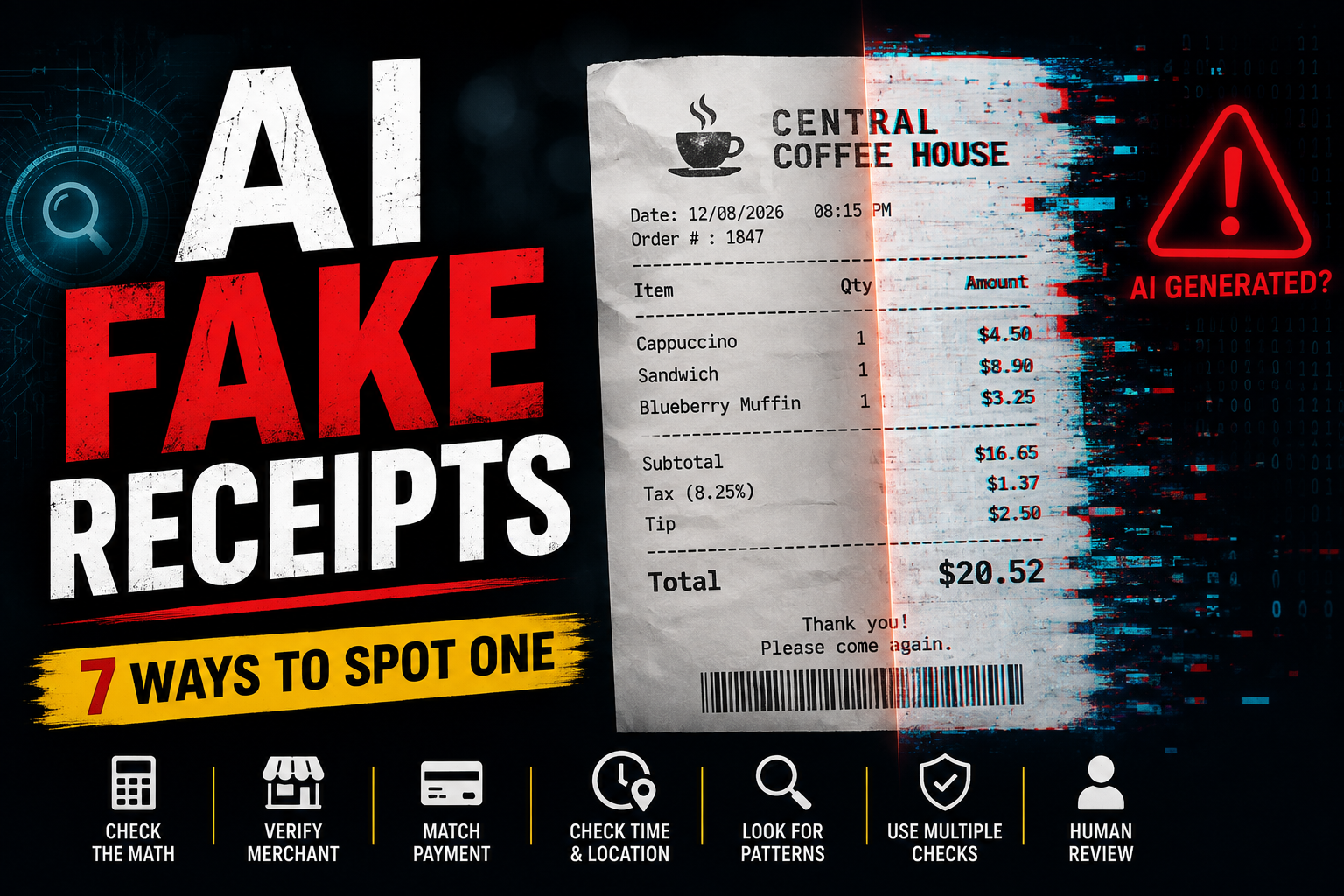
AI Fake Receipts Are Getting Real: 7 Powerful Ways to Spot One
Imagine this.
An employee sends you a photo of a restaurant receipt. The logo looks right. The paper is slightly wrinkled. There is a realistic shadow from the phone camera. The date, tax, tip, and total are all there.
You approve the expense.
There is only one problem.
The purchase may never have happened.
That is what makes AI fake receipts different from the badly edited receipts many businesses dealt with in the past. Generative AI can now create convincing financial documents without requiring advanced editing skills.
And this is no longer just a theoretical problem.
A 2026 Emburse survey https://www.emburse.com/blog/ai-generated-receipts-expense-fraud?utm_source=chatgpt.com of 2,000 employed adults in the U.S. and UK found that 34% said they had used AI to generate a fake receipt for a business expense.
AppZen reported another striking change. Among fraudulent receipts flagged in its customer data, AI-generated receipts reportedly increased from almost 0% in March 2025 to 70.8% by mid-May 2026.
That does not mean 70.8% of all business receipts are fake. It means AI-generated documents represented a large share of the fraudulent receipts identified in that dataset.
So if AI fake receipts can look increasingly realistic, how are you supposed to catch them?
The answer is surprisingly practical.
Stop asking only whether the receipt looks real. Start verifying whether the transaction is real.
Here are seven powerful checks you can use.
What Are AI Fake Receipts?
AI fake receipts are fabricated or manipulated receipts created with generative AI tools.
Instead of manually editing an existing receipt, someone may be able to generate a document containing details such as:
- Merchant names and logos
- Products and prices
- Dates and timestamps
- Taxes and tips
- Payment information
- Paper textures
- Folds and wrinkles
- Shadows and camera-like imperfections
That last part matters.
In the past, people often searched for obvious visual mistakes when checking suspicious images.
Strange fonts. Broken logos. Weird spacing. Impossible shadows.
Those clues can still matter, but they are becoming less reliable as AI-generated images improve.
A receipt can look imperfect and still be fake.
That is why detecting AI fake receipts requires more than staring at pixels.
Why AI Fake Receipts Are Becoming a Serious Problem
Receipt fraud existed long before generative AI.
Someone could edit a total, submit the same receipt twice, or create a fake invoice.
What AI changes is the barrier to entry.
Creating something convincing may require much less technical skill than traditional image manipulation.
For a business processing hundreds or thousands of expenses, that creates another problem: individually small fraudulent claims can hide inside a huge volume of legitimate expenses.
For example, imagine an employee submits a $47 meal receipt.
Nothing about $47 immediately screams fraud.
Now imagine similar claims appear repeatedly over several months.
The individual receipt may not be the biggest clue.
The pattern may be.
That brings us to the first check.
1. Spot AI Fake Receipts by Checking the Math
Start with the boring stuff.
Seriously.
Before trying an AI detector or zooming into pixels, take out a calculator.
Check whether:
Quantity × unit price = line total
Then verify:
Line totals − discounts = subtotal
Then check whether:
Subtotal + tax + tip = final total
Imagine a receipt shows:
Coffee — $4.50
Sandwich — $11.50
Dessert — $6.00
Subtotal: $22.00
So far, everything works.
But then:
Tax: $5.72
Now you have another question.
Would that tax amount make sense for that type of purchase in that location?
The arithmetic may work while the underlying details still don’t.
So don’t stop at addition.
Check whether the numbers make sense in context.
This simple habit can expose suspicious AI fake receipts before you need more complicated tools.
2. Verify the Merchant Behind AI Fake Receipts
A professional-looking logo proves very little.
If a receipt looks suspicious, search for the merchant independently.
Check:
- Exact business name
- Street address
- Phone number
- Official website
- Business category
- Opening hours
- Location
Suppose the receipt says:
Central Coffee House
1428 Market Street
It sounds believable.
But does that business actually exist at that address?
If it does, go one step further.
Does the receipt contain products that business actually sells?
Does the phone number belong to the merchant?
Would the business have been open at the time printed on the receipt?
These checks don’t require sophisticated AI detection.
They require basic verification.
And that’s an important theme throughout this article:
Don’t verify the picture. Verify the story behind the picture.
3. Match AI Fake Receipts With Real Payment Records
This is one of the strongest checks available.
A receipt is a document.
A purchase is a transaction.
Those are not the same thing.
If someone paid using a company card, compare the submitted receipt against the actual card transaction.
For example:
Submitted receipt
Merchant: ABC Restaurant
Date: August 12
Total: $86.40
Corporate card record
Merchant: ABC Restaurant
Date: August 12
Total: $86.40
Those records supporting each other gives you much stronger evidence than the receipt image alone.
Now imagine the receipt says $86.40 but the card transaction says $46.40.
That deserves investigation.
The same principle can apply to:
- Bank transactions
- Corporate cards
- Digital wallets
- Merchant confirmations
- Booking records
- Order confirmations
Of course, not every legitimate expense will have every type of supporting evidence.
Cash purchases are an obvious example.
But for higher-risk or suspicious claims, independent transaction evidence can be extremely valuable.
If you’re trying to identify AI fake receipts, this is the mindset I would remember:
A realistic receipt proves that a realistic receipt exists. It does not automatically prove that a purchase happened.
4. Find Hidden Inconsistencies in AI Fake Receipts
Now we move beyond the image itself.
Ask whether all the information fits together.
Check the:
Date.
Time.
Currency.
Location.
Tax.
Products.
Payment method.
Imagine someone submits a restaurant receipt from London at 8:15 p.m.
The restaurant is real.
The address is correct.
The prices look reasonable.
But the employee’s approved business travel shows they were in New York that evening.
That’s a much stronger warning sign than a slightly unusual font.
The same logic works with smaller inconsistencies.
A receipt might show a store transaction at 3 a.m. even though that location closes at 10 p.m.
Or it might use a currency that doesn’t match the country.
Or the tax format might not fit the claimed location.
One inconsistency does not automatically prove fraud.
But multiple inconsistencies should trigger a closer review.
5. Don’t Let Realistic AI Fake Receipts Fool You
This is where things get tricky.
People naturally trust visual imperfections.
A slightly crooked photo feels authentic.
A folded receipt feels authentic.
A coffee stain feels authentic.
Uneven lighting feels authentic.
But generative AI can increasingly reproduce visual characteristics associated with real-world photographs and documents.
So don’t use this logic:
“It looks messy, therefore it must be real.”
At the same time, don’t assume every strange-looking receipt is fake.
Real receipts can be damaged, faded, photographed badly, or printed by old machines.
Visual inspection should therefore be treated as a warning system, not a final verdict.
Ask instead:
Can the transaction be independently verified?
That question is much harder for a fake document to answer.
6. Detect AI Fake Receipts by Looking for Patterns
Fraud becomes easier to notice when you stop looking at receipts one at a time.
Imagine an employee repeatedly submits:
$46.80
$48.25
$47.60
$49.10
$48.75
Suppose the company’s automatic approval threshold is $50.
Is that proof of fraud?
No.
But would I investigate the pattern?
Absolutely.
Other patterns worth checking include:
- Repeated merchants
- Duplicate totals
- Similar receipt layouts
- Frequent claims just below approval limits
- Unusual increases in spending
- Multiple claims submitted near deadlines
- Repeated weekend expenses
- Expenses inconsistent with someone’s role or travel
This is one reason automated expense systems can be useful.
Humans are good at understanding context.
Software can be good at comparing large numbers of transactions.
Using both can make suspicious AI fake receipts harder to hide.
7. Use Multiple Checks to Catch AI Fake Receipts
There is a tempting solution to this entire problem:
Upload the receipt to an AI detector.
Wait for a score.
Done.
Unfortunately, real fraud detection isn’t that simple.
An automated tool may identify suspicious metadata, visual anomalies, duplicate documents, unusual transaction patterns, or other risk signals.
But a detector should be treated as evidence, not a judge.
Instead, build layers of verification.
Layer 1: Inspect the receipt.
Layer 2: Recalculate the numbers.
Layer 3: Verify the merchant.
Layer 4: Match the payment.
Layer 5: Check time and location.
Layer 6: Compare previous expenses.
Layer 7: Send suspicious cases for human review.
An AI fake receipt may pass one check.
Passing several independent checks is much harder.
How Small Businesses Can Prevent AI Fake Receipt Fraud
You don’t necessarily need an expensive enterprise fraud platform to improve your defenses.
Start with your process.
First, write a clear expense policy.
Employees should understand what qualifies as a business expense and what evidence they need to provide.
Second, connect corporate-card transactions to expense reports whenever possible.
That makes it easier to compare submitted documents with real payment data.
Third, don’t audit only huge expenses.
Small fraudulent expenses can be attractive precisely because they attract less attention.
Fourth, randomly review some normal-looking claims.
Predictable controls are easier to work around.
Finally, create an escalation process.
A suspicious receipt should not automatically mean accusing someone of fraud.
Instead, request additional evidence.
For example:
- Payment confirmation
- Booking record
- Merchant confirmation
- Original digital receipt
- Business purpose
A good fraud-prevention system should find inconsistencies without treating every employee like a criminal.
Can AI Detect AI Fake Receipts?
Yes, AI can help detect suspicious receipts.
But don’t confuse detection probability with proof.
AI-based fraud systems may analyze receipt information, spending patterns, transaction records, duplicate submissions, or inconsistencies.
That can dramatically reduce the amount of manual review businesses need to perform.
However, no detection system should become the only source of truth.
False positives are possible.
False negatives are possible.
And AI-generated content will continue improving.
That’s why the strongest approach combines:
Automation + independent records + human judgment.
AI Fake Receipts vs Real Receipts: Quick Checklist
| Check | More Reassuring | Potential Warning |
|---|---|---|
| Math | Totals reconcile | Incorrect calculations |
| Merchant | Business independently verified | Details don’t match |
| Payment | Matching transaction exists | No supporting transaction |
| Location | Fits travel/activity | Impossible location |
| Time | Business was open | Impossible timestamp |
| Tax | Fits transaction/location | Unusual tax calculation |
| History | Normal expense pattern | Repeated suspicious patterns |
| Evidence | Multiple records agree | Receipt is the only proof |
Remember:
A red flag is a reason to verify, not automatic proof of fraud.
The Bigger Problem Behind AI Fake Receipts
There is something bigger happening here than expense fraud.
For years, we became comfortable treating screenshots, photos, receipts, emails, and other digital documents as evidence.
Generative AI is forcing us to rethink that assumption.
Seeing something is becoming less useful as proof that something actually happened.
This affects far more than AI fake receipts.
It affects invoices.
Screenshots.
Product photos.
Identity documents.
Voice recordings.
And potentially many other forms of digital evidence.
This problem is also part of a wider rise in AI-powered financial scams, where generative AI can make fraud harder to recognize.
The solution cannot simply be:
“Become better at spotting AI.”
Humans will not win an endless visual guessing game against increasingly capable generation systems.
Instead, verification needs to move toward independent records and multiple sources of evidence.
That is the real lesson behind the fake receipt problem.
Final Thoughts: AI Fake Receipts Require Smarter Verification
AI fake receipts are becoming more convincing, but businesses are not defenseless.
You don’t need superhuman eyesight.
You need a better verification process.
Check the math.
Verify the merchant.
Match the payment.
Check the time and location.
Look for patterns.
Use technology where it helps.
And when something doesn’t add up, ask for independent evidence.
Most importantly, remember this:
The goal isn’t to prove whether an image was made by AI.
The goal is to prove whether the transaction actually happened.
That difference could become increasingly important as AI-generated financial documents become harder to distinguish from the real thing.
Frequently Asked Questions About AI Fake Receipts
What are AI fake receipts?
AI fake receipts are fabricated or manipulated receipts created using generative AI. They may imitate merchant information, prices, taxes, timestamps and the visual appearance of genuine paper receipts.
How can I spot AI fake receipts?
To spot AI fake receipts, check the calculations, independently verify the merchant, compare the receipt with payment records, examine time and location details, and look for unusual patterns across multiple expenses.
Can AI fake receipts look completely real?
AI-generated receipts can appear highly convincing. Visual appearance alone should therefore not be treated as proof that the underlying transaction occurred.
Can an AI detector identify AI fake receipts?
AI detection and fraud-monitoring tools can provide useful risk signals, but they should be combined with payment records, merchant verification and human review rather than treated as definitive proof.
What is the best way to prevent AI fake receipt fraud?
Build multiple verification layers. Match receipts with actual transactions whenever possible, maintain clear expense policies, audit suspicious patterns and request additional evidence when a claim cannot be independently verified.