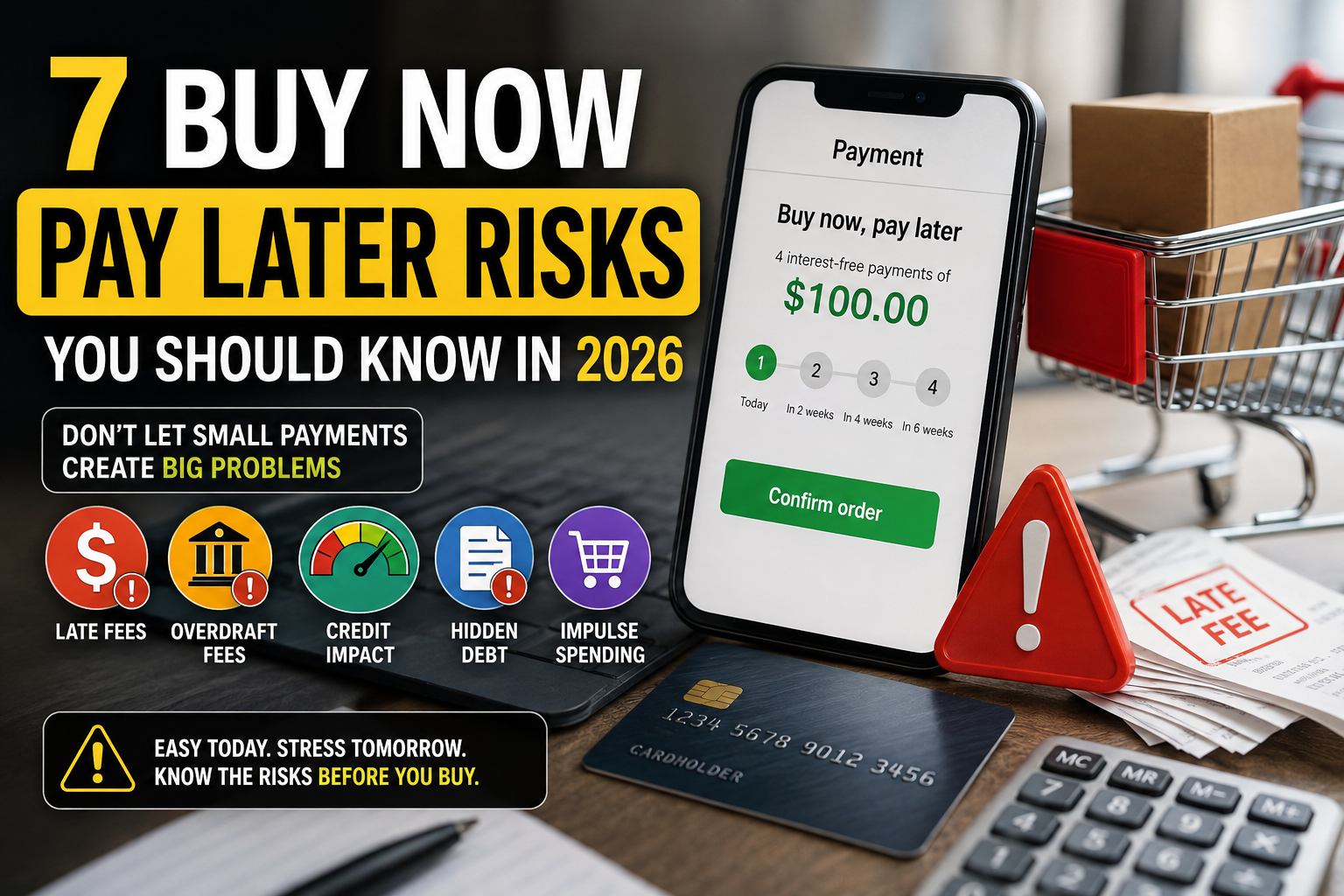
7 Buy Now Pay Later Risks You Should Know in 2026
Buy now, pay later can make a $400 purchase feel surprisingly affordable.
Instead of paying $400 today, you might see four payments of just $100. No huge bill. No traditional credit card application. Sometimes, no interest.
That sounds convenient.
But the smaller payment on the checkout screen does not make the purchase cheaper.
Buy Now Pay Later risks become especially important when you have several plans running at the same time, use BNPL for everyday expenses, or rely on automatic payments from an account with little money left in it.
New Federal Reserve data makes that risk harder to ignore. In its 2026 analysis of BNPL use, the Fed found that 26% of BNPL users had paid late at least once during the previous year. It also found that 11% had a BNPL payment trigger an overdraft or non-sufficient funds fee.https://www.federalreserve.gov/publications/2026-august-consumer-community-context.htm?utm_source=chatgpt.com
That does not mean BNPL is automatically bad.
Used carefully, a pay-in-four plan can help spread a planned purchase across several paychecks without interest. The problem begins when “four easy payments” makes you focus on the installment instead of the total cost and your ability to repay it.
Here are seven Buy Now Pay Later risks worth understanding before you tap that button in 2026.
What Is Buy Now, Pay Later?
Buy Now, Pay Later, commonly called BNPL, is a form of short-term financing offered at online and physical checkouts.
A common version is “pay in four.”
Imagine buying a $400 laptop accessory bundle.
Instead of paying $400 immediately, a typical pay-in-four arrangement might look like this:
| Payment | Amount |
|---|---|
| At checkout | $100 |
| Payment 2 | $100 |
| Payment 3 | $100 |
| Payment 4 | $100 |
| Total | $400 |
The payments are often spread across roughly six weeks.
If there is no interest and you make every payment on time, the financing itself may cost you nothing.
That simplicity is exactly what makes BNPL attractive.
It is also why the risks are easy to underestimate.
According to the Consumer Financial Protection Bureau, the number of BNPL loans among the lenders it studied increased from 19.8 million in 2019 to 335.8 million in 2023, while dollar volume increased from $2.7 billion to $45.2 billion.
BNPL is no longer a tiny checkout feature. It has become a meaningful part of consumer borrowing.
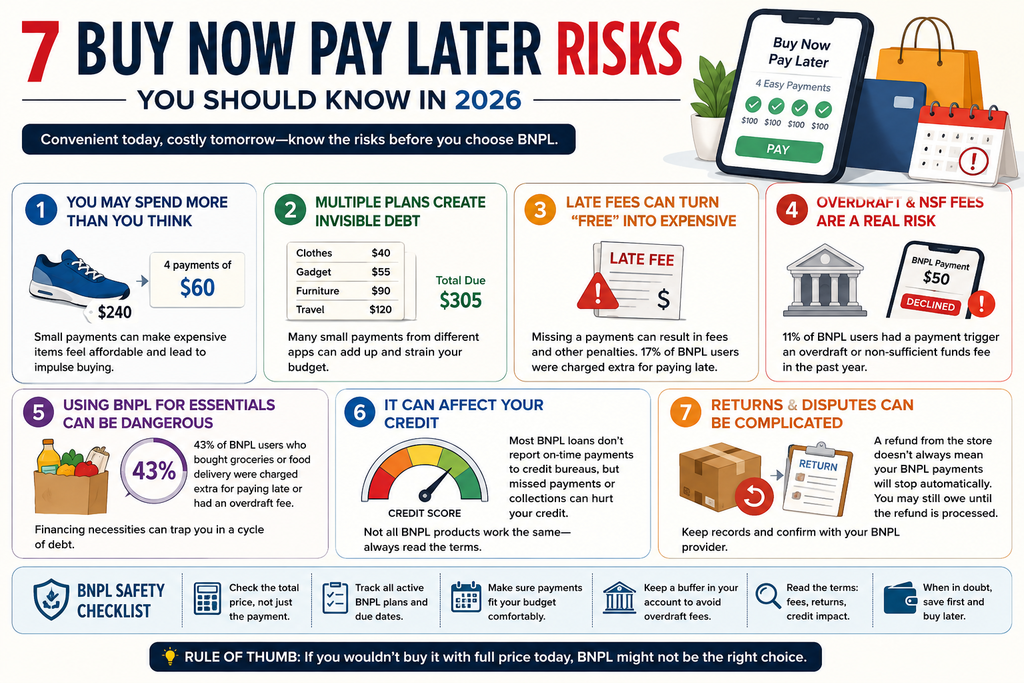
1. Buy Now Pay Later Risks Start With Spending More Than You Think
One of the biggest Buy Now Pay Later risks has nothing to do with an obvious fee.
It is psychological.
Suppose you want $240 headphones.
Seeing this:
Price: $240
may make you stop and think.
But seeing this:
4 payments of $60
can make the same product feel easier to afford.
The product did not become cheaper. Only the way the price was presented changed.
That distinction matters.
BNPL can shift your attention from:
“Can I afford a $240 purchase?”
to:
“Can I afford $60 today?”
Those are not the same question.
You also need to afford the remaining $180.
A better rule
Before using BNPL, temporarily ignore the installment amount.
Ask yourself:
Would I still buy this if the checkout page required me to pay the full price today?
If the answer is no because the total price feels too expensive, BNPL may be helping you justify a purchase rather than helping you finance one.
That is an important warning sign.
2. Multiple BNPL Plans Can Create Invisible Debt
One $25 payment does not look dangerous.
Neither does one $40 payment.
Neither does another $65 payment.
The problem appears when all three are due around the same time.
Imagine this:
| Purchase | Upcoming BNPL Payment |
|---|---|
| Clothes | $40 |
| Phone accessory | $55 |
| Furniture | $90 |
| Travel booking | $120 |
| Total upcoming payments | $305 |
Individually, every purchase may have looked manageable.
Together, you suddenly need $305.
This is one of the most practical Buy Now Pay Later risks because BNPL borrowing can be fragmented across different apps and purchases.
You may remember your rent, phone bill and credit card balance.
Remembering six small installment schedules is harder.
If managing several payments is becoming difficult, using a structured budget can help you see where your money is going. Our guide to The Best AI Budgeting Apps 2026 That Actually Work explains how budgeting tools can help track spending, bills, and financial goals in one place.
The CFPB has specifically studied consumers using multiple BNPL loans and BNPL alongside other forms of unsecured debt.
How to prevent BNPL stacking
Before opening another plan, write down:
- every active BNPL purchase,
- remaining balance,
- next payment,
- due date,
- and total payments due before your next paycheck.
Then calculate one number:
Total BNPL payments due before next payday.
That number matters much more than the small installment displayed on your newest purchase.
3. Buy Now Pay Later Risks Include Late Fees
“Interest-free” does not necessarily mean “consequence-free.”
Depending on the provider and product, missing a payment can result in fees or other consequences.
The Federal Reserve reported that 17% of BNPL users were charged extra for paying late during the previous year.
That changes the economics of what initially looked like free financing.
Imagine a $100 purchase divided into four $25 payments.
If everything goes according to plan, you pay $100.
But if missed payments cause fees, the financing is no longer truly cost-free for you.
There may also be consequences beyond the immediate fee, such as restrictions on future purchases or collection activity depending on the lender and situation.
Never assume every BNPL provider works the same way
Before accepting a plan, check:
- late-payment policy,
- payment rescheduling rules,
- autopay terms,
- potential fees,
- refund policy,
- dispute process,
- and what happens after a missed payment.
The boring terms on the screen matter more than the giant “0%” marketing message.
4. A BNPL Payment Can Trigger an Overdraft Fee
This is one of the Buy Now Pay Later risks consumers can easily miss.
Many BNPL payments are automated.
Automatic payments are convenient when there is enough money in your account.
They become a problem when there is not.
The Federal Reserve found that 11% of BNPL users had a BNPL payment trigger an overdraft or NSF fee in the prior year.
The risk was much higher among financially stretched users.
Among BNPL users who could cover less than $100 of an emergency using savings, 18% experienced an overdraft triggered by BNPL. Among those who could cover $2,000 or more, the figure was only 4%.
Consider a simple example.
Your bank account has $45.
Tomorrow:
- BNPL autopay: $50
- streaming subscription: $15
- phone bill: $45
Your BNPL purchase might have been interest-free.
But your cash-flow problem is not.
That is why you should never judge BNPL affordability based only on the day you make the purchase.
Use a BNPL buffer
If your next installment is $75, having exactly $75 available is risky.
Other automatic charges may hit first.
Keep enough of a buffer to cover scheduled payments and essential expenses rather than treating your current account balance as fully spendable money.
5. Using BNPL for Groceries Can Be a Financial Warning Sign
Buying a planned appliance through BNPL is one thing.
Needing BNPL to buy this week’s groceries is different.
The Federal Reserve’s 2026 data shows why.
Among BNPL users who purchased groceries or food delivery, 43% were charged extra for paying late or incurred an overdraft/NSF fee in the prior year.
That was higher than the corresponding figure for clothing, electronics, furniture, travel and several other categories examined in the report.
This does not mean someone should be judged for financing essentials.
People can face job losses, emergencies, unexpected bills and temporary cash shortages.
But from a personal-finance perspective, repeatedly borrowing for consumable necessities creates a dangerous cycle.
You can still be paying for last week’s groceries when you need to buy this week’s groceries.
Then another installment is created.
And another.
Treat this as a cash-flow alarm
If you regularly need BNPL for groceries, food delivery or other everyday necessities, the first problem to solve may not be finding a better BNPL provider.
It may be the gap between your essential expenses and available income.
Start with:
- total monthly take-home income,
- essential fixed expenses,
- minimum debt payments,
- essential variable expenses,
- current BNPL obligations.
If essentials consistently exceed the money available, adding another payment plan postpones the problem rather than fixing it.
6. Buy Now Pay Later Risks Can Affect Your Credit Differently
Another common misunderstanding is:
“BNPL doesn’t affect credit.”
That statement is too broad.
BNPL products do not all work exactly the same way.
The CFPB says most traditional pay-in-four BNPL products generally have not reported normal payment history to the major credit reporting companies. However, unpaid debt that reaches collections may be reported and could damage a consumer’s credit.
Other installment products can work differently, including performing hard credit inquiries or reporting payment history.
Therefore, never assume that your BNPL activity is invisible simply because one provider did not perform a traditional hard credit check.
Before accepting a plan, ask:
Does this specific product perform a hard credit inquiry?
Does it report on-time payments?
Does it report missed payments?
What happens if the debt is sent to collections?
The exact terms of the product matter.
7. Returns and Disputes Can Become More Complicated
Imagine buying a $300 product using BNPL.
You receive it.
It is defective.
You return it to the retailer.
You might naturally assume:
“I returned it, so my payments automatically stop.”
Do not make that assumption.
A purchase can involve two separate relationships: the retailer that sold the item and the company financing the payment plan.
Depending on the provider and situation, a refund may need to move through the merchant and BNPL system before your balance is adjusted.
Meanwhile, a scheduled payment may still be approaching.
The FTC advises consumers to check a payment plan’s refund policy and understand what happens when they return or dispute a purchase.
If you return a BNPL purchase
Do not simply delete the app and assume everything is finished.
Instead:
- keep the return receipt,
- save emails and screenshots,
- check the BNPL app,
- confirm whether upcoming payments changed,
- contact the provider if the balance is incorrect,
- keep records until the refund is fully processed.
Documentation can save you a lot of frustration later.
The Real Cost of “Four Easy Payments”
Here is a useful way to think about Buy Now Pay Later risks.
BNPL does not necessarily make an expensive product expensive.
The product already had that price.
Instead, BNPL can make the price feel smaller today while moving part of the financial pressure into the future.
Consider two people buying the same $400 item.
Person A
Has $2,000 available after essential expenses and deliberately chooses four $100 interest-free payments.
Person B
Has $120 available until payday and chooses the same four $100 payments because $400 is unaffordable today.
They use the same product.
But their financial risk is completely different.
For Person A, BNPL may simply be a cash-management choice.
For Person B, one unexpected $150 expense could interfere with upcoming payments.
This is why asking “Is BNPL good or bad?” is not particularly useful.
A better question is:
“Does this purchase still fit my budget after accounting for every future payment?”
Buy Now Pay Later vs Credit Card vs Saving First
There is no payment method that is best in every situation.
| Option | Potential Advantage | Main Risk |
|---|---|---|
| BNPL | Can spread a purchase into smaller payments | Stacking plans, late fees and overdrafts |
| Credit card | Flexible repayment and potentially stronger purchase protections | Interest can become expensive if balance is carried |
| Debit/cash | No new debt | Money leaves immediately |
| Save first | No repayment obligation | You must wait to purchase |
For a non-essential purchase, saving first is often the simplest low-risk option.
Suppose you want a $600 television.
A six-week BNPL schedule may put pressure on your next few paychecks.
Saving $100 per month for six months takes longer, but when you buy the television, the financial obligation ends immediately.
Waiting is not exciting.
But boring financial decisions are often very effective.
When Can BNPL Make Sense?
After discussing Buy Now Pay Later risks, it is important not to pretend the product has no legitimate use.
BNPL may be reasonable when:
- the purchase was already planned,
- you could afford the full price,
- the plan genuinely charges no interest,
- you understand all fees,
- you have stable income,
- future installments fit comfortably within your budget,
- and you are not already juggling multiple payment plans.
For example, imagine you have $1,500 available for a $600 planned purchase.
You choose four $150 interest-free payments because you prefer keeping more cash available temporarily.
That is very different from having $160 available and using BNPL because it is the only way to complete a $600 purchase.
The first situation spreads cash flow.
The second potentially creates a cash-flow problem.
When Should You Avoid BNPL?
Consider avoiding another BNPL purchase when:
- you need it to afford basic necessities repeatedly,
- you do not know how many active plans you have,
- your account is frequently close to zero,
- you have missed previous installments,
- you are using one debt product to cover another,
- you are buying impulsively because the installment looks cheap,
- or you could not comfortably handle the payments after a small financial emergency.
One particularly useful test is this:
The unexpected-expense test
Before clicking Buy Now Pay Later, imagine an unexpected $300 expense arriving tomorrow.
Could you still make every BNPL payment, pay your essential bills and buy food?
If a small emergency would immediately break the repayment plan, the purchase may be too aggressive for your current budget.
A 60-Second BNPL Safety Checklist
Before accepting your next BNPL offer, answer these questions:
1. What is the full purchase price?
Ignore the installment amount for a moment.
2. How much BNPL debt do I already have?
Check every provider.
3. How much is due before my next paycheck?
Add the payments together.
4. Are there late or rescheduling fees?
Read the actual terms.
5. Is autopay connected to an account with enough money?
Leave a buffer.
6. Could missed payments or collections affect my credit?
Check the specific product.
7. Am I financing something I need or something I suddenly want?
Be especially careful with impulse purchases.
8. Could I wait and save instead?
Sometimes the best financing option is no financing at all.
If you cannot confidently answer these questions, do not rush through checkout.
Frequently Asked Questions
Is Buy Now Pay Later bad?
No. BNPL is a financial tool, and the outcome depends heavily on how it is used. A planned interest-free purchase that comfortably fits your budget is very different from repeatedly financing things you cannot currently afford.
What are the biggest Buy Now Pay Later risks?
Major Buy Now Pay Later risks include overspending, juggling multiple loans, late-payment costs, overdraft or NSF fees, potential collection problems, credit implications and complications involving returns or disputes.
Does Buy Now Pay Later affect your credit score?
It depends on the product and provider. Many pay-in-four products traditionally have not reported normal payment history to major credit bureaus, but unpaid accounts sent to collections may affect credit. Other installment products may have different reporting and credit-check practices.
Can BNPL cause overdraft fees?
Yes. If an automatic BNPL payment reaches a linked bank account without sufficient funds, an overdraft or NSF fee may occur depending on the account and circumstances. Federal Reserve data shows this happened to 11% of BNPL users surveyed about the prior year.
Is BNPL better than a credit card?
Not automatically. An interest-free BNPL plan may be cheaper than carrying an interest-bearing credit card balance, but credit cards can offer different protections and repayment flexibility. Compare the actual terms rather than assuming one product is always better.
How many BNPL plans are too many?
There is no magic number. The important question is whether all scheduled payments comfortably fit your budget. If you cannot immediately state your total outstanding BNPL balance and upcoming payments, that is a sign to stop adding new plans.
Final Thoughts: Convenience Is Not the Same as Affordability
The biggest lesson from these Buy Now Pay Later risks is simple:
A smaller payment is not a smaller price.
BNPL can be useful when it helps manage the timing of a purchase you already planned and can comfortably afford.
It becomes dangerous when it makes unaffordable purchases feel affordable.
The latest Federal Reserve findings underline that difference. More than one-quarter of BNPL users reported paying late at least once during the previous year, while more than one in ten experienced an overdraft or NSF fee triggered by a BNPL payment.
So before clicking “Pay in 4,” forget the first installment for a moment.
Look at the full price.
Look at every other payment you owe.
Look at your next paycheck.
Then ask one question:
Am I spreading out a purchase I can afford—or borrowing because I cannot afford it yet?
That answer tells you far more than the checkout button ever will.