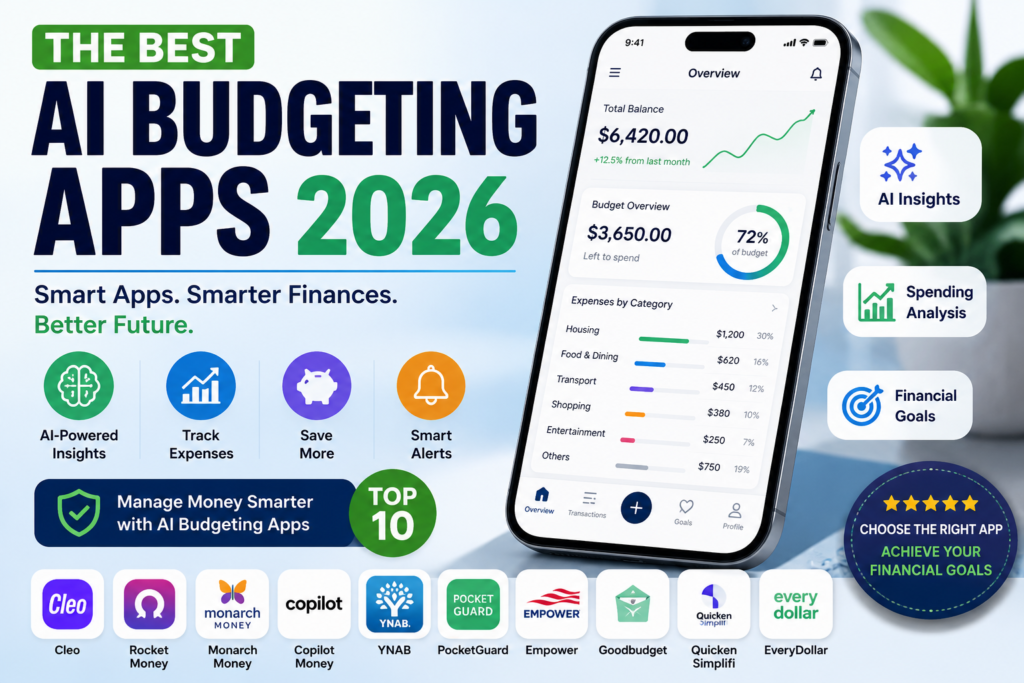
Managing money has become more challenging than ever. Between rising living costs, online shopping, streaming subscriptions, food delivery apps, and unexpected bills, it’s easy to lose track of where your money goes. If you’ve ever checked your bank balance at the end of the month and wondered, “How did I spend this much?” you’re not alone.
The good news is that managing your finances no longer has to be stressful. Thanks to artificial intelligence, budgeting is becoming smarter, faster, and far more personalized than it was just a few years ago. Instead of writing down every expense manually or updating spreadsheets every weekend, you can now let AI do most of the work for you.
This is exactly why AI Budgeting Apps 2026 are becoming increasingly popular among students, professionals, families, freelancers, and even small business owners. These apps don’t just record your spending. They analyze your financial habits, identify unnecessary expenses, predict future bills, and recommend practical ways to save money.
For example, imagine buying coffee every morning before work. Spending a few dollars each day may not seem important. However, an AI budgeting app might show that you’ve spent more than $150 on coffee in a single month. Seeing your spending in one place makes it much easier to understand where small expenses quietly add up.
Moreover, many AI budgeting apps automatically detect subscriptions, remind you about upcoming payments, and help you create realistic savings goals. As a result, you spend less time organizing your finances and more time making informed financial decisions.
In this guide, you’ll discover the best AI Budgeting Apps 2026, compare their features, learn their advantages and disadvantages, and find the right app for your financial goals.
Why More People Are Using AI Budgeting Apps in 2026
Artificial intelligence is no longer limited to chatbots or image generation. Today, it plays an important role in personal finance.
People now use multiple payment methods every day, including debit cards, credit cards, digital wallets, online banking, and buy-now-pay-later services. Tracking all these transactions manually can quickly become overwhelming.
Fortunately, AI budgeting apps simplify the entire process.
Instead of asking users to categorize every transaction themselves, these apps automatically organize spending into categories such as groceries, transportation, dining, entertainment, shopping, healthcare, and utilities.
In addition, AI learns from your spending habits over time. The longer you use the app, the smarter its recommendations become.
Suppose you usually spend around $300 each month on groceries. If your grocery spending suddenly jumps to $500, the app may alert you and encourage you to review your recent purchases.
Similarly, if you accidentally pay for two streaming services that you rarely use, AI can detect those recurring subscriptions and suggest canceling them.
These personalized insights are one of the biggest reasons why AI Budgeting Apps 2026 continue to grow in popularity.
What Are AI Budgeting Apps?
Before comparing different apps, it’s important to understand what makes an AI budgeting app different from a traditional budgeting tool.
Simply put, an AI budgeting app uses artificial intelligence and machine learning to analyze your financial activity automatically.
Traditional budgeting apps often require users to enter expenses manually or organize transactions themselves. While those apps still work well, they demand more time and effort.
On the other hand, AI budgeting apps reduce most of that work through automation.
After connecting your bank account or credit card securely, the app starts learning from your financial behavior.
It can automatically:
- Categorize expenses
- Track monthly income
- Monitor recurring subscriptions
- Predict upcoming bills
- Identify unusual transactions
- Recommend realistic budgets
- Suggest ways to save money
- Monitor spending trends
- Forecast future cash flow
Most importantly, these apps don’t simply collect data. They transform financial information into practical advice that helps users make smarter decisions every day.
How Do AI Budgeting Apps Work?
Although each budgeting app offers different features, most follow a similar process.
Connect Your Financial Accounts
The first step is linking your bank account, debit card, credit card, or digital wallet.
Many people worry about security. However, reputable AI budgeting apps use bank-level encryption and secure read-only connections. This means the app can view your transactions without being able to move your money.
As a result, your financial information remains protected while the app analyzes your spending.
Analyze Your Spending Patterns
Once your accounts are connected, artificial intelligence begins reviewing your financial activity.
It studies information such as:
- Monthly income
- Fixed bills
- Grocery spending
- Transportation costs
- Entertainment expenses
- Shopping habits
- Subscription payments
- Savings history
Initially, recommendations may be fairly general.
However, as the AI gathers more data, it gradually understands your financial habits and provides increasingly personalized suggestions.
For example, if you usually receive your salary on the first day of each month, the app may recommend transferring part of that income directly into your savings account before unnecessary spending begins.
Provide Personalized Financial Insights
This is where AI truly becomes valuable.
Instead of offering generic financial advice, AI budgeting apps create recommendations based on your own spending behavior.
Imagine earning $4,000 each month.
At the end of June, your AI budgeting app notices the following:
- Restaurant spending increased by 25%.
- Entertainment expenses doubled.
- Grocery spending remained stable.
- Two subscriptions haven’t been used in over three months.
- Savings dropped below your monthly goal.
Rather than simply displaying these numbers, the app suggests practical actions.
For example, it may recommend canceling unused subscriptions, reducing restaurant spending by $100 next month, and automatically moving $200 into savings every payday.
Consequently, small financial improvements become easier to achieve without making dramatic lifestyle changes.
Key Benefits of AI Budgeting Apps 2026
Choosing the right budgeting app is about more than tracking expenses.
The best AI Budgeting Apps 2026 help users build healthier financial habits while reducing stress.
Some of the biggest benefits include
Automatic Expense Tracking
Transactions are categorized automatically, saving both time and effort.
Smarter Budget Recommendations
AI creates personalized budgets based on your income and spending history rather than using generic templates.
Subscription Detection
Many users unknowingly pay for services they rarely use.
Fortunately, AI can identify recurring subscriptions and encourage users to cancel unnecessary ones.
Spending Alerts
If your spending suddenly increases in a particular category, the app can notify you before it becomes a bigger financial problem.
Better Savings Habits
Perhaps the biggest advantage is consistency.
Instead of relying on willpower alone, AI helps users build sustainable financial habits by providing timely reminders and personalized recommendations.
Top 10 AI Budgeting Apps 2026
Not every budgeting app is built the same. Some focus on helping you reduce unnecessary spending, while others are designed for investment tracking, debt management, or family budgeting.
Therefore, choosing the right app depends on your financial goals rather than simply downloading the most popular one.
Below are the best AI Budgeting Apps 2026 based on features, ease of use, security, pricing, and overall value.
1. Cleo: One of the Best AI Budgeting Apps 2026
If you’re new to budgeting, Cleo is one of the easiest apps to start with. Instead of showing complicated financial reports, it interacts with users through a friendly AI chatbot.
The app automatically analyzes your spending habits and explains your finances in simple language.
Key Features
- AI-powered financial assistant
- Automatic expense tracking
- Savings challenges
- Budget recommendations
- Daily spending insights
Pros
✔ Easy to understand
✔ Fun and interactive interface
✔ Great for young adults
✔ Automatic spending analysis
Cons
✘ Premium features require a subscription
✘ Limited investment tracking
Best For: Students and beginners who want simple budgeting advice.
2. Rocket Money: AI Budgeting Apps 2026 for Subscription Tracking
Many people pay for subscriptions they no longer use.
Fortunately, Rocket Money helps solve this problem.
The app automatically detects recurring subscriptions, monitors monthly bills, and helps users reduce unnecessary expenses.
For example, imagine you’re paying for two streaming services that you haven’t opened in months. Rocket Money highlights those subscriptions and reminds you to cancel them.
Key Features
- Subscription tracking
- Bill negotiation
- Expense monitoring
- Spending alerts
- Monthly budgeting
Pros
✔ Finds hidden subscriptions
✔ Saves money automatically
✔ User-friendly dashboard
Cons
✘ Some premium tools require payment
✘ Available features vary by country
Best For: Anyone trying to reduce monthly expenses.
3. Monarch Money: AI Budgeting Apps 2026 for Families
If you want one app that combines budgeting, investments, savings, and long-term financial planning, Monarch Money is one of the strongest choices.
Unlike many budgeting apps, Monarch Money provides a complete financial overview.
Moreover, it allows couples and families to manage finances together.
Key Features
- Budget planning
- Investment tracking
- Cash-flow forecasting
- Financial goals
- Family collaboration
Pros
✔ Excellent dashboard
✔ Supports multiple financial accounts
✔ Great long-term planning tools
Cons
✘ No free plan
✘ Higher monthly price
Best For: Families and professionals.
4. Copilot Money – Best Design
Some budgeting apps feel outdated.
Copilot Money focuses on creating a modern and clean experience without sacrificing powerful AI features.
The dashboard is simple, colorful, and easy to understand.
Key Features
- AI expense categorization
- Spending analysis
- Monthly reports
- Personalized budgets
- Smart notifications
Pros
✔ Beautiful interface
✔ Fast performance
✔ Detailed financial reports
Cons
✘ Limited platform availability
✘ Premium subscription required
Best For: Apple users who want a premium budgeting experience.
5. YNAB – Best for Better Budgeting
YNAB has been one of the most trusted budgeting tools for years.
Although it started as a traditional budgeting app, it now includes smarter automation features that reduce manual work.
Instead of telling users what they spent, YNAB teaches them how to plan future spending more effectively.
Key Features
- Goal-based budgeting
- Debt reduction planning
- Savings targets
- Spending reports
- Budget forecasting
Pros
✔ Excellent educational resources
✔ Strong budgeting philosophy
✔ Great community support
Cons
✘ Learning curve for beginners
✘ Monthly subscription required
Best For: People serious about improving long-term financial habits.
6. PocketGuard – Best for Avoiding Overspending
PocketGuard answers one simple question:
“How much money can I safely spend today?”
Instead of overwhelming users with detailed reports, it focuses on your available spending after bills, savings, and other essentials.
Key Features
- Spending limits
- Smart categorization
- Bill tracking
- Savings goals
- Cash-flow overview
Pros
✔ Very beginner-friendly
✔ Prevents overspending
✔ Easy dashboard
Cons
✘ Fewer advanced investment tools
✘ Premium features locked
Best For: Everyday budgeting.
7. Empower – Best Free Financial Dashboard
If you want to monitor investments together with your budget, Empower is worth considering.
It combines budgeting, retirement planning, and investment tracking in one place.
In addition, the free version includes several powerful financial planning tools.
Key Features
- Net worth tracking
- Retirement planning
- Investment analysis
- Cash-flow reports
- Budget monitoring
Pros
✔ Excellent free tools
✔ Investment insights
✔ Strong security
Cons
✘ Budgeting tools are simpler than competitors
✘ Better suited for higher-income users
Best For: Investors.
8. Goodbudget – Best Envelope Budgeting
Goodbudget follows the traditional envelope budgeting method while adding digital convenience.
Instead of physically separating cash into envelopes, the app creates virtual spending categories.
Pros
✔ Great for families
✔ Encourages disciplined spending
✔ Easy synchronization
Cons
✘ Less automation than AI-first apps
✘ Requires occasional manual updates
Best For: Couples managing shared expenses.
9. Quicken Simplifi – Best Personal Finance Manager
Quicken Simplifi provides one of the most complete personal finance experiences available today.
It combines budgeting, bill tracking, subscriptions, and cash-flow forecasting inside one dashboard.
Pros
✔ Comprehensive financial overview
✔ Smart reports
✔ Strong planning features
Cons
✘ Paid subscription
✘ Learning curve
Best For: Users managing multiple financial accounts.
10. EveryDollar focuses on creating monthly budgets quickly.
Rather than overwhelming users with advanced analytics, it keeps budgeting simple.
Pros
✔ Easy setup
✔ Beginner-friendly
✔ Goal-focused budgeting
Cons
✘ Fewer AI features
✘ Premium version required for automation
Best For: People starting their budgeting journey.
Quick Comparison Table
| App | Best For | Free Plan | AI Features | Platform |
|---|---|---|---|---|
| Cleo | Beginners | ✅ | ⭐⭐⭐⭐ | Android & iOS |
| Rocket Money | Subscriptions | ✅ | ⭐⭐⭐⭐⭐ | Android & iOS |
| Monarch Money | Families | ❌ | ⭐⭐⭐⭐⭐ | Android, iOS & Web |
| Copilot Money | Apple Users | ❌ | ⭐⭐⭐⭐ | iOS |
| YNAB | Budget Planning | Trial | ⭐⭐⭐⭐ | Android, iOS & Web |
| PocketGuard | Overspending | ✅ | ⭐⭐⭐⭐ | Android & iOS |
| Empower | Investments | ✅ | ⭐⭐⭐ | Android, iOS & Web |
| Goodbudget | Couples | ✅ | ⭐⭐ | Android & iOS |
| Quicken Simplifi | Personal Finance | Trial | ⭐⭐⭐⭐ | Android, iOS & Web |
| EveryDollar | Simple Budgeting | ✅ | ⭐⭐⭐ | Android & iOS |
Which AI Budgeting App Should You Choose?
The answer depends on your financial goals.
- Choose Cleo if you’re completely new to budgeting.
- Choose Rocket Money if subscriptions are wasting your money.
- Choose Monarch Money if you want an all-in-one financial dashboard.
- Choose Copilot Money if you prefer a premium Apple experience.
- Choose YNAB if building long-term budgeting habits is your main priority.
Ultimately, the best AI Budgeting Apps 2026 are the ones you’ll actually use consistently. Even the most advanced app can’t improve your finances unless you review your spending regularly and follow its recommendations.
How to Choose the Best AI Budgeting Apps 2026
Choosing the right budgeting app depends on your financial goals rather than downloading the most popular option.
For example, if your biggest challenge is overspending, an app like PocketGuard may be a better choice. On the other hand, if you want investment tracking together with budgeting, Monarch Money or Empower could be a better fit.
Before selecting an app, ask yourself these questions:
- Do I need a free or premium app?
- Do I want automatic expense tracking?
- Will I connect multiple bank accounts?
- Is investment tracking important?
- Do I need family budgeting features?
- Does the app support my country?
Most importantly, choose an app that you’ll actually use every week. Even the smartest AI cannot improve your finances if you never open the app.
Are AI Budgeting Apps 2026 Safe to Use?
Security is one of the biggest concerns when connecting financial accounts to any app.
Fortunately, most trusted AI budgeting apps use bank-level encryption, secure authentication, and read-only connections. This means they can analyze your transactions without moving your money.
However, users should still follow good security practices.
To keep your financial information safe:
- Enable two-factor authentication.
- Use a strong and unique password.
- Download apps only from official app stores.
- Review connected accounts regularly.
- Update the app whenever a new version is available.
Therefore, choosing a well-known budgeting app is usually much safer than using unknown financial software.
Common Mistakes When Using AI Budgeting Apps 2026
Although AI budgeting apps are powerful, many users fail to get the best results because of simple mistakes.
Avoid these common problems:
Ignoring Spending Alerts
AI can only help if you pay attention to its recommendations.
Setting Unrealistic Budgets
Creating an impossible budget often leads to frustration. Instead, start with realistic spending goals and improve gradually.
Forgetting to Review Monthly Reports
Moreover, reviewing your monthly financial report helps you understand long-term spending patterns.
Keeping Unused Subscriptions
Many people continue paying for services they no longer use. Regularly reviewing subscriptions can save hundreds of dollars each year.
Relying Only on Automation
Artificial intelligence is a helpful assistant, but it should not replace your own financial decisions.
Expert Tips to Get the Most from AI Budgeting Apps 2026
Want better results? These simple habits can make a big difference.
- Review your budget every week.
- Set realistic savings goals.
- Turn on spending notifications.
- Link all your active financial accounts.
- Check your monthly reports carefully.
- Cancel subscriptions you no longer use.
- Increase your savings automatically after each payday.
In addition, update your financial goals every few months as your income or expenses change.
Final Thoughts on AI Budgeting Apps 2026
Managing money doesn’t have to be difficult. The best AI Budgeting Apps 2026 help you understand where your money goes, reduce unnecessary spending, and build healthier financial habits.
Moreover, these apps save time by automating tasks that once required hours of manual work. From tracking daily expenses to predicting future bills, AI has made personal finance more accessible than ever.
That said, no budgeting app can replace smart financial decisions. The most successful users combine AI insights with consistent budgeting habits and regular financial reviews.
If you’re just getting started, choose one app that matches your needs and use it consistently for at least a few months. Ultimately, building good financial habits matters more than downloading dozens of different apps.
With the right mindset and the right AI budgeting tool, reaching your financial goals in 2026 becomes much more achievable.
Frequently Asked Questions About AI Budgeting Apps 2026
What are the best AI Budgeting Apps 2026?
Some of the best options include Cleo, Rocket Money, Monarch Money, Copilot Money, YNAB, PocketGuard, Empower, Goodbudget, Quicken Simplifi, and EveryDollar. The right choice depends on your financial goals and preferred features.
Are AI budgeting apps free?
Many AI budgeting apps offer free plans with basic budgeting features. However, premium subscriptions usually unlock advanced AI insights, investment tracking, and additional financial planning tools.
Can AI budgeting apps really help save money?
Yes. By automatically tracking expenses, identifying unnecessary spending, and providing personalized recommendations, AI budgeting apps can help users build better financial habits and increase their savings over time.
Which AI budgeting app is best for beginners?
Cleo is one of the easiest apps for beginners because it offers a simple interface, automatic expense tracking, and easy-to-understand financial advice.
Are AI budgeting apps safe?
Federal Trade Commission (FTC)
Most trusted AI budgeting apps use bank-level encryption and secure authentication. Nevertheless, users should always enable two-factor authentication and use strong passwords to protect their accounts.