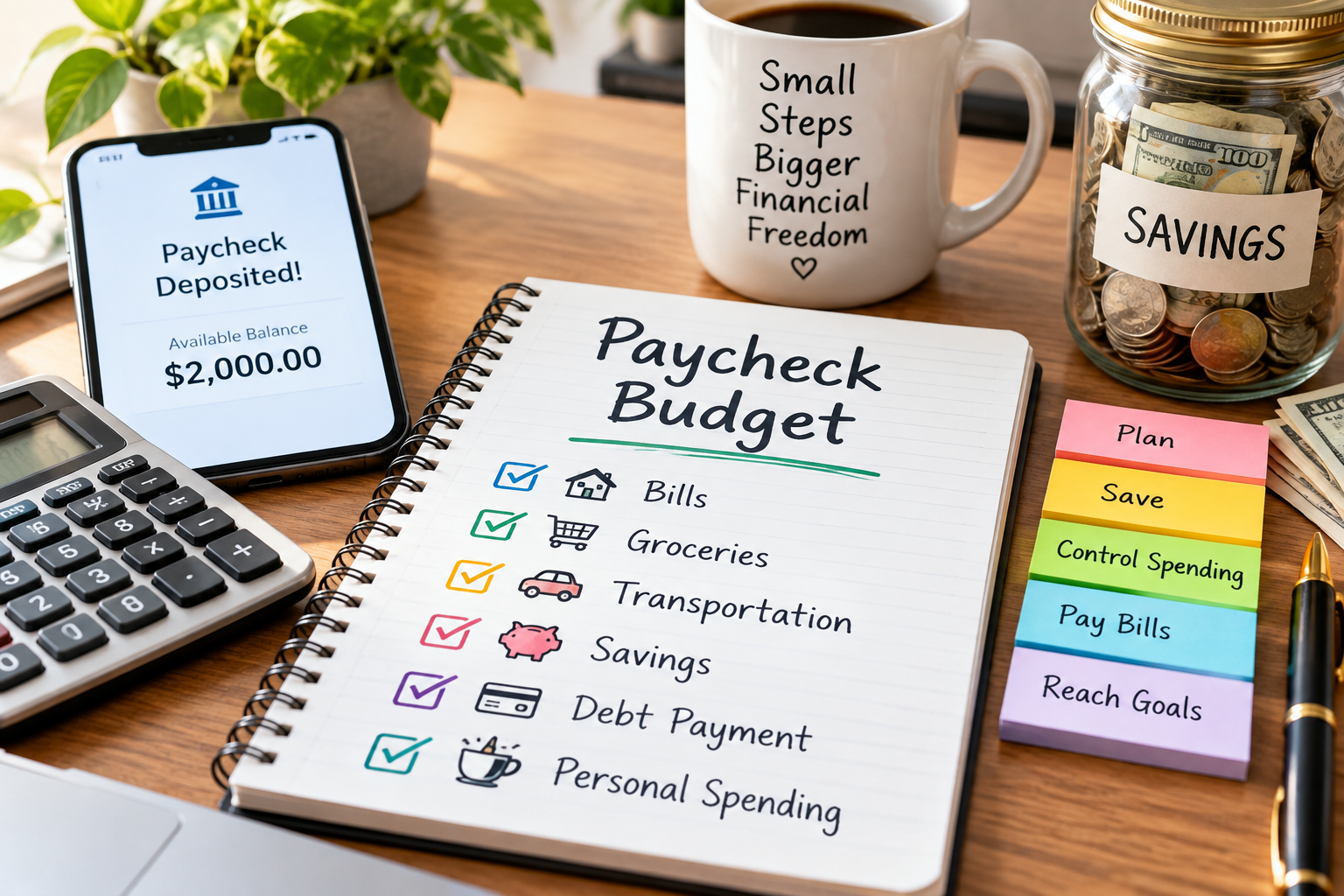
Paycheck Budgeting: 7 Smart Ways to Make Your Salary Last Longer
Getting paid feels good. Then rent comes out. The phone bill hits. Groceries cost more than expected. A subscription renews that you forgot about.
And suddenly, you’re checking your bank balance and wondering: Where did my paycheck go?
If that sounds familiar, you don’t necessarily need a complicated spreadsheet or an extreme no-spending challenge. What you may need is a better paycheck budgeting system—one that tells your money where to go before everyday spending starts eating into it.
Here are seven practical ways to make your paycheck last longer without making your life miserable.
What Is Paycheck Budgeting?
Paycheck budgeting simply means planning your money around when you actually get paid.
Instead of looking at your income as one big monthly number, you give each paycheck a job. Some money covers bills. Some handles everyday spending. Some goes toward savings, debt, or expenses you know are coming later.
This can be especially useful if you get paid weekly, every two weeks, twice a month, or your income changes from paycheck to paycheck.
The goal isn’t to account for every dollar perfectly.
The goal is to stop reaching the last few days before payday and thinking, “How am I going to make this stretch?”
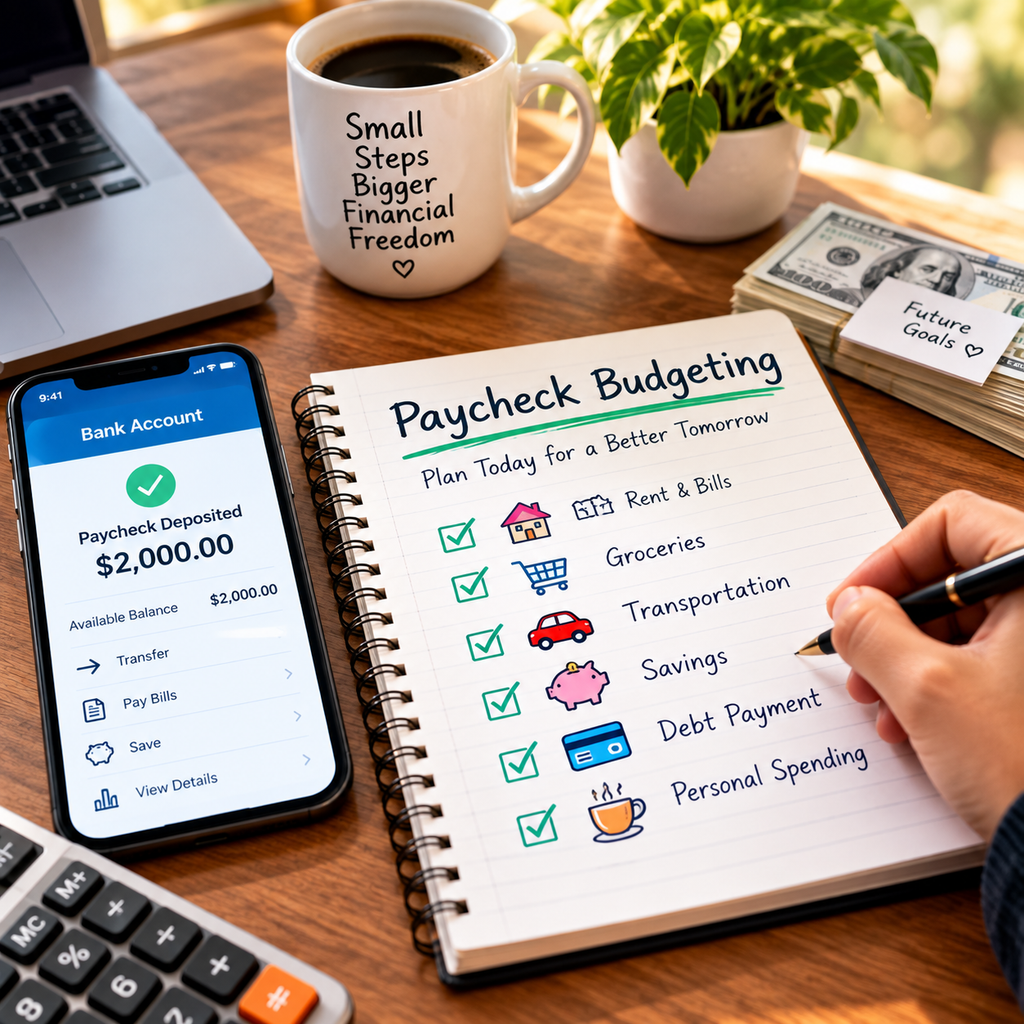
1. Start With Your Real Take-Home Pay
A budget built around your salary before taxes isn’t very useful.
Start with the amount that actually reaches your bank account after taxes, insurance, retirement contributions, and other payroll deductions.
For example, imagine your paycheck is $2,000.
Don’t immediately decide that $400 is available for shopping or eating out. First ask:
- What bills are due before my next paycheck?
- How much will I need for groceries and transportation?
- Is there a debt payment coming?
- What irregular expense might show up?
- How much can I realistically save?
This small change makes paycheck budgeting much more realistic because you’re planning with money you actually have.
2. Pay the Important Stuff First
When payday arrives, it’s tempting to think about what you can buy.
Try reversing that order.
Cover your essential obligations first: housing, utilities, groceries, transportation, insurance, minimum debt payments, and other necessary expenses.
Then look at what remains.
This creates a simple rule:
Needs first. Future you second. Wants third.
That doesn’t mean you can never enjoy your money. A budget with zero room for fun can be hard to maintain.
It simply means Friday-night spending shouldn’t accidentally use money you’ll need for Tuesday’s electricity bill.
3. Turn Monthly Spending Into a Weekly Limit
A monthly spending allowance can feel surprisingly large on payday.
Say you have $600 available for flexible spending for the month.
Seeing $600 in your account may make a $70 dinner or a $100 shopping trip feel harmless.
But divide that $600 into four weekly amounts, and you get roughly $150 per week.
Now the decision looks different.
A weekly limit gives you a shorter finish line. Instead of trying to predict your spending for the next 30 days, you only need to manage the next seven.
You don’t have to follow the number perfectly. Think of it as a guardrail, not a punishment.
If tracking every expense feels difficult, a budgeting app can make it easier to see where your money goes and stay within your weekly spending limit.
4. Save on Payday, Not at the End of the Month
One of the easiest promises to make is:
“I’ll save whatever is left at the end of the month.”
The problem is that there may be very little left.
Try moving savings closer to payday instead.
Even a small automatic transfer can make saving part of your normal paycheck budgeting routine rather than something you do only during a “good month.”
The Consumer Financial Protection Bureau says recurring automatic transfers can be one of the easiest ways to make saving consistent. Some employers may also allow workers to split direct deposits between checking and savings accounts.
The amount doesn’t have to be impressive.
If $200 makes your budget too tight, start with $25 or $50. A savings plan you can actually repeat is more useful than an ambitious one you abandon after two paychecks.
5. Create a Small Emergency Buffer
A budget can look perfect until real life happens.
Your car needs a repair. Your phone breaks. You need medicine. A family expense appears unexpectedly.
That’s why paycheck budgeting should leave room for emergencies.
If you’re starting from zero, our emergency fund guide explains how to build a financial cushion step by step without putting too much pressure on your monthly budget.
According to the Federal Reserve’s 2026 report on U.S. household finances, 63% of adults said they could cover a hypothetical $400 emergency expense using cash or its equivalent. The same report found that 59% of adults had experienced at least one major unexpected expense during the previous 12 months.
You don’t need to build a huge emergency fund overnight.
Start with a smaller milestone:
$100 → $250 → $500 → $1,000
Then keep building toward a cushion that fits your expenses and situation.
The CFPB also notes that even a small amount set aside can provide some financial security when money is tight.
6. Stop Treating Predictable Expenses Like Emergencies
Christmas happens every year.
So do birthdays.
Car insurance renewals, school expenses, annual subscriptions, vacations, and routine car maintenance may not happen every month—but many of them aren’t truly unexpected.
This is where a sinking fund can help.
Suppose your annual car insurance bill is $600.
Instead of scrambling to find $600 when the bill arrives, you could put aside:
$600 ÷ 12 = $50 per month
You can use the same idea for travel, gifts, car repairs, technology upgrades, or other known future expenses.
The CFPB recommends looking back over several months when building a budget so you don’t overlook less-frequent costs such as insurance, medical expenses, gifts, vacations, and seasonal spending.
Those expenses didn’t disappear just because they weren’t due this month.
The CFPB recommends looking back over several months of spending so your budget includes less-frequent costs such as insurance, medical expenses, gifts, and vacations.https://www.consumerfinance.gov/owning-a-home/prepare/assess-your-spending/?utm_source=chatgpt.com
7. Give Yourself Some Guilt-Free Spending Money
Here’s something many budgets get wrong: they assume you’ll suddenly stop wanting coffee, restaurants, hobbies, entertainment, or anything fun.
That’s probably not realistic.
Instead, intentionally give yourself a reasonable amount of guilt-free spending money.
Once your essential bills, savings goals, and other priorities are covered, you can spend that amount without mentally calculating your rent every time you buy lunch.
The exact percentage isn’t important.
Someone with high housing costs may have very little room for wants. Someone with lower fixed expenses may have much more.
Your budget should reflect your numbers, not a percentage you saw on social media.
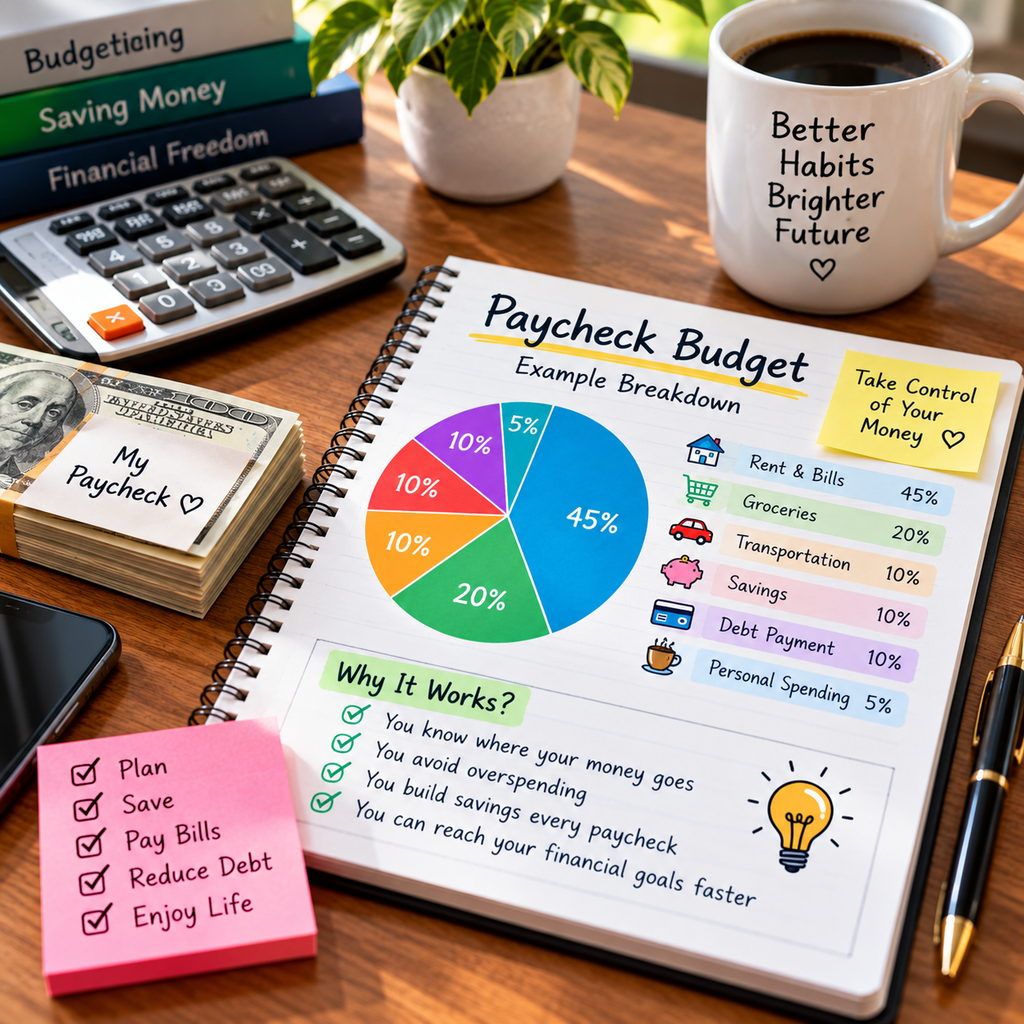
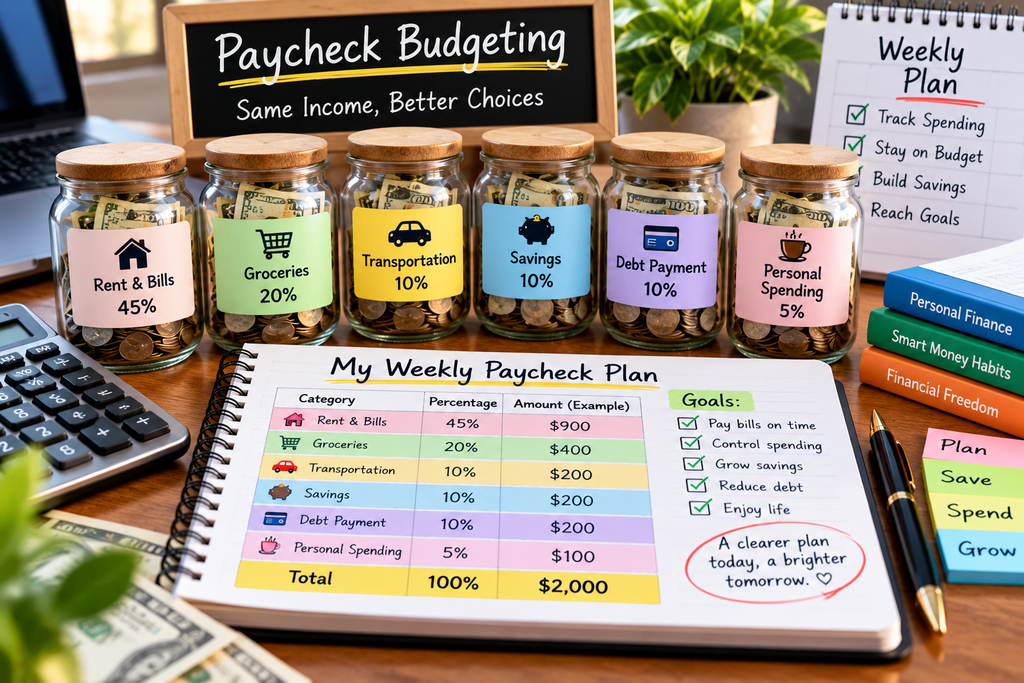
A Simple Paycheck Budgeting Example
Let’s say your take-home pay is $2,000 per paycheck.
One paycheck might look like this:
| Category | Amount |
|---|---|
| Rent and bills | $900 |
| Groceries | $250 |
| Transportation | $150 |
| Savings | $200 |
| Debt payment | $200 |
| Personal spending | $200 |
| Buffer | $100 |
| Total | $2,000 |
This is only an example—not a formula everyone should copy.
If your rent is higher, your numbers will look different. If you have children, medical costs, irregular income, or large debt payments, they may look completely different.
That’s okay.
A good budget isn’t the one with the prettiest percentages.
It’s the one you can actually live with.
What If Your Paycheck Still Isn’t Enough?
This part matters.
Sometimes the problem isn’t poor budgeting.
If your basic housing, food, transportation, insurance, childcare, and debt obligations consume almost everything you earn, reorganizing the same dollars can only do so much.
Start by separating the problem into two questions:
Where can I reduce expenses without hurting essential needs?
and
Is there a realistic way to increase income?
That could mean reviewing recurring subscriptions, shopping around for certain services, changing bill due dates where possible, picking up additional hours, or developing a higher-paying skill.
The CFPB notes that cash-flow problems can sometimes come from the timing of income and expenses, and that some creditors or service providers may allow customers to adjust payment due dates.
A budget is a tool. It cannot magically fix an income-expense gap that simply doesn’t add up.
Final Thoughts
Paycheck budgeting isn’t about becoming obsessed with every dollar you spend.
It’s about making fewer money decisions under pressure.
Start with your real take-home pay. Cover essential bills first. Break flexible spending into smaller weekly limits. Save something on payday. Prepare for expenses that you know will eventually arrive.
And leave yourself a little room to live.
You probably won’t build the perfect budget with your first paycheck.
You don’t need to.
Build one that works a little better than your current system, use it for a few pay cycles, and adjust it when real life proves your assumptions wrong.
That’s what a useful budget is supposed to do.
Frequently Asked Questions
What is paycheck budgeting?
Paycheck budgeting is a method of planning expenses, savings, debt payments, and discretionary spending around each paycheck rather than relying only on one monthly budget.
How do I budget when I get paid every two weeks?
List everything that must be paid before your next payday. Set aside that money first, then divide the remaining amount among groceries, transportation, savings, debt, and personal spending.
How much of each paycheck should I save?
There isn’t one percentage that works for everyone. Choose an amount that fits your income and essential expenses. Even a small, repeatable contribution can help you build the habit.
Should I save money if I have debt?
The answer depends on the type of debt, interest rate, minimum payments, and your financial situation. Having at least some emergency savings can help prevent an unexpected expense from immediately creating new debt.
Does paycheck budgeting work with irregular income?
Yes, but it usually requires more flexibility. Consider building your budget around a conservative income estimate, prioritizing essential expenses, and using higher-income periods to strengthen your cash buffer.