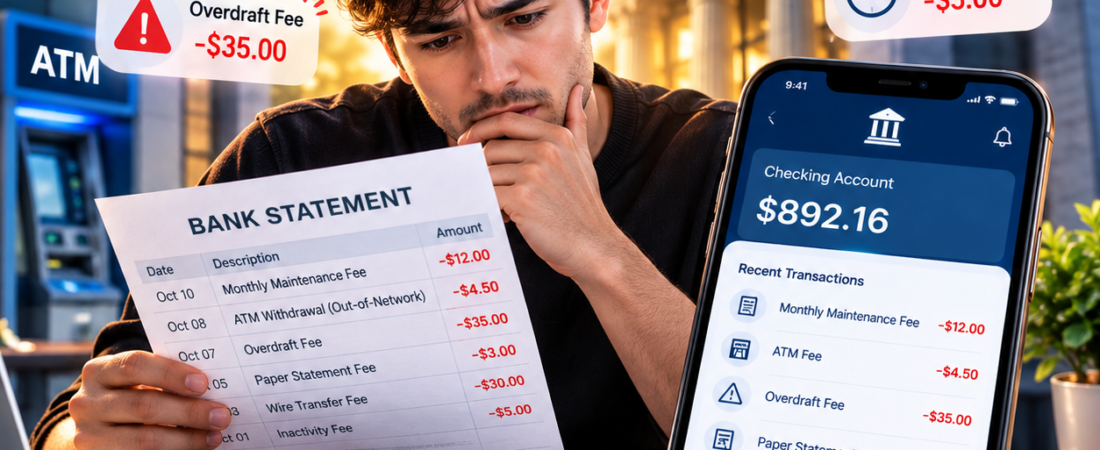
7 Hidden Bank Fees That Drain Your Money (And How to Stop Them)
You check your bank balance on Friday. Everything looks normal.
By Monday, your account has less money than you expected.
You haven’t made any major purchases. You haven’t transferred money to anyone. Yet somehow, a few dollars have disappeared.
The reason might be something many Americans overlook: hidden bank fees.
Banks can charge customers for everyday activities, including maintaining an account, using certain ATMs, transferring money, or spending more than their available balance.
These charges aren’t necessarily illegal or undisclosed. Many are listed in account agreements that customers rarely read.
But here’s the problem: even small fees can become expensive when they happen repeatedly.
For example, a $12 monthly maintenance fee costs $144 per year. Add a few out-of-network ATM charges, and the total can grow quickly.
The good news? Many banking charges are avoidable.
In this guide, we’ll break down seven common hidden bank fees, explain why banks charge them, and show you practical ways to protect your money.
What Are Hidden Bank Fees?
Hidden bank fees are banking charges that customers may not notice, understand, or expect when using their accounts.
The word hidden doesn’t necessarily mean a bank is secretly taking money. Financial institutions generally disclose account fees in their terms and conditions.
However, those disclosures can be lengthy, confusing, or easy to overlook.
Common examples include:
- Monthly account maintenance charges
- Overdraft fees
- Non-sufficient funds (NSF) fees
- Out-of-network ATM charges
- Wire transfer fees
- Paper statement fees
- Inactivity and account closure fees
The actual fees depend on your bank, account type, and banking activity.
Quick tip: Before opening a checking or savings account, ask for the bank’s current fee schedule. It can reveal costs not obvious on the account’s promotional page.
Understanding your bank’s fee structure is essential before opening an account. The Consumer Financial Protection Bureau https://www.consumerfinance.gov/consumer-tools/bank-accounts/?utm_source=chatgpt.com provides helpful information about checking accounts, common banking charges, and consumer rights.

1. Monthly Maintenance Fees: Paying to Keep Your Account Open
Imagine paying $12 every month to keep a checking account open.
That works out to:
| Period | Total Cost |
|---|---|
| 1 month | $12 |
| 6 months | $72 |
| 1 year | $144 |
| 3 years | $432 |
| 5 years | $720 |
These amounts are illustrative, but they demonstrate why recurring charges deserve attention.
Some banks waive monthly maintenance fees when customers meet certain requirements, such as maintaining a minimum balance or receiving qualifying direct deposits.
Avoiding unnecessary bank charges is just one part of managing your finances. A practical budgeting strategy can help you track spending, reduce waste, and build better saving habits.
How to Avoid Monthly Maintenance Fees
Start by checking whether your current account has a monthly service charge.
If it does, ask your bank three questions:
- What requirements qualify me for a fee waiver?
- Is there a checking account without a monthly maintenance fee?
- Can I switch accounts without losing my direct deposit arrangements?
You can also compare checking accounts at FDIC-insured banks and federally insured credit unions.
Best solution: Choose an account with no monthly maintenance fee, or one whose waiver requirements you can consistently meet.
Don’t keep an unnecessarily large balance to avoid a small fee without comparing alternatives.
2. Overdraft Fees: When a Small Purchase Becomes Expensive
Overdraft fees are among the most frustrating hidden bank fees because they can turn a small transaction into a much larger expense.
Suppose you have $18 in your checking account.
You make a $25 debit card purchase.
Your account doesn’t have enough money to cover the transaction.
Depending on your bank’s policies and your overdraft settings, the bank may decline the payment or cover it and charge a fee.
For example:
| Transaction | Amount |
|---|---|
| Available balance | $18 |
| Debit card purchase | -$25 |
| Account balance after payment | -$7 |
| Illustrative overdraft fee | -$30 |
| Final balance | -$37 |
A $7 shortfall has now become a $37 negative balance.
Not every bank charges overdraft fees, and rules vary by transaction type.
How to Avoid Overdraft Fees
Step 1: Review your overdraft settings.
Under federal rules, banks generally need your affirmative consent before charging overdraft fees for ATM withdrawals and one-time debit card transactions.
However, this opt-in rule doesn’t cover every transaction type, such as checks and certain automatic payments.
According to the Consumer Financial Protection Bureau https://www.consumerfinance.gov/consumer-tools/bank-accounts/answers/key-terms/?utm_source=chatgpt.com banks generally need your permission before charging overdraft fees on ATM withdrawals and one-time debit card purchases.
Step 2: Turn on low-balance alerts.
Set an alert when your available balance drops below an amount that gives you enough time to respond.
Step 3: Ask about overdraft protection transfers.
Some banks let you transfer funds from a linked savings account to cover a shortfall. Check whether the service carries a transfer fee.
Step 4: Compare banks.
Some institutions offer accounts without overdraft fees.
Best solution: Understand exactly which transactions your bank may cover, which it may decline, and what each outcome costs.
3. ATM Fees: The Small Charges That Add Up
Need $40 in cash?
You find a nearby ATM, withdraw cash, and keep going with your day.
But that withdrawal might cost more than you realize.
When using an ATM outside your bank’s network, you may face two separate charges:
- A fee from the ATM operator
- A fee from your own bank
For example, if the ATM operator charges $3.50 and your bank charges $2.50, your $40 withdrawal costs $6 in fees.

That’s 15% of the amount withdrawn.
These hidden bank fees can be especially expensive for people who use cash often.
How to Avoid ATM Fees
Use your bank’s ATM locator before withdrawing cash.
Also consider whether your bank offers:
- Access to a large fee-free ATM network
- Reimbursement for certain out-of-network ATM fees
- Cash withdrawals at participating retailers
If you regularly withdraw cash, compare accounts based on their ATM policies rather than just their monthly maintenance fees.
Best solution: Use in-network ATMs whenever possible and avoid paying multiple fees for small withdrawals.
4. Wire Transfer Fees: Paying Extra to Move Your Own Money
Sending money to another bank account can sometimes be surprisingly expensive.
People often use wire transfers for large payments, property transactions, and international transfers.
However, banks may charge fees for outgoing and incoming wires.
International transfers can also involve intermediary bank charges and exchange-rate markups.
Consider this hypothetical example:
You want to send $1,000 internationally.
Your bank charges a $35 outgoing wire fee.
An intermediary bank deducts another $15.
The recipient may receive less than expected, even before considering currency conversion costs.
How to Avoid Wire Transfer Fees
Before sending money, compare the complete cost of available payment methods.
For domestic transfers, an ACH transfer may be a lower-cost alternative when speed and transaction requirements allow it.
For international transfers, compare:
- Upfront transfer fees
- Exchange rates
- Intermediary bank charges
- Recipient bank fees
- Estimated delivery times
- Final amount the recipient will receive
Important: Don’t compare transfer providers using advertised fees alone.
A service with a low transfer fee might still be expensive if it offers an unfavorable exchange rate.
Best solution: Compare the final amount received, not just the advertised transfer cost.
5. Paper Statement Fees: Paying for Something You Can View Online
Many customers still prefer receiving printed bank statements by mail.
However, some banks charge for paper statements.
For example, a $3 monthly statement fee adds up to $36 annually.
That might not sound significant, but you could save that money with a simple account setting.
How to Avoid Paper Statement Fees
Log in to your bank’s website or mobile app.
Find the statement delivery preferences and check whether paperless statements are available at no cost.
Before switching, confirm that you can download and save your statements for recordkeeping.
If you need paper statements for accessibility reasons or other circumstances, ask your bank whether it offers a fee waiver.
Best solution: Choose free electronic statements when they meet your needs.
6. Inactivity Fees: Getting Charged for Not Using Your Account
One of the more surprising hidden bank fees is an inactivity fee.
Some financial institutions charge customers when certain accounts remain inactive for a specified period.
Imagine opening a savings account for emergencies.
You deposit $500 and leave the money untouched.
Months later, you discover that the account has been charged an inactivity fee.
The exact rules depend on the institution and account agreement.
Inactivity fees are not universal, and some accounts have no such charges.
How to Avoid Inactivity Fees
Review the account’s inactivity and dormancy policies.
Ask your bank:
- How long can the account remain inactive?
- What activity prevents an inactivity fee?
- Will the bank notify me before charging a fee?
- Does the account have a fee-free alternative?
Also remember that account inactivity and state unclaimed-property rules are separate issues.
A bank account may eventually become subject to state unclaimed-property procedures if the owner doesn’t maintain contact or activity for a legally specified period.
Best solution: Track accounts you rarely use and close unnecessary ones through the bank’s proper procedures.
7. Early Account Closure Fees: The Cost of Switching Banks
Found a better checking account?
Switching banks can help reduce unnecessary charges.
But some banks impose early account closure fees when customers close an account shortly after opening it.
For example, a bank might charge $25 if you close an account within a specified introductory period.
The amount and time requirement vary by institution.
How to Avoid Early Account Closure Fees
Before opening a new account, check whether it has a minimum account-opening period.
If you’re considering closing your current account, review its fee schedule first.
Also make sure you:
- Move recurring direct deposits.
- Update automatic bill payments.
- Allow pending transactions to clear.
- Confirm the account is officially closed.
- Keep written confirmation of closure.
Best solution: Plan your bank switch carefully to avoid unnecessary fees or missed payments.
How Much Could Hidden Bank Fees Cost You Every Year?
Let’s look at a realistic hypothetical scenario.
Suppose someone pays:
| Bank Fee | Annual Cost |
|---|---|
| Monthly maintenance ($12 × 12) | $144 |
| ATM fees ($6 × 6 withdrawals) | $36 |
| Overdraft fees ($30 × 3) | $90 |
| Paper statements ($3 × 12) | $36 |
| One outgoing wire transfer | $35 |
| Total Annual Fees | $341 |
That’s $341 spent on banking charges in one year.
Over five years, the same fees would total $1,705, assuming the costs remain unchanged.
Not everyone pays these charges, and some accounts offer ways to avoid them.
Still, the example shows why it’s worth reviewing your banking costs.
How to Find Hidden Bank Fees in Your Bank Statement
Knowing which fees exist is useful.
But the real opportunity comes from identifying charges on your own account.
Here’s a simple process you can complete in approximately 15 minutes.

Step 1: Download Three Months of Statements
Open your bank’s website or mobile app.
Download your three most recent monthly statements.
Three months won’t reveal every possible fee, but it’s a useful starting point.
Step 2: Search for Common Fee Descriptions
Look for transaction descriptions containing terms such as:
- Service charge
- Maintenance fee
- Overdraft
- NSF
- ATM surcharge
- Wire transfer
- Statement fee
- Inactivity fee
Some banks use different terminology, so review unfamiliar deductions too.
While reviewing your bank statement, watch for suspicious transactions and unexpected payment alerts. Learning how to spot a fake bank alert can help protect your money from financial scams.
Step 3: Calculate Your Total Fees
Add up the banking charges you find.
For example:
Monthly maintenance: $12
ATM fees: $6
Overdraft fee: $30
Total fees: $48
If you paid those same fees every month, the annual cost would reach $576.
Step 4: Contact Your Bank
Ask a representative to explain each fee.
If a charge was unexpected, request a review.
You can also ask whether the bank offers a one-time courtesy refund or a different account with fewer charges.
A refund isn’t guaranteed, but it may be worth asking.
Step 5: Compare Alternatives
If your bank consistently charges fees you can’t avoid, compare other accounts.
Look at monthly fees, minimum balances, ATM access, overdraft policies, and transfer costs.
Don’t switch based on a promotional bonus alone.
The best account fits how you actually manage your money.
What to Do If Your Bank Charged You an Incorrect Fee
Not every unexpected charge is legitimate.
Sometimes a bank may apply a fee incorrectly or charge an amount that doesn’t match the applicable account agreement.
If you believe a fee is wrong, take these steps.
1. Save the Evidence
Keep copies of your statements, transaction details, account agreement, and any relevant bank notifications.
2. Contact Your Bank
Explain which fee you’re disputing and why.
Ask the bank to review the charge and provide a written explanation.
3. Request a Refund
If the bank confirms an error, ask it to reverse the fee.
If the bank denies your request, ask what account terms or transaction details support the charge.
4. Escalate the Complaint
If the issue remains unresolved, you can submit a complaint to the Consumer Financial Protection Bureau (CFPB).
The CFPB accepts complaints about many consumer financial products and services.
Different legal protections and deadlines may apply depending on whether you’re disputing a bank fee, an unauthorized electronic transfer, or another type of transaction error.
Important: If you suspect an unauthorized transaction, report it promptly rather than treating it as an ordinary fee dispute.
Are Online Banks Better for Avoiding Hidden Bank Fees?
Online banks can be attractive because some offer checking accounts without monthly maintenance fees.
However, that doesn’t automatically make every online account cheaper.
Before switching, compare the full account features.
| Feature | What to Check |
|---|---|
| Monthly maintenance | Is there a recurring fee? |
| Minimum balance | Is a minimum required? |
| ATM access | Which withdrawals are free? |
| Overdraft policy | Are overdraft fees charged? |
| Cash deposits | Can you deposit cash conveniently? |
| Transfers | Are ACH and wire transfers available? |
| Customer support | Is help available when you need it? |
| Deposit insurance | Is the institution appropriately insured? |
For banks, verify FDIC insurance through official FDIC resources.
For federally insured credit unions, check coverage through the National Credit Union Administration (NCUA).
Remember that some financial technology apps partner with banks rather than operating as banks themselves.
Understand where your deposits are held and which protections apply before moving significant funds.
5 Smart Banking Habits That Help You Keep More Money
Avoiding hidden bank fees doesn’t require complicated financial strategies.
Small habits can make a meaningful difference.

Check Your Account Weekly
Review recent transactions and identify unfamiliar deductions.
Regular monitoring can also help you spot unauthorized activity.
Enable Account Alerts
Turn on low-balance and transaction alerts when your bank offers them.
These notifications can help you react before an avoidable problem becomes expensive.
Review Automatic Payments
Unexpected subscription renewals or bill payments can contribute to account shortfalls.
Keep a list of recurring payments and their expected dates.
Understand Your Bank’s Fee Schedule
Don’t assume your checking account is free because it was advertised that way.
Check the conditions you must meet to avoid charges.
Compare Accounts Once a Year
Banking products and account terms can change.
A quick annual review can help you determine whether your current account still meets your needs.
Frequently Asked Questions About Hidden Bank Fees
What are the most common hidden bank fees?
Common examples include monthly maintenance fees, overdraft fees, out-of-network ATM charges, wire transfer fees, and paper statement fees. Availability and amounts vary by bank and account type.
Are hidden bank fees legal?
Many bank fees are legal when properly disclosed and charged in accordance with applicable laws and account terms. However, misleading, unauthorized, or improperly assessed fees may raise consumer protection concerns.
Can I ask my bank to refund a fee?
Yes. You can request a fee review or courtesy refund. Banks may refund certain fees, but approval depends on the circumstances and the institution’s policies.
How can I avoid hidden bank fees?
Choose an account with a fee structure that fits your needs, use in-network ATMs, monitor your balance, review overdraft settings, and check your statements regularly.
Do all banks charge monthly maintenance fees?
No. Some banks and credit unions offer checking accounts without monthly maintenance fees. Others waive charges when customers meet specified requirements.
Can a bank charge me for an inactive account?
Some banks may charge inactivity fees under their account agreements. Check your institution’s policies, as these charges aren’t universal.
Is switching banks worth it to avoid fees?
It can be. If you regularly pay charges that another suitable account would eliminate, switching may save you money. Compare total costs and services before you decide.
Final Thoughts: Stop Losing Money to Avoidable Banking Charges
Hidden bank fees can quietly reduce your savings, especially when small charges repeat month after month.
A $3 statement fee or a $12 monthly maintenance charge might not seem significant on its own.

But together with overdraft charges, ATM fees, and transfer costs, the total can become surprisingly expensive.
Fortunately, you don’t need to become a financial expert to take control.
Start by reviewing your last three bank statements.
Identify every fee, confirm it was charged correctly, and ask your bank how to avoid it in the future.
If your account keeps costing more than it should, compare alternatives that better match your banking habits.
Your next step: Open your banking app today, find the fees you’ve paid over the last 90 days, and calculate how much you could save over the next year.
Sometimes the easiest way to improve your finances isn’t earning more money.
It’s keeping more of the money you already have.