
Hidden Money Transfer Fees: 7 Costly Traps to Avoid in 2026
Think your international money transfer is free? The exchange rate might tell a different story.
Imagine sending $1,000 overseas. One app advertises a $0 transfer fee. Another charges $5 upfront. Naturally, the free option looks better.
But what if the supposedly free service gives your recipient $20 less?
That’s the problem with hidden money transfer fees. The price displayed in a company’s advertisement isn’t always the total economic cost of sending money abroad.
And that difference matters, especially if you send money to family every month.
In this guide, we’ll uncover seven costly transfer traps, explain how exchange-rate markups work, and show you how to compare Wise, Remitly, Revolut, and traditional banks without falling for misleading pricing.
Hidden Money Transfer Fees: The Quick Answer
Hidden money transfer fees are costs that may not be obvious from the advertised transfer charge. They can include exchange-rate markups, intermediary bank charges, recipient withdrawal fees, payment-method surcharges, and fees that apply after introductory offers expire.
The most reliable way to compare transfers is to check how much money the recipient actually receives for the same total amount you pay.
Money Transfer Costs at a Glance
| Cost | What to check |
|---|---|
| Transfer fee | Flat or percentage-based charge |
| Exchange-rate markup | Difference from the mid-market rate |
| Payment fee | Bank account versus debit or credit card |
| Intermediary fee | Possible charges along a bank transfer route |
| Recipient fee | Charges for receiving or withdrawing money |
| Promotional pricing | Whether the rate changes after the first transfer |
The winner: Whichever eligible provider delivers the most money to your recipient at an acceptable speed and with suitable protections—not automatically the app advertising the lowest fee.
Why Hidden Money Transfer Fees Matter More Than You Think
Sending money internationally has become easier. You can initiate a transfer from your phone, track its progress, and sometimes deliver funds within minutes.
Yet convenience doesn’t automatically mean low cost.
According to the World Bank’s Remittance Prices Worldwide report for Q3 2025, the average cost of sending $200 from the United States was approximately 5.04%. The comparable averages were 4.61% from the United Kingdom and 5.27% from Canada.
These figures are historical averages across the services and routes studied—not the fee you will necessarily pay on your next transfer.
Still, they show why it’s worth comparing providers.
For someone transferring money every month, even a small percentage difference can add up.
Consider a hypothetical sender transferring $1,000 monthly:
- At a 1% total cost, the expense is $10 per transfer.
- At a 3% total cost, the expense is $30.
- At a 5% total cost, the expense is $50.
Over 12 transfers, the difference between 1% and 5% is $480.
That’s money that could otherwise go toward household expenses, savings, or education.
Trap #1: The Zero-Fee Transfer That Uses a Worse Exchange Rate
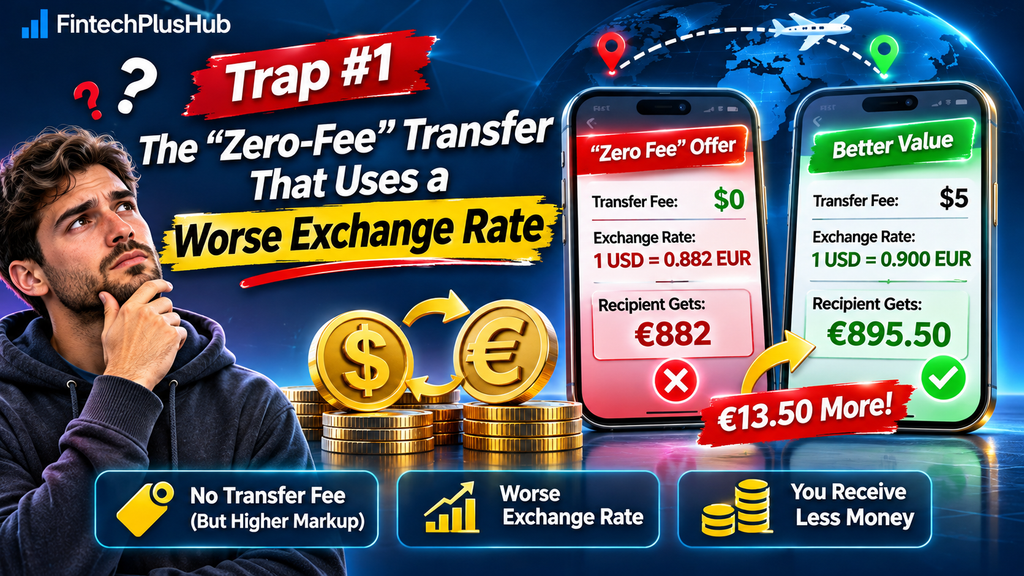
Here’s one of the easiest mistakes to make.
You see an advertisement promising:
Send money abroad with zero transfer fees.
That sounds excellent. But it doesn’t necessarily mean the currency conversion is free.
A provider can earn money through the difference between the reference exchange rate and the rate offered to customers.
That difference is called an exchange-rate markup or spread.
How an Exchange-Rate Markup Works
Let’s use a hypothetical example.
Assume the mid-market rate is:
$1 = 0.90 EUR
You’re sending $1,000.
At that rate, before fees, the conversion would equal €900.
Now imagine a provider offers:
$1 = 0.882 EUR
Your recipient gets €882.
The difference is €18, even though the advertised transfer fee might be zero.
In this simplified example, the provider’s exchange rate is 2% below the reference rate.
The important lesson?
A zero-dollar transfer fee doesn’t necessarily mean a zero-cost transfer.
The US Consumer Financial Protection Bureau has specifically warned about misleading claims involving free remittance transfers when consumers face costs through exchange-rate spreads.
How to Avoid This Trap
Before sending money, compare the offered exchange rate with a credible mid-market reference at approximately the same time.
Then check the final recipient amount. A provider can offer a competitive exchange rate but charge a separate transfer fee, so both numbers matter.
Trap #2: Comparing Transfer Fees Instead of the Money Received

Here’s where many comparisons go wrong.
People focus on the fee column and overlook the exchange rate.
Imagine three hypothetical providers handling the same $1,000 transfer.
| Provider | Advertised fee | Rate offered | Recipient gets |
|---|---|---|---|
| Provider A | $0 | 0.873 EUR/USD | €873.00 |
| Provider B | $5 | 0.900 EUR/USD | €895.50 |
| Provider C | $10 | 0.895 EUR/USD | €886.05 |
Illustrative calculations only. These are not real quotes from Wise, Remitly, Revolut, or any other provider. For this example, fees are deducted from the $1,000 before conversion.
Provider A looks cheapest because it advertises no fee.
But Provider B delivers €22.50 more.
That difference exists because Provider B’s stronger exchange rate more than offsets its $5 charge.
The Comparison Formula
When fees are deducted from the transfer amount:
Recipient amount = (Amount sent − transfer fee) × exchange rate
If fees are added on top, compare providers using the same total amount paid instead.
That’s the fairest way to compare offers.
Trap #3: Promotional Exchange Rates That Disappear

A new-customer promotion can genuinely be a good deal.
But the price on your first transfer may not be the price on your fifth.
Some providers offer special introductory exchange rates or reduced fees to eligible new customers.
For example, Remitly publishes promotional transfer offers that can be limited to first-time customers, specific destinations, and maximum qualifying amounts.
That doesn’t make the promotion bad.
It means you need to understand what happens afterward.
Three Questions to Ask Before Using a Promotional Rate
- Does the advertised exchange rate apply only to the first transfer?
- Is there a maximum amount eligible for the special rate?
- What exchange rate and fee will apply to future transfers?
If you send money every month, regular pricing may matter more than the first-transfer discount.
Smart move: Compare the promotional quote and the standard repeat-customer quote before choosing a long-term service.
Trap #4: Paying With a Credit Card Without Checking the Extra Cost

The way you fund a transfer can change its price.
Depending on the provider and destination, you might be able to pay using a bank account, debit card, or credit card.
These methods don’t always cost the same.
Wise, for example, explains that its transfer costs depend partly on the payment method, amount, and currency route.
Credit card payments may also create separate concerns, including potential cash-advance treatment by the card issuer.
That can mean additional fees or interest, depending on your card agreement.
What Should You Compare?
Before selecting a funding method, check:
- The provider’s payment-method fee.
- Any charge from your bank or card issuer.
- The expected delivery time.
- Whether the funding method changes the exchange rate or final amount.
A fast card-funded transfer might be worth paying more for in an emergency.
For a routine monthly payment, however, a cheaper funding option could make more sense.
Trap #5: Weekend Currency Exchange Fees
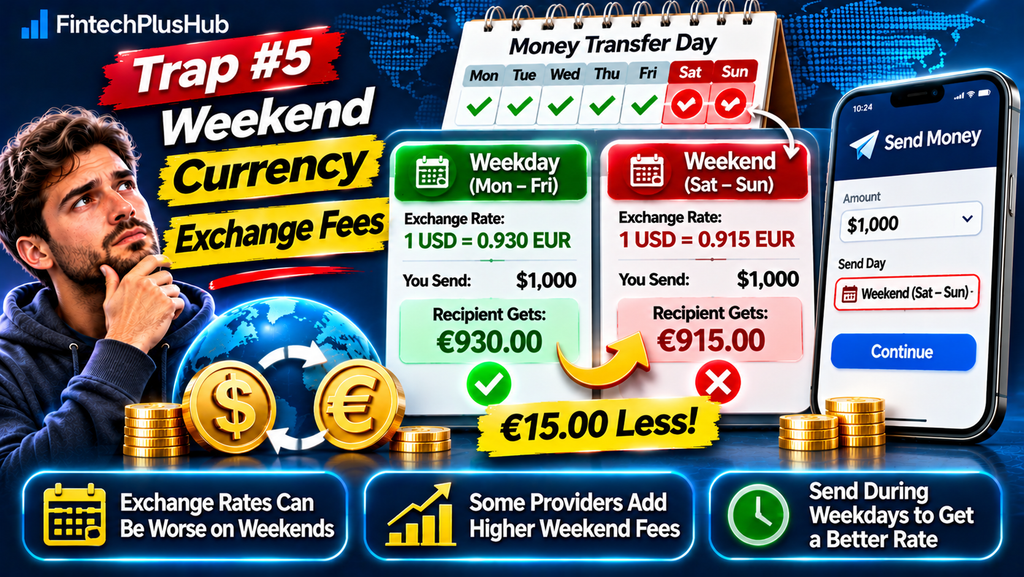
Imagine checking a currency conversion quote on Friday afternoon, then completing the exchange on Saturday.
The price may be different even if the broader market hasn’t moved in the way you expected.
Some financial apps apply additional charges when currency markets are closed.
Revolut’s US help documentation, for example, lists a 1% out-of-market-hours exchange fee for Standard-plan customers, while its stated rules differ for other plans.
It also describes fair-usage limits that can trigger additional charges.
These conditions are plan-specific and can change.
How to Avoid Weekend Surprises
If your transfer isn’t urgent, compare the total quote during normal market hours.
If you must send money on a weekend, review the app’s exchange fee and final recipient amount before confirming.
Don’t assume the weekday quote will remain identical.
Trap #6: Intermediary Bank and Recipient Charges

Sometimes the amount leaving your account isn’t the amount that reaches the recipient.
Traditional international bank transfers may involve intermediary institutions.
These banks help route payments across financial networks.
Depending on the transfer arrangement, charges may be deducted along the way.
A recipient bank might also impose a fee.
The UK’s Financial Conduct Authority has identified cases where intermediary bank charges were not clearly displayed upfront, making international payment costs harder to compare.
Questions to Ask Your Bank
Before sending a large international transfer, ask:
- Will intermediary banks be involved?
- Can any fees be deducted before the funds arrive?
- Does the receiving bank charge for incoming transfers?
- Is the recipient amount guaranteed or estimated?
These questions are especially important when paying tuition, rent, invoices, or other obligations where the recipient needs an exact amount.
Trap #7: Forgetting the Long-Term Cost of Small Transfers

A transfer that costs only a few dollars may seem harmless.
But frequency changes the calculation.
Suppose you send $500 abroad twice a month.
That’s $12,000 per year.
Now compare two hypothetical total-cost levels.
| Total transfer cost | Annual cost on $12,000 |
|---|---|
| 1% | $120 |
| 2% | $240 |
| 3% | $360 |
| 5% | $600 |
The difference between 1% and 5% is $480 per year.
These calculations assume the percentage applies consistently to the full amount and exclude any separate costs not included in the percentage.
For regular senders, it may be worth comparing transfer services every few months instead of automatically using the same provider forever.
Rates, fees, promotions, and eligibility can change.
You can also use AI budgeting apps to track recurring expenses and understand how small transfer fees affect your monthly budget.
Wise vs. Remitly vs. Revolut: Which Has Lower Hidden Money Transfer Fees?
There isn’t one universally cheapest international transfer app.
The best option depends on your sending country, receiving country, currency pair, payment method, amount, and delivery requirements.
Here’s what to examine with three popular services.
| Service | Pricing feature to examine | Important consideration |
|---|---|---|
| Wise | Mid-market exchange rate plus disclosed transfer fee | Fees vary by route, amount, and payment method |
| Remitly | Transfer quote, exchange rate, and promotional eligibility | First-transfer offers may differ from repeat pricing |
| Revolut | Plan limits, exchange fees, and transfer charges | Some currency exchanges incur weekend or fair-usage fees |
This is a comparison of published pricing structures, not a live price test or a ranking of which service is cheapest.
Wise: Check the Total Fee
Wise states that it uses the mid-market exchange rate without adding an exchange-rate markup.
Instead, it charges a transfer fee that depends on the currency, amount, and payment method.
This can make the pricing easier to understand, but it doesn’t guarantee Wise will deliver the most money on every route.
Remitly: Look Beyond the Welcome Offer
Remitly offers international transfers with pricing that varies by destination, funding method, and delivery option.
Some customers may qualify for promotional rates.
Always compare the final recipient amount and the standard price for later transfers.
Revolut: Review Your Plan
Revolut’s currency exchange pricing depends on the account plan and usage.
Certain plans and circumstances can involve weekend or fair-usage charges.
Review the applicable rules for your country and plan rather than assuming all customers receive the same pricing.
So Which One Wins?
For a specific transfer, the winner is the provider that delivers the best combination of:
Recipient amount + acceptable delivery speed + reliable service + suitable customer protections.
The lowest advertised fee alone doesn’t determine the winner.
How to Calculate Hidden Money Transfer Fees on a $1,000 Transfer
You don’t need an advanced finance calculator to spot an expensive transfer.
Let’s walk through a realistic-looking but entirely hypothetical comparison.
Assume:
- You want to spend exactly $1,000.
- The mid-market rate is 0.90 EUR per USD.
- Provider A charges no explicit transfer fee.
- Provider A offers 0.873 EUR per USD.
- Provider B charges $5, deducted before conversion.
- Provider B offers the full 0.90 EUR per USD.
Step 1: Calculate the Reference Amount
$1,000 × 0.90 = €900
That’s the amount at the reference exchange rate before fees.
Step 2: Calculate Provider A’s Result
$1,000 × 0.873 = €873
Compared with the reference amount, the recipient gets €27 less.
Step 3: Calculate Provider B’s Result
($1,000 − $5) × 0.90 = €895.50
Compared with the reference amount, the recipient gets €4.50 less.
Step 4: Compare the Difference
€895.50 − €873 = €22.50
Provider B delivers €22.50 more despite charging an explicit $5 fee.
This is why comparing recipient amounts can be much more useful than comparing advertisements.
Try This Hidden Money Transfer Fees Calculator
Use this simple calculator to estimate the difference between an offered exchange rate and a reference rate.
{@CALCULATOR_PLACEHOLDER}
Calculation method:
Reference recipient amount = (Transfer amount − applicable fees) × reference exchange rate
Actual recipient amount = (Transfer amount − applicable fees) × provider exchange rate
The difference shows the impact of the exchange rate under those assumptions. It does not automatically include intermediary fees, recipient fees, taxes, or separate funding charges.
For an accurate real-world comparison, use each provider’s current quote.
7 Ways to Avoid Hidden Money Transfer Fees Before You Send
Before confirming your next international payment, use this checklist.

- Compare the final recipient amount. This is usually the clearest starting point.
- Check the exchange-rate markup. Don’t focus only on the advertised fee.
- Review promotional conditions. First-transfer pricing may not last.
- Compare payment methods. Card funding can have different costs.
- Check weekend and usage charges. Especially with multi-currency accounts.
- Ask about third-party fees. Important for some international bank transfers.
- Save the final quote and receipt. You’ll have a record if the delivered amount differs unexpectedly.
A few minutes of comparison can make a meaningful difference, particularly for people sending money overseas regularly.
What US, UK, and Canadian Senders Should Know
The fundamentals of international transfer pricing are similar across these markets, but consumer rules and provider availability differ.
United States
The CFPB’s remittance transfer rules generally require covered providers to disclose important information, including applicable fees, exchange rates, and recipient amounts before payment, subject to regulatory exceptions.
United Kingdom
The FCA expects firms to provide clear information about international payment costs. Its published findings highlight the importance of transparency around exchange-rate markups and intermediary charges.
Canada
Canadian senders should review the applicable provider disclosures, payment method, exchange rate, and final recipient amount. Specific protections can depend on the provider, product, and jurisdiction.
In every market, remember that advertised rates may differ by destination and customer eligibility.
Frequently Asked Questions About Hidden Money Transfer Fees
Are zero-fee international money transfers really free?
Sometimes a transfer can have no explicit sending fee, but that doesn’t prove the total cost is zero. Compare the exchange rate, any payment-method charges, and the recipient amount.
What is an exchange-rate markup?
An exchange-rate markup is the difference between a reference exchange rate and the rate offered to the customer. It can represent an additional currency conversion cost.
Is Wise always cheaper than Remitly?
No. The cheapest provider depends on the transfer route, amount, funding method, promotions, and current quote.
Can banks charge fees after a transfer is sent?
Some international bank transfers can involve intermediary or recipient-bank charges. Check the transfer arrangement and fee disclosures beforehand.
How can I avoid hidden money transfer fees?
Compare the final recipient amount across providers using the same total amount paid, destination, currency, and funding method. Review any conditions before confirming.
Do international transfer fees change on weekends?
They can. Some services apply weekend currency exchange charges or different conditions outside normal market hours.
Final Thoughts: Don’t Let Hidden Money Transfer Fees Eat Into Your Money

The cheapest-looking international money transfer isn’t always the cheapest one.
A zero-fee advertisement might be attractive, but the exchange rate, funding method, and recipient charges can change the actual result.
The good news is that you don’t have to become a currency expert to make a better decision.
Start with one simple question:
How much money will my recipient actually receive for the total amount I’m paying?
Compare that figure across a few reputable providers, check the delivery conditions, and keep a record of the quote.
When you send money internationally, every dollar matters. Understanding hidden money transfer fees helps you keep more of it.
If you want better control over your everyday finances, discover how AI financial agents can help you track spending, identify unnecessary charges, and improve your financial decisions.
Sources and Further Reading
- Consumer Financial Protection Bureau — Deceptive Remittance Marketing
- World Bank — Remittance Prices Worldwide
- UK Financial Conduct Authority — International Payment Pricing Transparency
- Wise — Fees for Sending Money
- Remitly — International Money Transfers
- Revolut US — Currency Exchange Fees and Limits
Editorial note: Pricing rules and exchange rates can change. All worked provider comparisons in this article are illustrative, not live tests or guarantees. Information checked November 1, 2026.