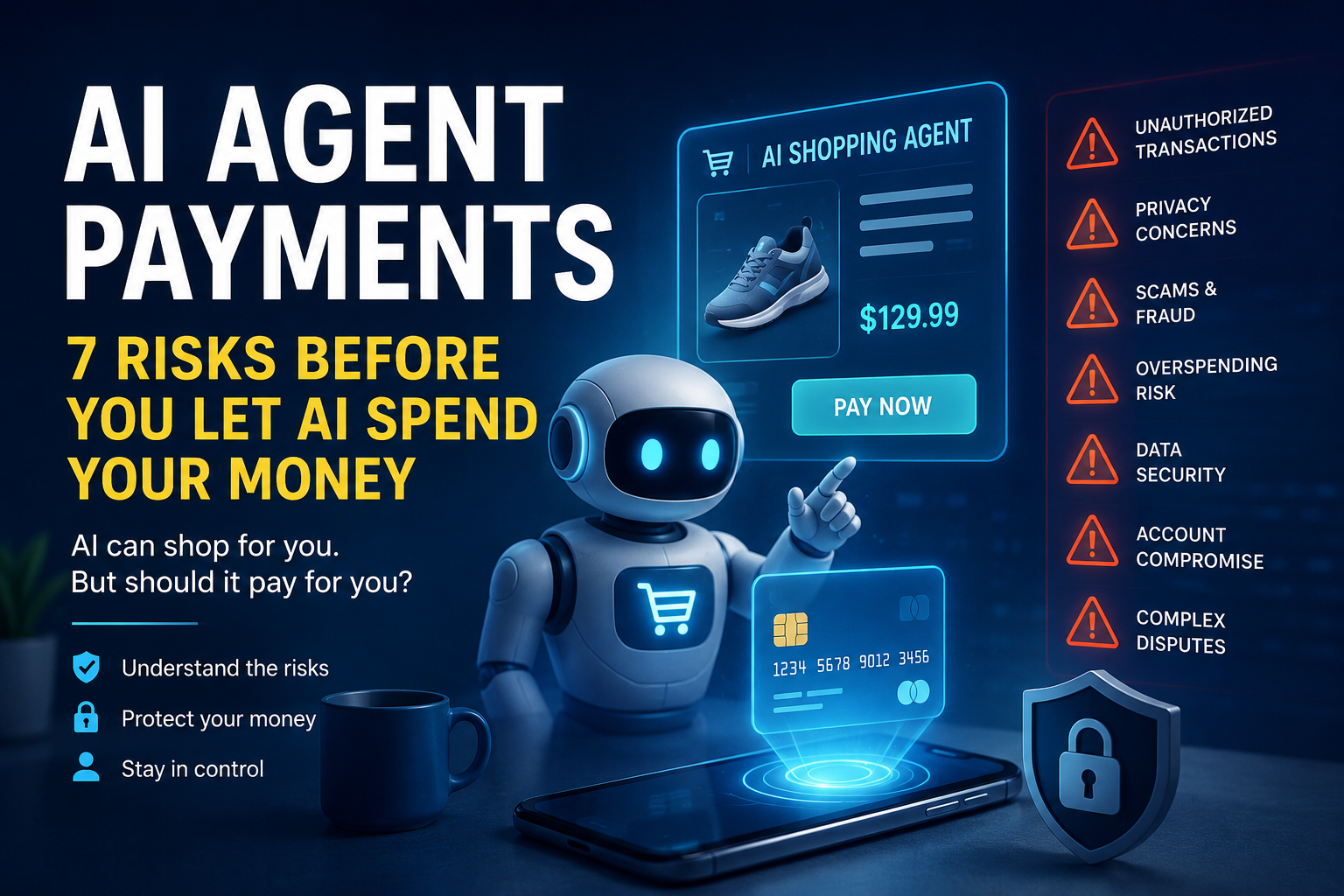
AI Agent Payments: 7 Critical Risks to Know in 2026
Imagine telling an AI assistant:
“Find me the cheapest flight to London next Friday. Keep it under $500, choose a morning departure, and book it.”
A few moments later, the flight is booked.
You did not search ten travel websites. You did not manually compare every price. You may not even have entered your card details at checkout.
Your AI agent handled much of the work for you.
That is the promise behind AI agent payments.
AI is moving beyond simply answering questions or recommending products. Payment companies are building infrastructure that can allow authorized AI agents to participate in real transactions.
Visa, for example, says its Intelligent Commerce technology is designed to give AI-initiated transactions payment credentials, authentication, controls, and protections. Mastercard is also developing Agent Pay infrastructure for agentic commerce.
This could make online shopping dramatically easier.
However, it creates a much more serious question:
What happens when software is allowed to spend your money?
Convenience is useful. Losing control of your bank account is not.
This guide explains how AI agent payments work, seven risks consumers should understand, and practical steps you can take before allowing an AI agent to make purchases for you.
“AI agent payments are part of a broader shift toward The Best AI Financial Agents 2026 for Smarter Finance, which are increasingly designed to handle financial tasks instead of simply providing recommendations.”
What Are AI Agent Payments?
AI agent payments are transactions in which an AI-powered agent participates in the purchasing process on behalf of a user.
A normal AI shopping assistant might help you find a laptop.
An AI agent could potentially go further.
For example, you might tell it:
Find a 4-star hotel near Manhattan for under $250 per night, make sure it has free cancellation, and book the best option.
The agent could search available options, compare prices, apply your preferences, select an eligible hotel and initiate the transaction within the permissions you gave it.
That last part changes everything.
Traditional AI helps you decide.
Agentic AI can increasingly help you act.
“Visa is developing https://www.visa.com/en-us/solutions/intelligent-commerce?utm_source=chatgpt.com infrastructure designed to help AI agents find products and make authorized purchases using secure payment credentials and user-defined controls.”
Visa says its Intelligent Commerce infrastructure is intended to support trusted AI-initiated transactions through tools including payment credentials, authentication and controls.
Mastercard’s Agent Pay is similarly being developed to enable trusted payments in agentic commerce.
So this is no longer only a futuristic idea.
The payment infrastructure is actively being built.
Are AI Agent Payments Safe in 2026?
The short answer is:
They can be designed to be secure, but that does not make every AI-powered payment automatically safe.
Think about what happens when you shop normally.
You see the product.
You see the seller.
You check the price.
You press the payment button.
Now imagine delegating several of those decisions to software.
You may save ten minutes, but you have also introduced another layer between your intention and the final transaction.
That creates new questions:
- Did the AI understand exactly what you wanted?
- Is it dealing with the correct merchant?
- What information can the agent access?
- How much is it allowed to spend?
- What happens if the AI makes the wrong purchase?
- Who is responsible when something goes wrong?
These are not reasons to reject AI agent payments completely.
They are reasons to use them carefully.
1. AI Agent Payments Could Misunderstand What You Want
One of the simplest risks is also one of the easiest to underestimate.
AI can misunderstand instructions.
Suppose you say:
“Buy me the cheapest good laptop for video editing under $1,000.”
What exactly does “good” mean?
You may mean:
- at least 16GB RAM,
- strong battery life,
- a dedicated GPU,
- a reputable brand,
- and a good display.
The AI may interpret your request differently.
If it only optimizes for price and basic specifications, you could end up with a machine that technically meets the request but is terrible for your actual workflow.
With a recommendation, you can simply ignore a bad suggestion.
With an autonomous purchase, the mistake could cost money.
Solution: Give AI Narrow Spending Instructions
Avoid vague commands such as:
“Buy the best one.”
Instead, define clear limits.
For example:
“Find a laptop under $1,000 with at least 16GB RAM and 512GB SSD. Only consider these three brands. Do not complete the purchase until I approve the final product and price.”
That final sentence is especially important.
For expensive purchases, AI should help reduce your workload—not remove you from the decision entirely.
2. Giving an AI Agent Too Much Spending Permission
This may become one of the biggest consumer problems with autonomous payments.
An AI agent does not necessarily need unlimited access to your money to be useful.
Imagine giving an agent permission to purchase household products whenever supplies run low.
That sounds convenient.
But what if there is no:
- maximum transaction value,
- monthly spending limit,
- approved merchant list,
- product restriction,
- or confirmation requirement?
You have effectively given software an open-ended purchasing mandate.
Solution: Use the Least Permission Necessary
A safer approach is to give the agent only the authority required for a specific task.
For example:
Maximum per transaction: $50
Monthly maximum: $200
Approved merchants: selected trusted retailers
Allowed category: household essentials
Purchases above $50: manual approval required
The principle is simple:
An AI agent should not have more financial authority than it actually needs.
3. Scammers Could Pretend to Be Trusted AI Agents
Fraud is already an enormous problem without autonomous AI payments.
According to the U.S. Federal Trade Commission, consumers reported about $15.9 billion in total fraud losses in 2025.
Imposter scams alone generated more than one million reports, with reported losses reaching approximately $3.5 billion.
That does not mean AI agent payments caused those losses.
They did not.
But the numbers show the environment into which autonomous payments are arriving.
Consumers already struggle with fake banks, fake businesses, impersonation attempts and fraudulent messages.
Now imagine scammers creating:
“Official AI Shopping Assistant”
or
“Secure Bank AI Agent.”
A convincing interface could trick someone into providing payment authorization or account credentials.
Solution: Verify the Agent Before Connecting Money
Do not connect your bank account or payment card to an AI service simply because its website looks professional.
Before authorizing an AI agent:
- verify who operates it,
- download apps from official sources,
- check whether the payment provider supports the service,
- use strong authentication,
- and never provide passwords or verification codes through unexpected messages.
Moreover, be suspicious when an AI service creates urgency around transferring money or changing security settings.
Convenience should never override verification.
4. AI Agent Payments Create New Privacy Questions
Money tells a surprisingly detailed story about your life.
Your transactions can reveal where you travel, what you buy, which subscriptions you use, what brands you prefer and how much you tend to spend.
An AI shopping agent may need some personal information to work effectively.
But there is a big difference between an agent knowing:
“I prefer aisle seats.”
and giving a service unnecessary access to years of financial activity.
The more information an agent can access, the more important questions about storage, sharing, retention and security become.
Solution: Check What Data the Agent Can Access
Before connecting an AI agent to a financial service, ask:
What information does this service actually need?
If an AI only needs to purchase a $30 household item, unrestricted access to your financial history would be difficult to justify.
Review privacy and permission settings.
Remove integrations you no longer use.
Where available, prefer tokenized payment credentials or systems that avoid unnecessarily exposing your underlying card details.
5. A Compromised AI Agent Could Become a Financial Target
Your credit card is valuable to attackers.
Your bank account is valuable.
An AI agent authorized to use those payment methods could also become valuable.
That makes agent security extremely important.
An attacker does not necessarily need to steal the physical card if they can compromise an authorized system capable of initiating transactions.
Payment networks appear to recognize this problem.
Visa’s Intelligent Commerce approach includes authentication, payment credentials and controls for AI-initiated transactions.
Visa has also announced technologies including an Agentic Registry and Agent Scoring designed to help establish trust around AI agents participating in commerce.
Solution: Treat AI Payment Accounts Like Banking Accounts
Use:
- unique passwords,
- multi-factor authentication,
- transaction notifications,
- device security,
- spending limits,
- and regular permission reviews.
If an AI payment service offers an instant way to revoke an agent’s purchasing authority, know where that control is before you need it.
Security settings are boring—right up until the day they save your money.
6. Refunds and Disputes Could Become More Complicated
Imagine an AI agent books the wrong hotel.
You say:
“I never wanted this.”
The merchant says:
“Your authorized AI agent made the purchase.”
Who is responsible?
That question can become complicated depending on the payment system, merchant, user authorization, platform rules and applicable law.
Traditional online payments already have refund and dispute processes.
Agentic commerce adds another layer: determining whether the transaction accurately represented the user’s intent.
Solution: Keep Humans in the Loop for High-Value Purchases
For everyday purchases such as a $10 household item, full automation may eventually make sense.
For a $2,000 laptop?
A $5,000 vacation?
A major investment?
The risk changes dramatically.
A useful rule is:
The larger or less reversible the transaction, the more human confirmation you should require.
Let AI search.
Let AI compare.
Let AI negotiate where appropriate.
But for important transactions, you should still see the final merchant, product, conditions and total price before payment.
7. Convenience Could Make Overspending Easier
This risk has nothing to do with hackers.
It is about human behavior.
Online shopping is already extremely easy.
AI could remove even more friction.
Instead of:
search → compare → open website → add to cart → enter information → review → pay
the experience could become:
“Buy it.”
Done.
Removing friction can save time.
However, some friction is useful.
The extra thirty seconds at checkout sometimes gives you enough time to think:
“Do I actually need this?”
Solution: Give Your AI a Budget, Not Just a Payment Method
This could be one of the smartest uses of financial AI.
Instead of telling an agent:
“Buy what I need.”
Tell it:
“My non-essential shopping budget is $300 this month. Never exceed it. Ask me before any purchase above $50.”
An intelligent payment agent should ideally help enforce your financial boundaries rather than weaken them.
How Payment Companies Are Making AI Agent Payments Safer
The payment industry is not ignoring these risks.
Visa says its Intelligent Commerce system is designed around secure AI-initiated transactions using payment credentials, controls, authentication and protections.
In 2026, Visa also announced Agent Scoring and an Agentic Registry as part of its efforts to establish trust between consumers, merchants and AI agents.
Mastercard has been developing Agent Pay for similar agentic-commerce use cases.
Moreover, Mastercard announced Agent Pay for Machines in June 2026, extending the idea toward automated, high-frequency and low-value machine-driven transactions.
These developments matter because AI agent payments need more than intelligence.
They need identity.
They need authorization.
They need limits.
They need fraud detection.
And most importantly, they need a reliable way to prove that a transaction represents what the user actually authorized.
A Safer Way to Use AI Agent Payments
I would not treat every AI purchase equally.
Buying a $12 pack of household supplies is very different from booking a $4,000 vacation.
A practical approach is to divide transactions by risk.
| Transaction | AI Role | Human Approval |
|---|---|---|
| Low-cost recurring item | Find + buy | Optional |
| Grocery order | Build cart | Review total |
| Electronics | Research + compare | Required |
| Flights/hotels | Search + prepare booking | Required |
| Large financial transaction | Research only | Always required |
The goal is not to choose between AI or humans.
The better model is:
AI handles the repetitive work. Humans control important financial decisions.
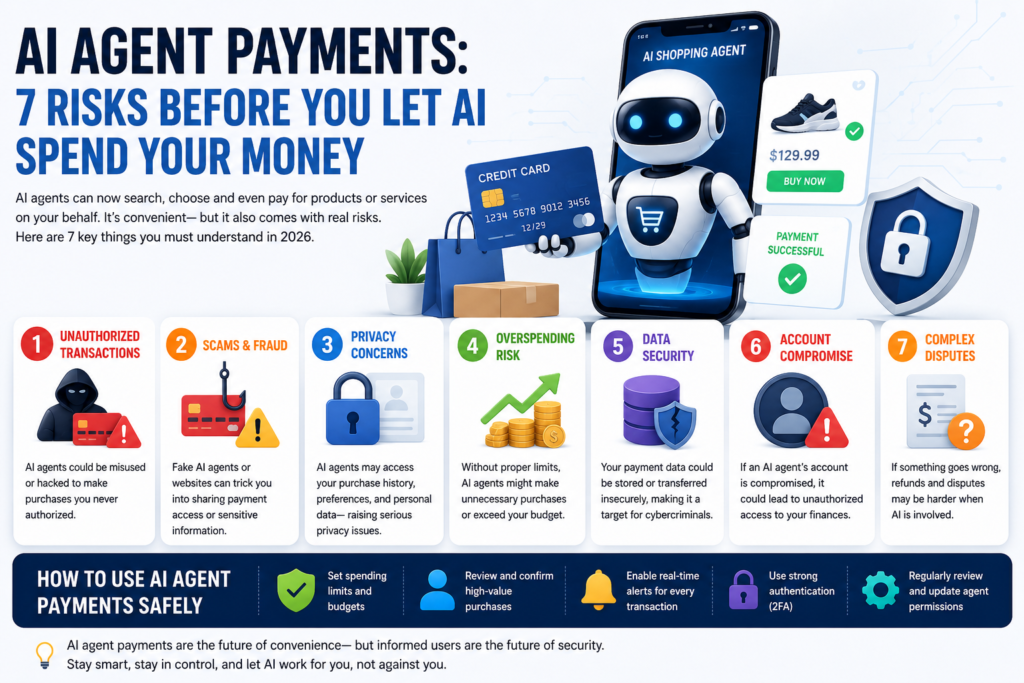
7 Things to Check Before Letting an AI Spend Your Money
Before enabling AI agent payments, ask yourself:
- Who operates this AI agent?
Make sure you know which company is actually handling the service. - What payment information can it access?
Give it only what is necessary. - Is there a spending limit?
Set both transaction and monthly limits when available. - Does it require approval for expensive purchases?
If not, think carefully before enabling autonomous spending. - Can I instantly revoke access?
You should be able to disconnect the agent quickly. - Will I receive transaction alerts?
Turn them on. - What happens if the AI makes a mistake?
Understand cancellation, refund and dispute rules before trusting automation with significant purchases.
If a service cannot answer these questions clearly, giving it access to your money may be premature.
Are AI Agent Payments the Future?
Probably some form of them.
AI already helps people search, compare products and make decisions.
Allowing an agent to complete an authorized transaction is a logical next step.
Visa has said it expects millions of consumers to use AI agents to complete purchases by the 2026 holiday season.
But adoption will depend on something more important than convenience:
trust.
Consumers need confidence that an AI agent will follow instructions, protect payment information, respect spending limits and provide a clear path when something goes wrong.
That is why the most important development in agentic commerce may not be an AI that can buy something in two seconds.
It may be an AI that knows when not to buy.
Final Thoughts: Should You Trust AI Agent Payments?
AI agent payments could become one of the biggest changes to online commerce since digital wallets.
They could search thousands of products, compare prices, follow budgets and complete routine purchases with very little effort.
That sounds fantastic.
But giving software permission to recommend a product is fundamentally different from giving software permission to spend your money.
For now, the safest approach is controlled automation.
Use AI for research.
Use it for comparisons.
Give it narrow permissions for low-risk tasks.
Set spending limits.
Keep transaction alerts enabled.
And when meaningful money is involved, keep yourself in the final decision.
AI should make managing money easier.
It should never make you lose control of it.
Frequently Asked Questions
What are AI agent payments?
AI agent payments are transactions where an authorized AI agent participates in finding, selecting or purchasing products and services on behalf of a user.
Are AI agent payments safe?
They can include strong security measures, but safety depends on the platform, authentication, permissions, payment infrastructure and how much authority the user gives the agent. Consumers should use spending limits and manual confirmation for important purchases.
Can AI agents spend money automatically?
Some emerging agentic-commerce systems are being designed to allow authorized agents to initiate or complete transactions within user-defined permissions. The exact capabilities depend on the service and payment infrastructure.
What is the biggest risk of AI agents making payments?
There is no single risk. Important concerns include excessive permissions, fraud, compromised accounts, privacy, incorrect purchases, overspending and disputes about user intent.
Should I give an AI agent my credit card?
Avoid handing raw card credentials to an unknown AI service. Use trusted payment systems, review permissions, enable strong authentication and prefer protected or tokenized payment mechanisms where available.