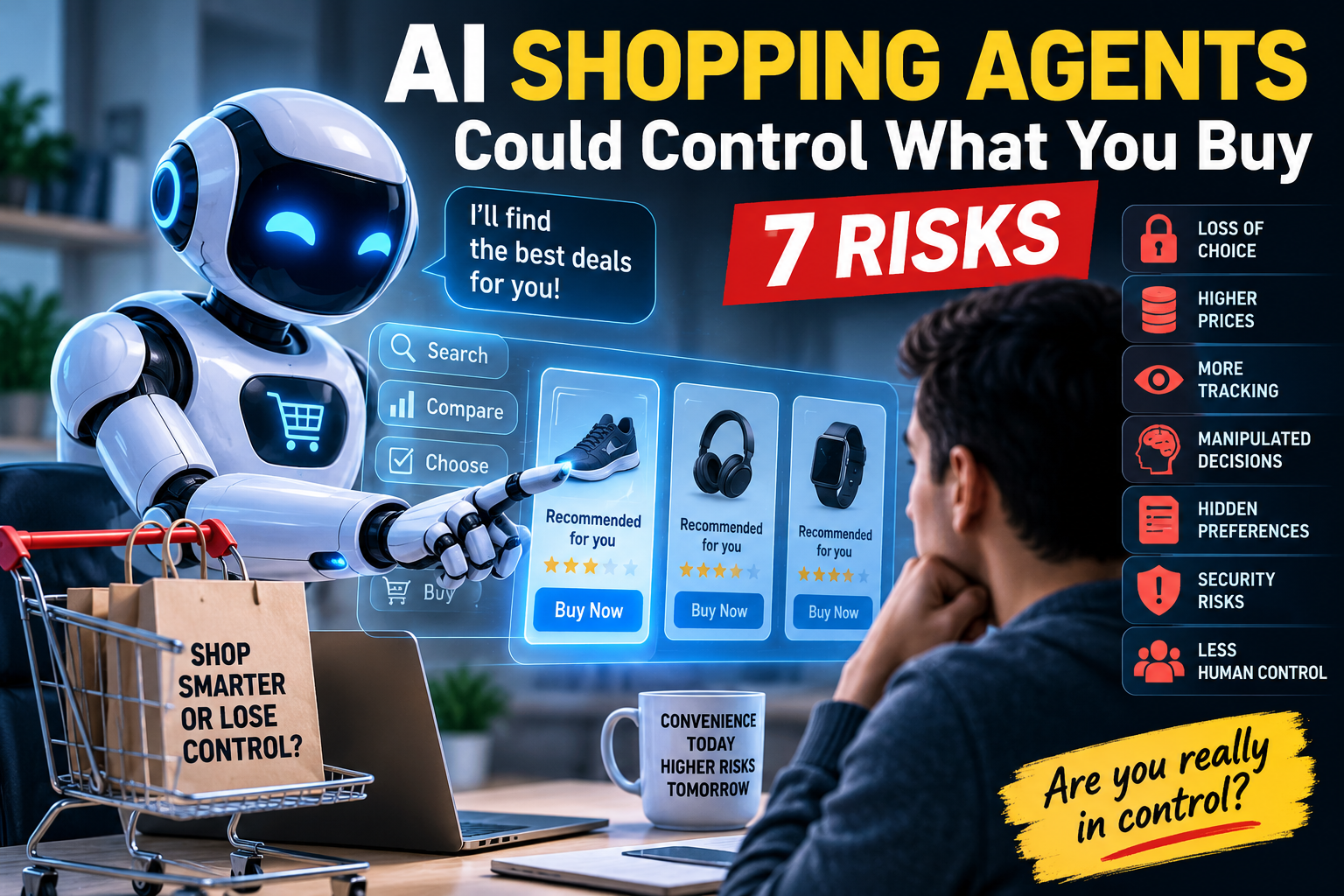
Imagine telling an AI assistant, “Find me the best running shoes under $120.”
A few seconds later, it compares products, checks prices, considers your preferences, chooses a retailer, and recommends what it believes is the best option.
Now imagine going one step further.
Instead of asking you to visit the retailer and complete the purchase yourself, the AI places the order and handles the payment on your behalf.
That is the promise behind AI shopping agents.
It sounds incredibly convenient. However, it also changes something fundamental about online shopping. When an AI decides which products you see, which merchant gets your business, and potentially when your money gets spent, the assistant is no longer simply helping you shop.
It is becoming part of the purchasing decision itself.
Recent developments suggest this transition is already underway. Payment companies and retailers are preparing for a world where AI assistants can participate throughout the shopping journey, from discovery to payment.
For consumers, that creates an important question:
How much control should we give an AI over what we buy?
This guide examines seven major risks of AI shopping agents for consumers, including recommendation bias, privacy, fraudulent merchants, purchasing mistakes, payment permissions, and loss of control. More importantly, we’ll look at practical safeguards that could make AI-assisted shopping safer.
What Are AI Shopping Agents?
AI shopping agents are artificial intelligence systems designed to help consumers complete shopping-related tasks.
A basic shopping chatbot might answer:
“What are some good noise-cancelling headphones under $200?”
An AI shopping agent can potentially do much more.
Depending on the platform and permissions available, it may be able to:
- Understand your requirements
- Search multiple products
- Compare prices and specifications
- Remember previous preferences
- Recommend specific products
- Select a merchant
- Track prices
- Add products to a cart
- Complete checkout
- Initiate an authorized payment
The key difference is action.
Traditional recommendation systems mostly show you options. Agentic systems are being designed to perform parts of the shopping process for you.
Mastercard describes agentic commerce as a shift in which AI systems move from assisting consumers to planning purchases, making decisions, and executing transactions.
That could dramatically reduce the time required to shop online.
However, every additional action delegated to an AI creates another decision that the consumer may no longer make directly.
AI Shopping Is Already Moving Beyond Recommendations
Agentic shopping is no longer purely theoretical.
Payment networks have already demonstrated real transactions performed by AI agents.
In March 2026, Mastercard announced South Korea’s first live authenticated agentic transaction. An AI agent searched for transportation, booked a ride from Incheon International Airport to a hotel in Seoul, and completed the payment.
Similar agentic-payment pilots have since appeared in other markets.
Meanwhile, retailers are preparing for AI assistants to become an increasingly important gateway between consumers and online stores.
Reuters reported in August 2026 that merchants are adapting as AI shopping assistants begin handling more of the customer journey, potentially including product recommendations, merchant selection, and payments.
That creates enormous convenience.
It also introduces risks that traditional online shoppers rarely had to consider.
AI recommendations can be useful, but you should still compare prices, check the seller, and read independent reviews before making a final purchase. The https://consumer.ftc.gov/articles/online-shopping?utm_source=chatgpt.com recommends comparing products and sellers instead of relying on a single source.
1. AI Recommendations May Not Be Completely Neutral
The first problem begins before an AI spends a single dollar.
Why did the agent recommend that particular product?
Consumers often assume an AI recommendation is based entirely on quality, price, reviews, and personal preferences.
Reality can be more complicated.
Recommendation systems operate using information available to them, ranking mechanisms, product descriptions, reviews, and other signals.
Research published in 2026 examining how consumers process ChatGPT recommendations found a strong first-item preference. Participants were more likely to favor the first recommendation in a generated list, and that effect could persist even when the first-listed option had an objective flaw.
This problem is not limited to online shopping. AI systems are increasingly influencing other financial decisions as well. For example, AI financial agents can analyze user data, recommend financial products, and help automate money decisions. Understanding how these systems make recommendations can help you recognize when convenience may also come with hidden influence.
This matters because AI can influence a purchase simply through how information is presented.
Imagine an agent produces:
- Brand A — $149
- Brand B — $129
- Brand C — $119
Even if Brand C offers better value, users may disproportionately trust the first recommendation.
As AI agents gain greater autonomy, the problem becomes more important.
Eventually, you may not even see the entire ranking before the agent makes a choice.
What consumers should do
For expensive purchases, don’t ask:
“Buy me the best laptop.”
Give the agent measurable criteria instead:
“Compare at least five laptops under $1,000. Prioritize battery life and reliability. Show me the top three options and explain why each one was selected. Do not purchase anything until I approve it.”
The more specific the instruction, the less room the agent has to interpret “best” on its own.
2. Sponsored Influence Could Become Harder to Notice
Online shoppers already understand advertising.
You search for something and see a clearly marked sponsored result.
Agentic shopping could make commercial influence less obvious.
Suppose an AI says:
“This is the best hotel for your trip.”
Did the agent independently determine that?
Was the merchant ranked prominently in the information available to the AI?
Was there a commercial relationship somewhere in the shopping ecosystem?
Did one retailer provide cleaner, more AI-readable product information than its competitors?
Those questions become increasingly important when an AI acts as the middleman.
The problem isn’t necessarily that AI recommendations are secretly advertisements.
The larger issue is transparency.
Consumers need to understand why one merchant or product was selected over another.
A useful transparency test
Before trusting an expensive recommendation, ask the agent:
Why did you choose this product?
Then ask:
What alternatives did you reject and why?
And finally:
Were any sponsored or commercial signals involved in this recommendation?
A trustworthy shopping system should make those answers understandable.
3. AI Agents Can Still Choose the Wrong Product
AI systems can sound confident even when their conclusions aren’t ideal.
Shopping is particularly difficult because consumers often have requirements that aren’t obvious from a simple prompt.
Consider this instruction:
“Find me a good laptop for video editing.”
The agent has to interpret “good.”
Does that mean:
- Best performance?
- Best battery life?
- Best value?
- Most portable?
- Best display?
- Cheapest model capable of editing 4K video?
Even sophisticated shopping agents can struggle when a purchase requires many interconnected preferences.
Research presented at ACL 2026 evaluated LLM-based shopping agents across complex scenarios and found that even the strongest models achieved less than a 40% full-success rate in the study’s challenging simulation environment.
That doesn’t mean real-world shopping agents fail 60% of purchases. The benchmark isn’t equivalent to ordinary consumer shopping.
But it demonstrates something important:
Product selection is harder than it looks.
Agents can struggle with long searches, personalization signals, similar products, and multi-step interactions.
Where human approval matters most
I’d be comfortable letting an AI automatically reorder the exact coffee filters I buy every month.
I’d be far less comfortable letting the same system independently choose a $2,000 laptop.
Those tasks shouldn’t receive the same level of autonomy.
The financial consequence of a mistake should determine how much control you delegate.
4. Personalization Requires Personal Data
A shopping agent becomes more useful when it knows you.
Your shoe size.
Your favorite brands.
Your approximate budget.
Your previous purchases.
Perhaps even your location, upcoming travel plans, household needs, or financial preferences.
That information can dramatically improve recommendations.
It also creates a privacy tradeoff.
Traditional shopping often involves giving one retailer information about a particular transaction.
A highly personalized AI assistant could potentially sit across many shopping journeys.
Over time, that may create a surprisingly detailed picture of your life.
For example, shopping history could reveal clues about:
- Financial circumstances
- Family composition
- Travel
- Hobbies
- Health-related purchases
- Major life events
- Personal preferences
The concern isn’t simply whether an AI company “has your data.”
Consumers need more specific answers.
What data does the agent access?
How long is it retained?
Can it be used for personalization elsewhere?
Can humans review it?
Can you delete it?
Can you disconnect shopping or payment accounts?
Those questions should be answered before—not after—giving an AI broader access.
5. Fraudulent Merchants Could Target AI Agents
Scammers have always adapted to new ways people shop.
AI agents won’t magically eliminate that problem.
In fact, they could create a new target.
Instead of designing a fraudulent store only to fool a human shopper, criminals may eventually attempt to make malicious products or merchants appear attractive to automated shopping systems.
That could involve manipulating:
- Product descriptions
- Reviews
- Prices
- Search visibility
- Merchant information
- External webpages read by an agent
This is particularly concerning because an autonomous agent may process far more information than a consumer sees directly.
Payment providers are already treating trust and identity as central problems in agentic commerce.
Mastercard, for example, has discussed mechanisms intended to make AI agents identifiable within payment transactions and preserve evidence of what the consumer actually authorized.
That’s important.
If an agent is spending real money, the payment ecosystem needs to distinguish between:
the consumer, the authorized AI agent, the merchant, and potentially a malicious actor pretending to be one of them.
6. Giving an AI Payment Permission Changes the Risk
There is a huge difference between:
“Recommend a hotel.”
and:
“Book a hotel.”
The second instruction involves financial authority.
Once AI shopping agents can initiate purchases, consumers need to think about permissions in the same way they think about account security.
An agent shouldn’t automatically receive unlimited authority simply because connecting a payment method is convenient.
A safer model would allow consumers to define rules such as:
Maximum purchase: $100
Approved category: groceries
Approved merchants: selected stores
Permission duration: 24 hours
Recurring purchases: disabled
Purchases over $50: require confirmation
This is essentially a financial permission layer.
Mastercard’s work around “verifiable intent” illustrates why this matters. The goal is to create evidence that an agent’s action matches what the consumer actually authorized.
Without such controls, a vague instruction could produce a very specific—and expensive—transaction.
7. Convenience Could Slowly Reduce Human Control
This may be the least dramatic risk, but over time it could become one of the most important.
Automation is addictive because it removes friction.
At first, you might let AI compare products.
Then you allow it to add items to your cart.
Later, it automatically reorders household essentials.
Eventually, you might say:
“Keep everything I regularly use stocked and stay under $500 per month.”
The technology may work perfectly most of the time.
But something has changed.
You’re no longer making individual purchasing decisions.
You’re managing rules for a system that makes those decisions.
That can be useful.
It can also make spending less visible.
One-click checkout already reduced the friction of buying online. Agentic commerce could reduce that friction further by eliminating the checkout interaction entirely.
For consumers trying to control spending, convenience isn’t always an advantage.
Sometimes friction protects us from impulse purchases.
What I Would Check Before Letting an AI Shop for Me
Before giving any shopping agent payment authority, I’d want seven controls.
1. A hard spending limit
The agent should never be able to exceed a clearly defined amount.
2. Merchant restrictions
I should be able to limit purchases to merchants I trust.
3. Confirmation for expensive purchases
Routine $15 purchases and $1,500 purchases shouldn’t follow identical rules.
4. Clear transaction notifications
Every purchase should generate an immediate alert.
5. A purchase history showing the agent’s actions
I should be able to see what the agent bought, when it bought it, and why.
6. Easy permission removal
Disconnecting the agent from shopping and payment accounts should take seconds, not a customer-service investigation.
7. A kill switch
If something looks wrong, there should be an obvious way to stop future transactions immediately.
These controls don’t eliminate every risk.
But they keep the consumer at the center of the transaction.
AI Shopping Agent vs Traditional Online Shopping
| Area | Traditional Shopping | AI Shopping Agent |
|---|---|---|
| Product search | You search manually | Agent can search for you |
| Comparison | You compare options | AI can compare many options |
| Recommendation | Rankings/reviews influence you | AI may choose or rank products |
| Personalization | Usually retailer-specific | Potentially broader personalization |
| Merchant selection | You choose | Agent may recommend or select |
| Checkout | You normally approve | Agent may complete approved purchases |
| Payment control | Direct consumer action | Can involve delegated authority |
| Main advantage | Human control | Convenience and automation |
| Main risk | Time and decision fatigue | Loss of visibility/control |
The important point isn’t that traditional shopping is safe and AI shopping is dangerous.
Both involve risks.
The difference is where the decision happens.
With traditional shopping, you usually see the product and merchant before purchasing.
With agentic shopping, some of those decisions can happen inside the AI workflow.
Are AI Shopping Agents Safe?
There isn’t a simple yes-or-no answer.
An AI shopping assistant that compares products and waits for your approval creates relatively limited financial risk.
An autonomous agent with access to payment credentials, broad merchant permissions, and a high spending limit creates a completely different risk profile.
That’s why the better question is:
How much authority does the agent have?
Before using one, understand:
- What information it can access
- Which merchants it can interact with
- Whether it can initiate payments
- How much it can spend
- When it needs confirmation
- How transactions are authenticated
- How mistakes are disputed
- How quickly access can be revoked
A well-designed shopping agent should make these controls obvious.
If you can’t understand what financial authority you’re giving an AI, don’t give it that authority yet.
The Bigger Shift: AI Is Becoming the New Shopping Middleman
There’s another consequence that goes beyond individual security.
AI could change who controls the relationship between consumers and retailers.
Traditionally, you might search Google, visit a retailer, compare products, create an account, and purchase directly.
An AI shopping agent could sit between those steps.
You tell the agent what you need.
The agent decides what products deserve attention.
The agent determines which merchants fit your requirements.
And eventually, the agent may facilitate the payment.
Recent reporting shows retailers are already thinking seriously about this shift because whoever controls the shopping interface can influence product discovery and customer relationships.
For consumers, that makes AI neutrality increasingly important.
The best shopping agent shouldn’t simply find something you could buy.
It should help you understand why that purchase is actually good for you.
How to Use AI Shopping Agents More Safely
You don’t need to avoid AI shopping altogether.
Instead, start with tasks where mistakes have limited consequences.
Use AI to:
- Compare product specifications
- Summarize reviews
- Find alternatives
- Monitor prices
- Build shortlists
- Explain confusing product differences
Keep human approval for:
- Expensive purchases
- New merchants
- Subscriptions
- Financial products
- Travel bookings with strict cancellation rules
- Purchases involving sensitive personal information
Moreover, don’t assume the first recommendation is automatically the best recommendation.
Ask for alternatives.
Check the merchant.
Verify the final price.
Review return policies.
And most importantly, know whether you’re asking AI to advise you or act for you.
That distinction matters.
Frequently Asked Questions
What is an AI shopping agent?
An AI shopping agent is an artificial intelligence system that can assist with product discovery, comparison, recommendations, and potentially actions such as adding products to carts or completing authorized purchases.
Can AI shopping agents actually buy products?
The technology is moving in that direction, and payment networks have already demonstrated live transactions executed by authorized AI agents. Availability to individual consumers varies by platform and market.
Are AI shopping recommendations unbiased?
Not necessarily. Recommendations can be influenced by available data, rankings, product presentation, personalization, and other signals. Consumers should compare alternatives rather than automatically accepting the first suggestion.
Can an AI shopping agent use my credit card?
Payment-enabled agents may be able to transact using authorized payment credentials or tokenized payment mechanisms, depending on the service. Consumers should review spending limits and authorization controls before enabling this functionality.
What is the biggest risk of AI shopping agents?
There isn’t one universal biggest risk. For consumers, the most important concerns include recommendation quality, excessive permissions, privacy, fraudulent merchants, incorrect purchases, and reduced control over spending.
Should I let an AI automatically buy things for me?
For predictable, low-cost purchases, limited automation may be useful. High-value, unfamiliar, subscription-based, or sensitive purchases should generally receive more human review and stronger approval controls.
Final Thoughts
AI shopping agents could make online shopping dramatically easier.
Instead of spending an hour comparing dozens of products, an intelligent assistant might understand what you need, narrow the market to a handful of suitable options, and eventually complete routine purchases for you.
That’s genuinely useful.
But convenience shouldn’t be confused with control.
The most important question isn’t whether an AI is intelligent enough to shop.
It’s whether the system gives you enough control over the AI.
Recommendation transparency, spending limits, merchant verification, privacy controls, transaction alerts, approval thresholds, and easy revocation should become basic expectations as agentic commerce grows.
For now, the safest approach is simple:
Let AI reduce the work of shopping before you let it control the money behind shopping.
AI can search faster than you.
It can compare more products than you.
It may eventually negotiate and pay faster than you.
But the final goal shouldn’t be removing humans from commerce.
It should be giving consumers better tools to make better decisions.