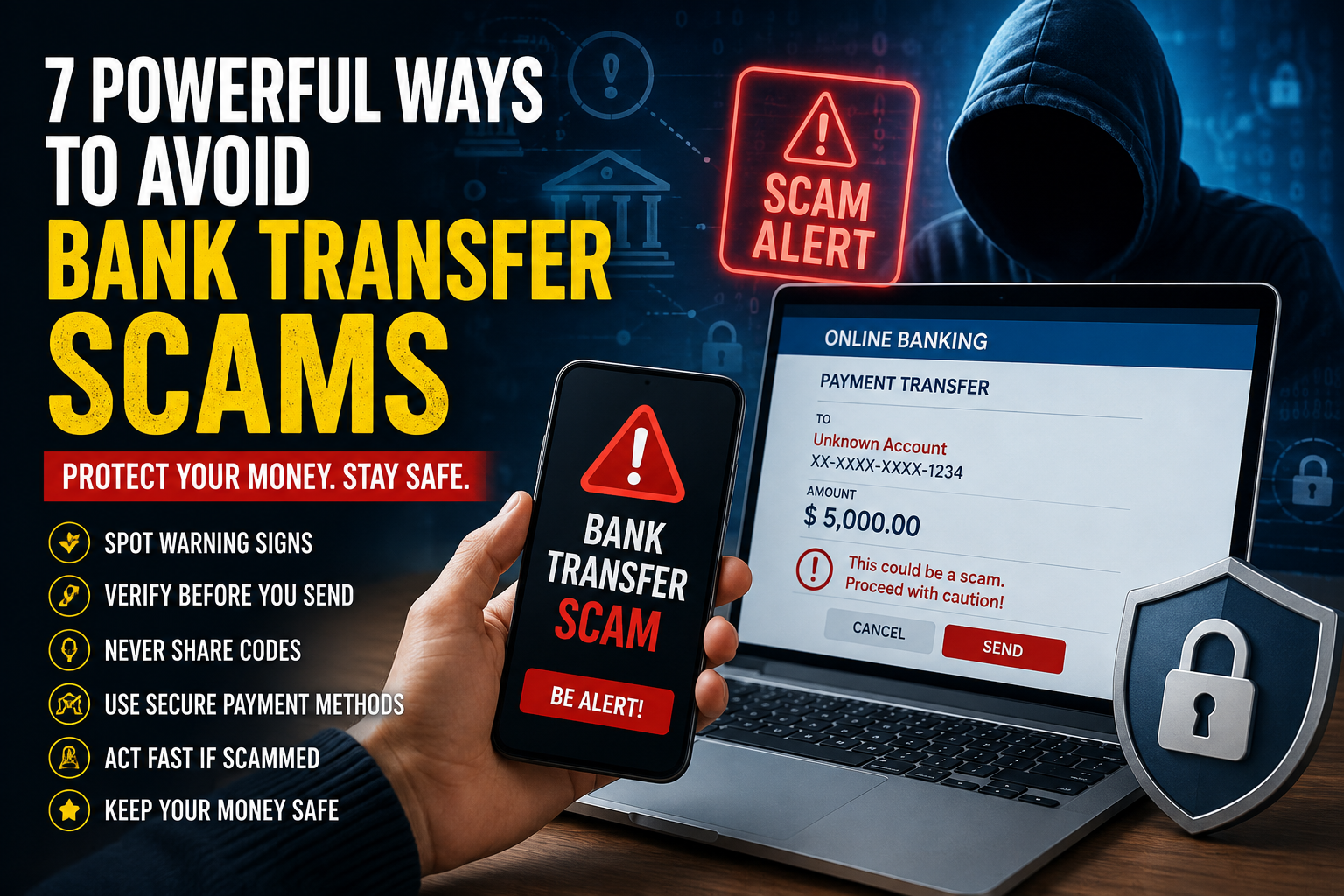
7 Powerful Ways to Avoid Bank Transfer Scams in 2026
Bank transfers have made moving money incredibly easy. You can pay a bill, send money to family, or complete a purchase in seconds.
Unfortunately, scammers love that speed too.
Bank transfer scams are especially dangerous because the victim often sends the money willingly after being manipulated. By the time something feels wrong, the transfer may already be difficult to recover.
And the problem is not small.
According to the Federal Trade Commission (FTC), consumers reported more than $4 billion in scam losses involving bank transfers and cryptocurrency last year.
That does not mean you should stop using digital payments. It means you need to know what a suspicious payment request looks like before pressing Send.
This guide explains how to avoid bank transfer scams, the warning signs you should never ignore, and what to do immediately if you have already sent money.
What Are Bank Transfer Scams?
Bank transfer scams happen when criminals manipulate someone into transferring money to an account controlled by the scammer.
The important word here is manipulate.
Your bank account does not always need to be hacked.
Instead, a scammer may convince you to authorize the payment.
For example, imagine receiving this message:
“We detected suspicious activity on your bank account. Transfer your balance to this secure account immediately to protect your money.”
It sounds frightening.
It may even appear to come from your bank.
But transferring the money could actually send your savings directly to a criminal.
Scammers frequently create urgency because they do not want you to stop, think, or verify the story.
Therefore, one simple rule can protect you from many financial scams:
Never let someone else’s urgency control your money.
Why Bank Transfer Scams Are So Dangerous
Credit card fraud and bank transfer fraud are not always the same.
With some credit card transactions, consumers may have dispute protections available.
However, when you personally authorize a bank transfer or send money through certain payment services, recovering it can become much more difficult.
This is exactly why scammers often prefer payment methods that move money quickly.
Moreover, modern scams can look surprisingly convincing.
A criminal might know:
- your name,
- your bank’s name,
- part of your personal information,
- where you work,
- or details collected from leaked data or social media.
None of those details prove the person contacting you is legitimate.
Scammers may also use fake invoices, receipts, or payment confirmations to make a fraudulent transfer look legitimate. If a financial document looks suspicious, read our guide on AI Fake Receipts Are Getting Real: 7 Ways to Spot One before trusting it.
1. Never Transfer Money to “Protect” Your Account
This is one of the biggest warning signs of bank transfer scams.
A caller might say:
“Someone is stealing money from your account.”
Then comes the solution:
“Move your money into our secure account.”
Stop.
Your bank should not need you to move your savings to a stranger’s account to keep them safe.
The FTC specifically warns consumers not to transfer money because someone claims doing so will “protect” it.
What should you do instead?
End the conversation.
Then independently contact your bank using its official app, the number printed on your card or statement, or a trusted official website.
Do not use the number or link supplied by the person who contacted you.
That small difference matters.
You are changing the situation from them contacting you to you contacting your real bank.
2. Treat Urgent Payment Requests as a Warning
Scammers hate one thing:
time.
The longer you think, the greater the chance you notice something is wrong.
That is why scam messages often include phrases such as:
- “Pay immediately.”
- “Your account will be suspended.”
- “You have 30 minutes.”
- “Do not tell anyone.”
- “Police will contact you.”
- “Your money is at risk.”
- “This is your final warning.”
Fear pushes people toward quick decisions.
A legitimate financial problem may still be urgent, but urgency should never replace verification.
Use the 10-minute rule
If an unexpected person asks you to transfer money, give yourself at least a few minutes before doing anything.
Do not click.
Do not transfer.
Do not provide a verification code.
Instead, independently verify the request.
Those few minutes could save thousands of dollars.
3. Verify the Person Using a Different Channel
Suppose your brother suddenly messages:
“Emergency. Send me $800 now.”
You recognize the profile picture.
You recognize the name.
Would you send the money?
Not yet.
Accounts can be compromised, and identities can be impersonated.
Call your brother using the phone number you already have.
If your boss requests an unusual company transfer by email, verify it through your normal workplace communication process.
If a bank calls you, end the call and contact the bank yourself.
This is called independent verification, and it is one of the simplest defenses against financial fraud.
A useful rule
Never verify a suspicious request using information provided inside the suspicious request itself.
If a suspicious text says:
“Call 555-1234 immediately.”
Do not call that number.
Find the organization’s legitimate contact information yourself.
4. Never Share Verification Codes
Imagine receiving a real one-time password from your bank.
Seconds later, someone claiming to work for the bank asks:
“What is the six-digit security code you just received?”
It might feel legitimate because the code really did come from your bank.
That is exactly what makes the trick dangerous.
The criminal may already be attempting to access your account and needs the code to complete the login or transaction.
Never give someone:
- one-time passwords,
- authentication codes,
- PIN numbers,
- online banking passwords,
- recovery codes,
- or card security information.
A verification code is designed to prove that you are you.
Handing it to another person can defeat that protection.
5. Be Suspicious When Someone Controls How You Must Pay
The story can change.
The payment method often gives the scam away.
According to the FTC, scammers frequently demand payment through methods that can make recovering money difficult, including bank transfers, wire transfers, cryptocurrency, payment apps, and gift cards.
For example:
“You won $20,000, but send a $500 transfer first.”
That is a major warning sign.
Or:
“You owe a government fine. Pay using cryptocurrency today.”
Again, stop.
A stranger insisting that there is only one specific way you can pay deserves immediate suspicion.
6. Double-Check Recipient Details Before Sending Money
Not every dangerous transfer begins with an obvious scam call.
Sometimes the problem appears during a legitimate payment.
Imagine paying a contractor $4,000.
You receive an email saying:
“We changed banks. Please send your payment to our new account.”
The email looks normal.
But what if the contractor’s email account was compromised?
You could send thousands of dollars to a criminal while believing you paid the real company.
Before making a large payment after receiving changed banking instructions:
Verify the change independently.
Call the business using a trusted number you already know.
Confirm the account information.
For important transfers, you can also consider sending a small test payment first when appropriate.
Moreover, carefully check the recipient name and account information before approving any transfer.
One minute of checking is cheaper than months of trying to recover stolen money.
7. Act Immediately If You Already Sent Money
Maybe you are reading this article because you already pressed Send.
Do not spend the next hour blaming yourself.
Use that hour.
Speed matters.
If you have already paid a scammer, follow the https://consumer.ftc.gov/articles/what-do-if-you-were-scammed?utm_source=chatgpt.com to understand what actions you can take based on your payment method.
Step 1: Contact your bank immediately
Tell the bank that the transfer was connected to suspected fraud.
Ask whether the payment can be stopped, recalled, frozen, or reversed.
There is no guarantee that recovery will be possible, but acting quickly gives you a better chance.
Step 2: Contact the payment service
If you used a money-transfer or payment app, report the fraudulent transaction directly through the service.
Ask whether the transaction can be reversed.
Step 3: Secure your accounts
If you shared login credentials:
- change your password,
- enable multi-factor authentication,
- review recent transactions,
- sign out of unknown devices,
- and check other accounts using the same password.
If you reused the compromised password elsewhere, change it there too.
Step 4: Save the evidence
Keep screenshots and records of:
- messages,
- phone numbers,
- email addresses,
- usernames,
- payment receipts,
- account details,
- dates,
- and transaction IDs.
Do not delete the conversation simply because it makes you uncomfortable.
It may be useful when reporting the fraud.
Step 5: Report the scam
In the United States, consumers can report scams to the Federal Trade Commission.
Your bank or payment provider may also have its own fraud-reporting procedure.
Common Bank Transfer Scam Warning Signs
Most scams do not arrive with a label saying SCAM.
They create a believable story.
However, several patterns appear repeatedly.
| Situation | Warning Sign | Safer Response |
|---|---|---|
| Bank calls about fraud | Tells you to move money | End call and contact bank yourself |
| Family member needs money | Sudden emergency request | Call them directly |
| Business changes bank details | Unexpected account change | Verify through a known contact |
| Government demands payment | Requires transfer/crypto/gift card | Verify through official channels |
| Caller asks for OTP | Wants security code | Never share it |
| Investment opportunity | Guaranteed fast profit | Research before sending money |
| Prize notification | Pay before receiving prize | Do not pay |
The pattern is usually simple:
Pressure + unusual payment request + lack of independent verification = danger.
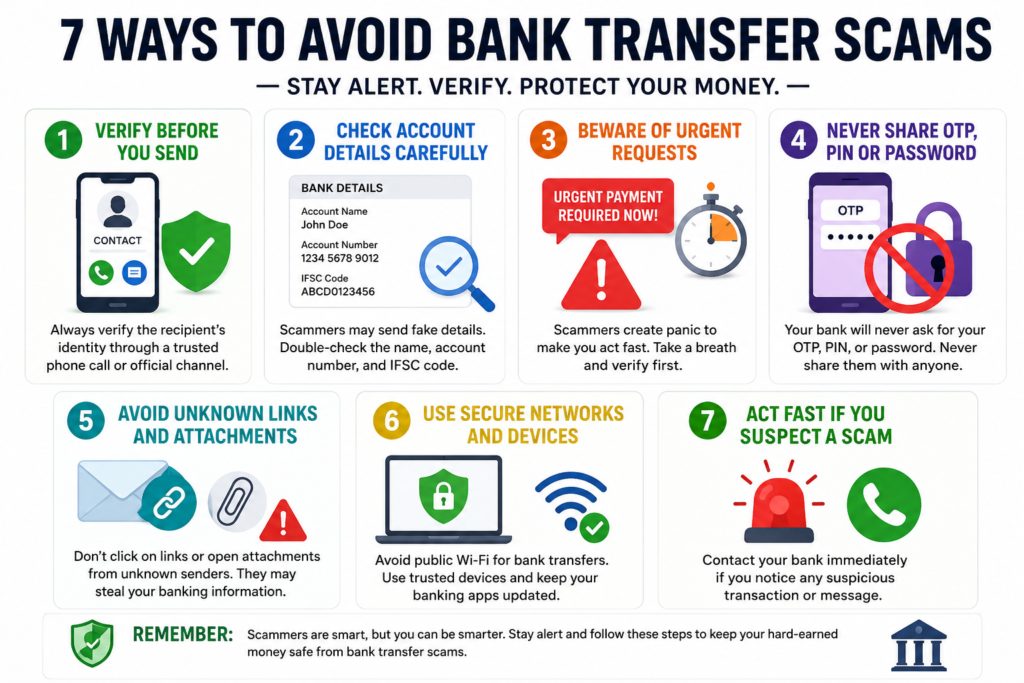
Bank Transfer Scam vs Legitimate Bank Contact
A scammer wants you emotionally involved.
Your real bank wants to verify what actually happened.
A suspicious caller might say:
“Transfer your money now or you will lose everything.”
A safer response is:
“I will contact my bank directly.”
Then end the call.
You do not need to argue with the caller.
You do not need to prove they are a scammer.
You simply need to prevent them from controlling your next financial decision.
How to Avoid Bank Transfer Scams Before They Happen
Fraud prevention should begin before the suspicious message arrives.
Use a strong, unique password for your banking account.
Enable multi-factor authentication whenever available.
Turn on transaction alerts.
Keep your phone and banking apps updated.
Avoid sharing financial information publicly.
Moreover, review your bank transactions regularly.
If something unusual happens, you want to notice it quickly rather than discovering it weeks later.
A 30-Second Safety Check Before Sending Money
Before sending an unexpected or unusually large transfer, ask yourself:
Do I personally know the recipient?
Was I expecting this request?
Have I verified the person independently?
Is someone pressuring me to act immediately?
Did the payment instructions suddenly change?
Is someone asking for my verification code?
Would I still send this money if I waited 10 minutes?
If something feels wrong, stop the transaction and investigate.
There is rarely a downside to verifying.
There can be an enormous downside to sending first and checking later.
Why Smart People Still Fall for Bank Transfer Scams
There is an uncomfortable misconception about scams:
“Only careless people get scammed.”
That is simply not a useful way to think about fraud.
Scammers do not need you to be unintelligent.
They need you to be distracted, frightened, excited, rushed, or emotionally invested for a few minutes.
Consider receiving a call while you are at work:
“Your bank account has been compromised. Someone is transferring $8,000 right now.”
Your first thought probably will not be about cybersecurity.
It will be:
My money.
That emotional reaction is what the scammer wants.
Therefore, good fraud protection is not about becoming suspicious of everything.
It is about creating habits that continue working when your emotions are high.
Stop. Verify. Then pay.
Frequently Asked Questions About Bank Transfer Scams
Can a bank transfer scam be reversed?
Sometimes, but recovery is not guaranteed.
Contact your bank or payment provider immediately, explain that the transfer is connected to fraud, and ask whether the transaction can be stopped or reversed.
The sooner you report it, the better.
Will a bank ask me to transfer money to protect my account?
Treat such a request as a major scam warning sign.
If someone contacts you and says you must move your money to keep it safe, end the conversation and contact your financial institution independently.
What information should I never give a caller?
Never provide passwords, PINs, authentication codes, or one-time verification codes to an unexpected caller.
Are payment apps safe?
Payment apps can be useful and legitimate.
The risk often comes from sending money to the wrong person or being manipulated into authorizing a payment.
Double-check the recipient before confirming a transaction.
What is the biggest warning sign of a bank transfer scam?
Unexpected urgency is one of the strongest warning signs.
Be especially careful when urgency is combined with instructions to transfer money, keep the transaction secret, or provide authentication information.
Final Thoughts
Technology has made moving money faster than ever.
Unfortunately, it has also given scammers opportunities to move stolen money quickly.
The best defense against bank transfer scams is not complicated cybersecurity knowledge.
It is a repeatable habit:
Stop. Verify. Send.
If someone unexpectedly asks you to move money, slow down.
If a bank supposedly calls you, contact the bank independently.
If payment instructions suddenly change, verify them.
If someone asks for your verification code, never provide it.
And if you already sent money, contact your bank immediately rather than waiting to see what happens.
A bank transfer may take seconds.
Your decision deserves longer than that.