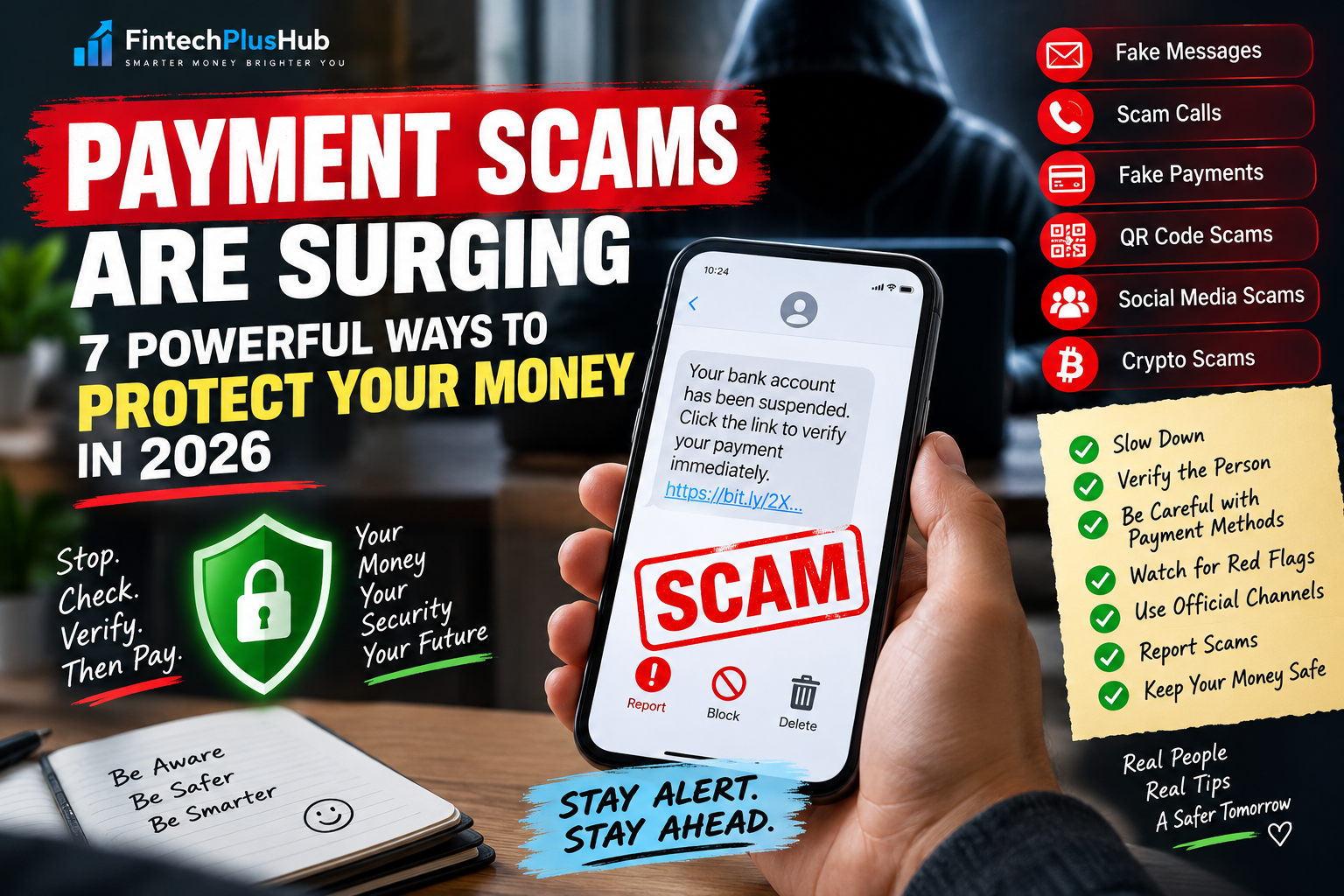
Payment Scams Are Surging: 7 Powerful Ways to Protect Your Money in 2026
Payment scams can happen faster than most people expect.
You get a text saying there is a problem with your bank account. A seller asks you to pay through a payment app. Someone claiming to be from your bank tells you to move your money to a “safe account.” Or you scan a QR code that looks completely normal.
You may have only a few seconds to decide whether to trust it.
That is exactly what scammers want.
Payment scams often work by creating fear, excitement, or urgency. The scammer wants you to act before you have time to check whether the story is real.
And the amount of money being lost is huge. According to the Federal Trade Commission (FTC), consumers reported losing about $16 billion to fraud in 2025, the highest amount on record. Imposter scams alone caused about $3.5 billion in reported losses.
The good news is that many payment scams leave warning signs.
This guide explains seven simple ways to spot those signs, protect your money, and act quickly if you have already sent a payment.
What Are Payment Scams?
Payment scams happen when someone tricks you into sending money, paying a fake bill, buying something that does not exist, or moving money to an account controlled by a scammer.
The scammer might contact you through:
- Text messages
- Phone calls
- Social media
- Fake websites
- QR codes
- Online marketplaces
- Payment apps
The story can change, but the goal is usually the same: get you to send money before you realize something is wrong.
A scammer might say:
“Your bank account has been hacked.”
“You have an unpaid bill.”
“Send this payment now or your account will be closed.”
“Move your money to this safe account.”
“You won a prize, but you need to pay a fee first.”
The FTC warns that scammers often prefer payment methods that can make it difficult for victims to recover their money, including bank transfers, wire transfers, cryptocurrency, payment apps, and gift cards.
So how can you protect yourself?
1. Stop Payment Scams by Slowing Down
One of the most powerful protections against payment scams costs absolutely nothing:
Wait.
Scammers hate waiting.
They may tell you that your bank account will be frozen in 10 minutes. They might say the police are coming. They could claim that an amazing investment opportunity disappears today.
The pressure is intentional.
Imagine receiving this text:
“Suspicious activity detected. Your account will be suspended unless you verify immediately.”
Your first reaction may be to click the link.
Instead, stop.
Do not click the link. Do not call the number in the message. Do not send money.
Open your bank’s official app yourself or type the bank’s website address directly into your browser. You can also call the number printed on your bank card.
Simple rule:
Urgent message + unexpected payment request = stop and verify.
Taking five minutes to check could save you hundreds or thousands of dollars.
2. Never Move Money to a “Safe Account”
This is one of the most dangerous payment scams because the scammer may pretend to be protecting you.
You receive a call.
The person says:
“Someone is trying to steal money from your account.”
Then comes the supposed solution:
“Transfer your money to this secure account while we investigate.”
That should be a huge warning sign.
The FTC says some of the costliest impersonation scams begin with fake bank security alerts. Victims are then convinced to move their own money supposedly to protect it.
But the “safe account” belongs to the scammer.
What should you do?
Hang up.
Open your bank’s official app or contact the bank using a trusted number.
Ask:
“Is there actually suspicious activity on my account?”
Never use the phone number or link provided by the person who contacted you.
Your money does not become safer simply because a stranger tells you to move it somewhere else.
As payments become smarter and more automated, it is also important to understand the risks of AI agent payments before allowing technology to move money for you
3. Watch the Payment Method — It Can Expose Payment Scams
Sometimes you can identify payment scams simply by looking at how someone wants you to pay.
Be extremely careful if someone unexpectedly insists that you pay using:
- Cryptocurrency
- Gift cards
- Wire transfers
- Bank transfers
- Payment apps
- Cash
The FTC specifically warns consumers about scammers who demand particular payment methods.
Why?
Because some payments can be difficult to reverse once the money has been sent.
Imagine someone claiming to be from a government agency saying:
“You owe $800. Buy gift cards and send us the numbers.”
That is not a normal government payment process.
Or someone claiming to be your bank says:
“Send $2,000 through a payment app so we can secure your account.”
Again, stop.
The FTC warns that scammers often push people to pay through bank transfers, wire transfers, cryptocurrency, payment apps, or gift cards because getting the money back can be difficult. https://consumer.ftc.gov/consumer-alerts/2026/07/way-spot-scams-how-someone-asks-you-pay?utm_source=chatgpt.com
Safer approach
When possible, the FTC recommends considering a credit card, because credit cards generally provide stronger dispute protections than many scammer-preferred payment methods.
The payment method itself can be one of the biggest clues that something is wrong.
4. Verify the Person Before Sending Money
Modern payment scams can look surprisingly real.
A scammer can copy a company’s logo.
They can create a fake website.
They can pretend to use a familiar phone number.
They can even pretend to be someone you know.
So seeing a familiar name on your phone is no longer enough.
Suppose someone contacts you claiming to be from your bank.
Do not ask them:
“Are you really from my bank?”
Of course they will say yes.
Instead, verify them independently.
Use the 3-step verification rule:
Step 1: Stop communicating with the person.
Step 2: Find the official company contact information yourself.
Step 3: Contact the company separately and ask whether the request is real.
This small habit can stop many payment scams before money leaves your account.
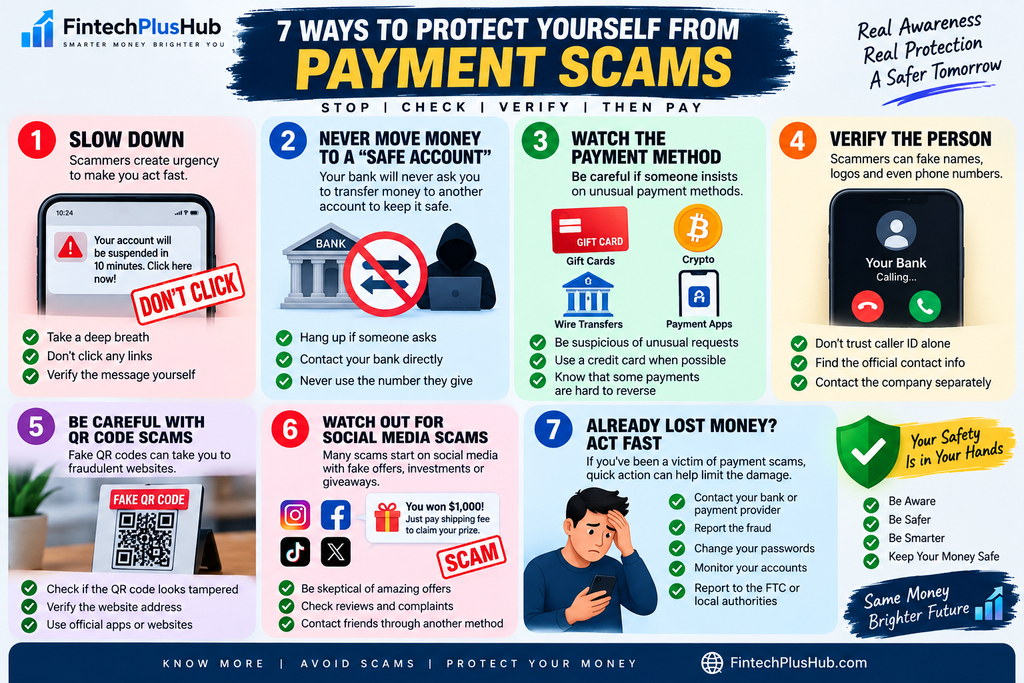
5. Be Careful With QR Code Payment Scams
QR codes are convenient.
Scan. Tap. Pay.
Unfortunately, scammers know that too.
In September 2026, the FTC warned about reports of scammers placing fake QR codes over legitimate QR codes on parking meters. Scanning the fake code could lead people to fraudulent websites designed to steal money or personal information.
And this problem is not limited to parking.
Be careful with QR codes found on:
- Parking meters
- Flyers
- Unexpected packages
- Emails
- Text messages
- Restaurant or public-area stickers
- Unexpected payment requests
Before paying through a QR code:
Look carefully at the physical code.
Does it look like a sticker has been placed over another QR code?
After scanning, check the website address before entering payment details.
If you are unsure, find the company’s official website or app yourself instead of using the QR code.
A QR code should be treated like a link: do not trust it simply because it looks convenient.
6. Protect Yourself From Social Media Payment Scams
Social media has become another major place where scams begin.
FTC data show that nearly 30% of consumers who reported losing money to scams in 2025 said the scam started on social media, with reported losses totaling about $2.1 billion.
You might see:
“Invest $500 and turn it into $5,000.”
“Limited-time crypto opportunity.”
“Congratulations! You won our giveaway.”
“Pay shipping and receive your free product.”
Or you might receive a message from what appears to be a friend’s account asking for emergency money.
Do not assume a profile is real just because it has photos, followers, or old posts.
Accounts can be hacked. Fake profiles can copy real people. Scammers can also buy advertisements.
Before sending money:
Search the person’s or company’s name with words such as:
- scam
- complaint
- review
- fraud
If a friend suddenly asks for money, contact that friend through another method.
Call them.
Do not rely only on the account sending the message.
That one phone call could stop a payment scam.
7. Already Lost Money to a Payment Scam? Act Fast
This may be the most important part of this guide.
Maybe you are reading this article because you already sent money.
Do not spend hours blaming yourself or wondering what to do.
Act immediately.
The faster you respond to payment scams, the better your chance of limiting additional damage.
If you paid through a bank transfer
Contact your bank immediately.
Tell them the transfer was connected to fraud and ask whether the transaction can be stopped or reversed.
If you paid through a payment app
Report the transaction to the payment app provider immediately and ask whether the payment can be reversed.
If your payment app was connected to a debit or credit card, contact your bank or card issuer too.
If you paid with a credit or debit card
Contact the company that issued the card.
Report the fraudulent charge and ask about disputing or reversing it.
If you paid with cryptocurrency
Contact the company or exchange you used to send the cryptocurrency and report the fraudulent transaction.
Crypto transactions can be difficult or impossible to reverse, but reporting the fraud quickly is still important.
If you shared your password
Change it immediately.
If you used that password on other websites, change it there too.
Turn on two-factor authentication where available.
If you shared personal information
Take steps to protect yourself against identity theft and monitor your financial accounts carefully.
In the United States, you can also report fraud to the FTC and use IdentityTheft.gov if your identity information has been exposed.
If you already paid a scammer, contact your bank or payment provider immediately and ask whether the transaction can be stopped or reversed. You can also follow the https://consumer.ftc.gov/articles/what-do-if-you-were-scammed?utm_source=chatgpt.com
The Powerful 10-Second Payment Scam Test
Before sending money to anyone unexpectedly, ask yourself five questions:
Did they contact me unexpectedly?
Are they creating fear or urgency?
Are they asking me to send or move money?
Are they telling me exactly how I must pay?
Can I verify this request independently?
If several warning signs appear together, do not pay yet.
Ten seconds of thinking can be much cheaper than months of trying to recover stolen money.
Common Payment Scams to Watch in 2026
While the exact story changes, many payment scams follow familiar patterns.
Bank impersonation scams
Someone pretends to be your bank and claims your money is at risk.
Fake bill payment scams
You search online to pay a bill but land on a fake or misleading payment website.
QR code scams
A fake QR code sends you to a fraudulent payment page.
Marketplace scams
A fake buyer or seller convinces you to send money outside the normal marketplace payment system.
Investment scams
Someone promises unusually high or guaranteed returns and asks you to transfer money or cryptocurrency.
Government impersonation scams
Someone pretends to represent a government agency and demands immediate payment.
Family emergency scams
A scammer claims that someone you love is in trouble and needs money immediately.
The details are different, but notice the pattern:
Trust + urgency + payment request.
Recognizing that pattern is one of the easiest ways to protect yourself.
How to Protect Your Money From Payment Scams Every Day
You do not need to become a cybersecurity expert.
Build a few simple habits.
Turn on transaction alerts for your bank and credit cards.
Use two-factor authentication on financial accounts.
Never share one-time verification codes.
Do not click payment links in unexpected messages.
Use official banking and payment apps.
Check website addresses before entering card information.
Avoid sending money to strangers through irreversible payment methods.
And most importantly, verify before you pay.
Technology will continue changing. Scammers will change their stories too.
Your basic defense does not have to change:
Stop. Check. Verify. Then pay.
Final Thoughts: Payment Scams Work Fast — You Don’t Have To
The strongest weapon used in many payment scams is not advanced technology.
It is pressure.
Scammers want you scared enough, excited enough, or worried enough to make a quick decision.
You do not have to play by their rules.
If someone unexpectedly asks you to send money, move money, buy gift cards, use cryptocurrency, or pay through an unfamiliar link, give yourself permission to stop.
Check the request independently.
Contact your bank or company through an official channel.
Ask someone you trust if something feels wrong.
A real company can usually wait a few minutes while you verify a payment.
A scammer does not want you to have those few minutes.
And sometimes, those few minutes are all you need to protect your money.