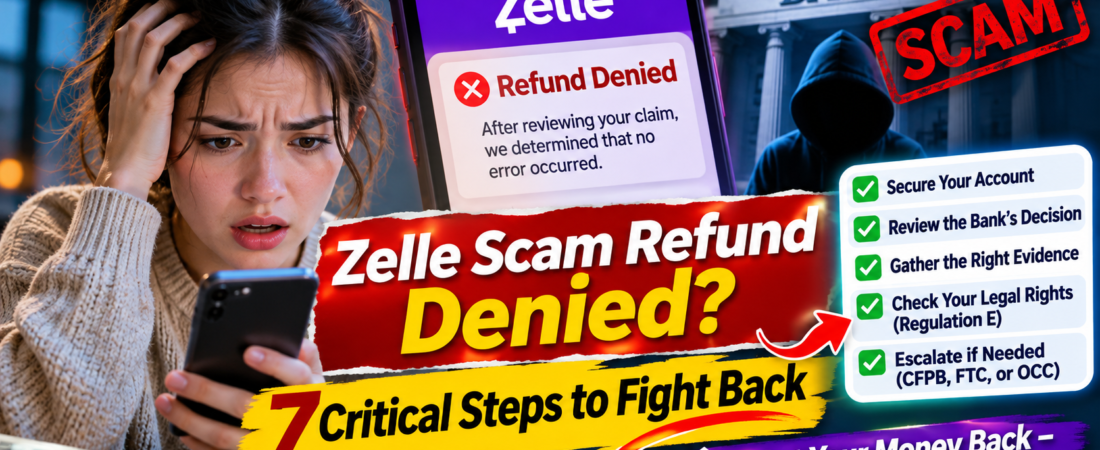
Zelle Scam Refund Denied? 7 Critical Steps to Fight Back
The money disappeared in seconds.
Getting it back could take weeks.
And then came the message you were hoping you would never see:
“After reviewing your claim, we determined that no error occurred.”
Your bank has denied your refund.
Now you’re staring at a transaction you never wanted to make, wondering how a scammer can walk away with your money while you’re left fighting to recover it.
If your Zelle scam refund was denied, don’t assume the bank’s first decision is necessarily the end of the story.
But don’t assume every scam qualifies for a refund, either.
A critical difference exists between someone stealing money from your account and someone deceiving you into sending it yourself.
That distinction can determine whether federal consumer protection laws apply, whether Zelle’s reimbursement policies may help, and what evidence matters when you challenge a denial.
Here’s what you need to know immediately:
If someone accessed your account and transferred money without your authorization, federal law may provide important protections.
If you personally sent money after being deceived, reimbursement can be harder. However, certain qualifying impostor scams may still be covered under Zelle’s reimbursement policies.
And if your bank has already rejected your claim, you may be able to request the investigation records, challenge factual mistakes, and escalate the complaint.
This guide explains exactly how.
Why a Zelle Scam Refund Can Be Denied
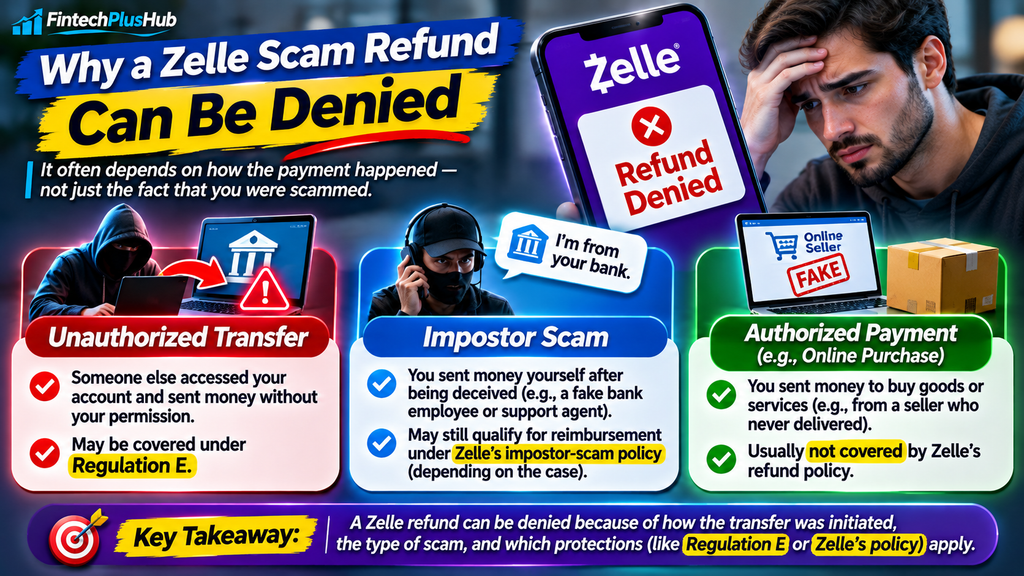
Imagine two people losing $2,000 through Zelle.
Both were scammed.
Both reported the transactions to their banks.
But their legal positions could differ greatly.
Person A: A criminal obtains stolen login credentials, accesses the person’s bank account, and transfers $2,000 without permission.
Person B: A criminal pretends to be a bank employee and convinces the person to personally transfer $2,000 into a supposedly secure account.
In both situations, the money ends up with a criminal.
But the transactions were initiated differently.
In the first case, someone other than the account holder initiated the transfer without authorization.
That can qualify as an unauthorized electronic fund transfer under Regulation E.
In the second case, the consumer initiated the transfer after being deceived.
That generally creates a more complicated reimbursement situation.
The important question isn’t simply whether a scam happened. It’s what happened during the payment.
The Consumer Financial Protection Bureau (CFPB) explains that transfers initiated by criminals using account credentials obtained through fraud can qualify as unauthorized transfers.
Meanwhile, Zelle acknowledges that certain qualifying impostor scams may be reimbursable even when the customer authorized the payment.
That difference is where your recovery strategy should begin.
Payment authorization risks aren’t limited to Zelle. As AI-powered transactions become more common, understanding the risks of AI agent payments can help consumers recognize how unauthorized or unintended payments may occur.
Zelle Scam Refund: Which Transactions May Qualify?
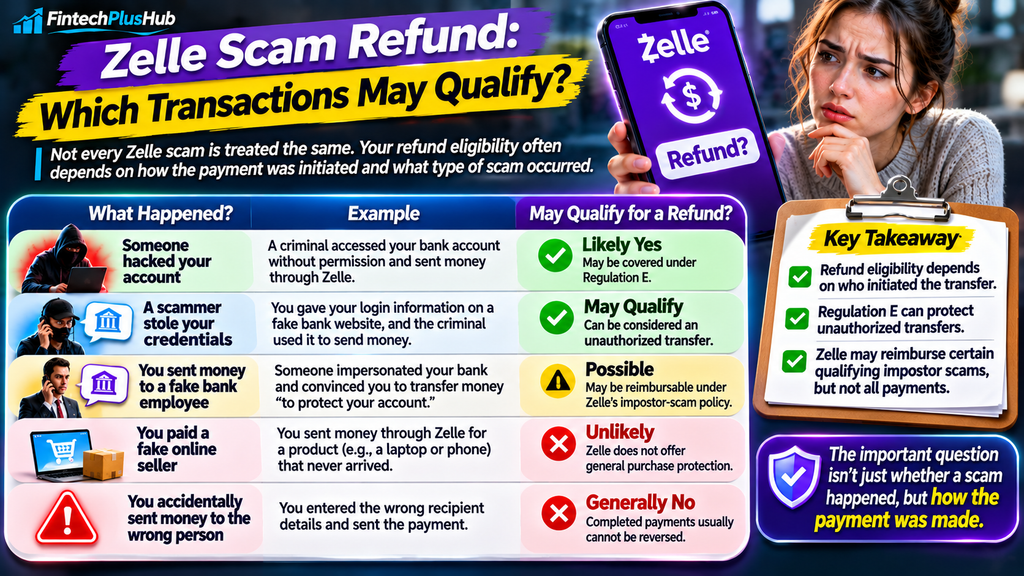
Before challenging your bank, identify which situation best describes your experience.
| What happened? | Potential protection | Important limitation |
|---|---|---|
| Someone hacked your account and sent money | Regulation E protections may apply | Facts and reporting requirements matter |
| A scammer stole your credentials and initiated a transfer | May qualify as an unauthorized transfer | The bank must evaluate the circumstances |
| You sent money to a fake bank employee | Certain impostor scams may qualify for reimbursement | Eligibility is not automatic |
| You paid a fake online seller | Recovery may be possible | Zelle does not provide general purchase protection |
| You accidentally sent money to the wrong person | Bank-assisted recovery may be possible | Completed payments usually cannot simply be canceled |
According to the CFPB’s electronic fund transfer guidance, certain unauthorized Zelle transfers may qualify for federal consumer protections.
Notice something important?
Being scammed does not automatically mean a transaction was unauthorized under federal law.
And being denied does not automatically mean the bank correctly evaluated the claim.
Those are two separate questions.
The next seven steps will help you address both.
7 Critical Steps After Your Zelle Scam Refund Is Denied

Step 1: Secure Your Bank Account Before Doing Anything Else
Your first instinct might be to call the bank and demand your money back.
That reaction is understandable.
But if someone gained access to your account, your remaining money could still be at risk.
Before spending hours fighting over the missing funds, make sure the criminal cannot take more.
Take these actions immediately if your account or credentials may be compromised:
- Contact your bank using its official app, website, or the number on your bank card.
- Tell the fraud department that your account may have been compromised.
- Change your online banking password from a trusted device.
- Review unfamiliar devices, login sessions, and payment recipients.
- Ask whether your bank should disable or restrict transfers temporarily.
- Review recent transactions for additional unauthorized activity.
- Change passwords on other accounts if you reused the compromised password.
- Secure your email account and enable multifactor authentication.
Do not rely on a phone number supplied in a suspicious text message.
A scammer might impersonate your bank’s fraud department and claim they need to help you recover the stolen money.
That second interaction could expose you to another scam.
Fake bank notifications can look surprisingly convincing. Learning how to identify fake bank alerts can help you avoid phishing links, stolen credentials, and fraudulent payment requests.
The FBI has specifically warned about criminals impersonating financial institution support staff to take over accounts and steal money.
What if the Zelle payment is still pending?
Check whether your bank’s payment activity screen offers a cancellation option.
Some payments to recipients who have not enrolled may still be cancelable.
However, completed Zelle payments to enrolled recipients generally cannot be canceled through the normal payment interface.
Contact your bank immediately to ask whether any recovery action is available.
Step 2: Determine Whether Your Zelle Scam Refund Involves an Unauthorized Transfer
This is one of the most important parts of your entire claim.
Ask yourself:
Who actually initiated the transfer?
Not who benefited from it.
Not who suggested it.
Who initiated it?
Consider these examples.
Example A: Someone else sent the money.
You receive a fake fraud alert.
You click a malicious link and enter your banking information.
Later, someone uses those credentials to access your account and send money through Zelle.
You did not initiate the payment.
This could qualify as an unauthorized electronic fund transfer.
The CFPB explicitly recognizes circumstances where criminals fraudulently obtain account information and use it to initiate transfers.
Example B: You personally sent the money.
Someone calls, claiming to work for your bank.
They say your account is under attack.
To protect your savings, they instruct you to open your banking app and transfer money to another account.
You complete the transfer yourself.
This is typically classified differently from an unauthorized account takeover.
However, certain qualifying impostor scams can be eligible for reimbursement under Zelle’s policies.
Example C: You paid someone for goods that never arrived.
You find a discounted laptop online.
The seller requests payment through Zelle.
You send $750.
The seller disappears.
This is an authorized payment involving an apparent purchase scam.
Zelle does not offer general purchase protection, so getting the money back may be difficult.
The Federal Trade Commission nevertheless recommends reporting the payment immediately and asking your financial institution whether it can reverse the transaction or recover your money.
Why this matters: Your claim should accurately describe what occurred. Never describe a payment you personally authorized as unauthorized simply because the recipient turned out to be a scammer.
Misrepresenting the circumstances can undermine your credibility.
Accuracy gives you the strongest foundation for challenging an incorrect decision.
Step 3: Contact Your Bank Again and Request a Formal Review
Your refund denial might have arrived by email, letter, or a notification inside your banking app.
Do not delete it.
Read the explanation carefully.
Look for phrases such as:
- Transaction authorized
- No error found
- Claim not eligible
- Insufficient evidence
- Payment completed successfully
- Claim closed
These phrases may sound final.
But the reason behind them matters.
For example, a bank might determine that the transfer was authorized because your normal banking credentials were used.
That fact alone does not necessarily settle whether someone else fraudulently obtained those credentials and initiated the payment.
For transactions covered by Regulation E, the bank must conduct a reasonable investigation based on the relevant facts.
What should you say when calling?
Use this example and adapt it to your actual circumstances:
“I’m calling about my denied Zelle fraud claim. I’d like to understand why the transaction was classified as authorized. I also want to request the investigation findings and ask whether my claim can be reconsidered based on the circumstances and supporting evidence.”
If someone else initiated the payment without your permission, explain that specifically.
If you personally sent the payment because someone impersonated your bank, explain that instead.
Ask the bank:
“Was my claim evaluated for unauthorized-transfer protections, an applicable Zelle impostor-scam reimbursement policy, or both?”
If the employee cannot answer, request a supervisor or a representative who handles fraud disputes.
A reconsideration request is not a guarantee that the bank will reopen a fully investigated claim.
However, correcting factual errors and providing relevant new information can make a meaningful difference.
Step 4: Build a Zelle Scam Refund Evidence File
A vague complaint is difficult to evaluate.
A detailed, organized timeline gives the bank specific facts to investigate.

You don’t need to write a ten-page report.
You need to show what happened, when it happened, and which evidence supports your account.
Start with the payment details.
Record:
- The date and approximate time of the transaction.
- The exact amount transferred.
- The recipient information visible in your banking records.
- The payment confirmation or transaction reference.
- The date you discovered the scam.
- The date you first contacted your bank.
- The bank’s claim number and denial date.
Then document how the scam occurred.
Did someone call you?
Did you receive a suspicious text?
Did someone pretend to be your bank?
Did you enter credentials on a fraudulent website?
Did the criminal direct you to transfer money?
Be specific.
Instead of writing:
“I got scammed and lost $2,000.”
Write something like:
“On October 12, I received a text claiming to be from my bank’s fraud department. I clicked the link and entered my login credentials. Later that evening, a $2,000 Zelle transfer appeared in my account. I did not initiate or authorize that transfer.”
That example is hypothetical, but it demonstrates how a factual timeline helps distinguish account takeover from an authorized payment.
A Simple Evidence Timeline
| Time | Event | Supporting evidence |
|---|---|---|
| 9:15 AM | Suspicious bank alert received | Screenshot of text |
| 9:22 AM | Fraudulent website visited | Browser history or saved URL |
| 10:08 AM | Unexpected Zelle transfer appeared | Bank transaction record |
| 10:20 AM | Bank fraud department contacted | Call log and claim number |
| Three days later | Additional evidence submitted | Secure message confirmation |
| Later | Refund claim denied | Bank denial letter |
This format can help a reviewer follow the sequence without searching through dozens of disconnected screenshots.
Important privacy warning: Submit sensitive evidence only through your bank’s verified secure channels. Do not publicly post complete account numbers, passwords, authentication codes, or unredacted financial statements.
Step 5: Request the Bank’s Investigation Records
Here’s something many consumers may not realize:
For a dispute covered by Regulation E, a bank that determines no error occurred must provide a written explanation of its findings.
Consumers also have the right to request copies of the documents the institution relied on when making that determination.
That requirement appears in 12 CFR § 1005.11(d).
This matters because the bank’s conclusion might not answer the question you actually raised.
For example, suppose the denial says:
“The payment was completed using valid account credentials.”
But your claim says:
“A criminal obtained my credentials through a fraudulent website and initiated the payment.”
Those statements do not necessarily contradict one another.
A criminal may use valid credentials without having actual authority to transfer money.
If the bank did not adequately address the possibility of unauthorized access, ask for clarification.
Questions Worth Asking
“What evidence established that I initiated this transfer?”
“Did the investigation examine my report that my credentials were compromised?”
“Was the transaction evaluated as an unauthorized electronic fund transfer?”
“May I receive the documents relied upon in denying my dispute?”
“Can I provide additional evidence showing that another person initiated the payment?”
Regulation E requires financial institutions to follow specific error-resolution procedures for covered transactions. It does not guarantee that every disputed transfer will be refunded.
Still, understanding the bank’s reasoning can help you decide whether further action is justified.
Under Regulation E Section 1005.11, financial institutions must follow specific investigation and documentation requirements for covered disputes.
Step 6: Check Regulation E and Zelle’s Impostor-Scam Policy
This step is especially important if your initial refund request was rejected.
There are two distinct types of potential protection.
Protection A: Regulation E for Unauthorized Transfers
Regulation E is a federal consumer protection regulation implementing the Electronic Fund Transfer Act.
For covered unauthorized electronic fund transfers, it establishes consumer liability limitations and error-resolution requirements.
The CFPB specifically states that transfers initiated by criminals using account access information obtained through fraud may qualify as unauthorized transfers.
It also explains that a consumer’s negligence, by itself, cannot increase liability beyond what Regulation E permits.
That means a person who was tricked into disclosing credentials does not automatically lose all unauthorized-transfer protections.
But there is an important limitation:
The fraudster must have initiated the transfer without actual authority for it to fit the relevant unauthorized-transfer definition.
If you personally initiated the payment after being deceived, do not automatically assume Regulation E guarantees reimbursement.
Those circumstances need separate evaluation.
Protection B: Qualifying Impostor Scams Under Zelle’s Policies
Zelle publicly states that participating financial institutions are required to reimburse certain qualifying impostor scams, including some cases in which the customer authorized the transaction.
That is particularly relevant when a criminal impersonates a trusted person or organization.
However, the policy does not mean every impersonation scam qualifies.
Eligibility depends on the applicable requirements and circumstances.
If a person pretending to be your bank convinced you to send money, ask:
“Was my claim reviewed under Zelle’s qualifying impostor-scam reimbursement policy?”
Request the specific reason if the bank determined that your situation was not eligible.
Do not assume the answer is yes. Do not assume the answer is no. Ask the bank to explain the applicable policy.
You can verify Zelle’s public position in its official fraud-reporting guidance and data center.
Step 7: Escalate Your Zelle Scam Refund Complaint
You’ve contacted the bank.
You’ve provided evidence.
You’ve asked for an explanation.
And the bank still refuses to refund the money.
What now?
If you believe the bank misunderstood the facts, failed to investigate a covered error properly, or incorrectly applied an applicable reimbursement policy, consider escalating your complaint.
Option 1: Submit a CFPB Complaint
The Consumer Financial Protection Bureau accepts complaints involving money transfers and bank accounts.
Its complaint system allows consumers to explain the issue and upload supporting documents.
When submitting a complaint:
- Identify the bank or financial institution.
- Explain what happened in chronological order.
- State whether the disputed transfer was initiated by someone else or by you.
- Include the amount, relevant dates, and claim number.
- Explain why you believe the denial was incorrect.
- Attach the denial and relevant evidence.
- Clearly state the resolution you are requesting.
The CFPB says most companies respond to complaints within 15 days, although some require additional time.
Submitting a complaint does not guarantee reimbursement.
But it creates a formal record and requires the company to address the complaint through the CFPB process.
Option 2: Contact the Bank’s Federal Regulator
If your bank is nationally chartered, the Office of the Comptroller of the Currency (OCC) may be an appropriate regulator.
For other banks and credit unions, the relevant authority may be the FDIC, Federal Reserve, NCUA, or a state regulator.
You can ask the bank which agency supervises it.
The OCC provides a consumer complaint process for institutions within its jurisdiction.
Option 3: Report the Scam to the FTC
Report the incident to the Federal Trade Commission through its official fraud-reporting system.
An FTC report does not automatically recover your money.
However, reporting helps authorities identify fraud patterns and investigate deceptive activity.
Option 4: Report Online Fraud to the FBI
You can also report internet-related financial crime through the FBI’s Internet Crime Complaint Center.
Provide accurate transaction information and preserve relevant evidence.
Avoid sending duplicate or inconsistent descriptions of the same event.
One more warning: Do not pay a stranger who promises to recover your Zelle money in exchange for an upfront fee.
Someone who knows you’ve already lost money may try to exploit your situation again.
How Long Does a Zelle Scam Refund Investigation Take?
This is where understanding the rules can help you set realistic expectations.
For an error covered by Regulation E, financial institutions generally must investigate within 10 business days after receiving a qualifying notice of error.
If the institution needs additional time, it may generally extend the investigation to 45 calendar days, provided it meets applicable requirements, including provisional credit rules.
Some transactions qualify for longer investigation periods of up to 90 days.
Special provisions also apply to certain new accounts.
These timelines do not mean every authorized scam payment must be refunded within 10 days.
They concern the regulation’s error-resolution process.
Don’t Ignore the 60-Day Reporting Rule
For a covered Regulation E error, a consumer generally must report the issue within 60 days after the institution sends the statement first showing the error.
Different liability rules may apply depending on when unauthorized activity is discovered and reported.
Waiting can make a difficult situation worse.
Report suspicious transfers immediately, even if you are unsure whether your case qualifies.
The CFPB provides a detailed explanation of these time limits in its official Regulation E guidance.
What to Say When Your Zelle Scam Refund Was Denied
Sometimes the hardest part is knowing how to explain the situation without getting emotional or leaving out important details.
A written request can help.
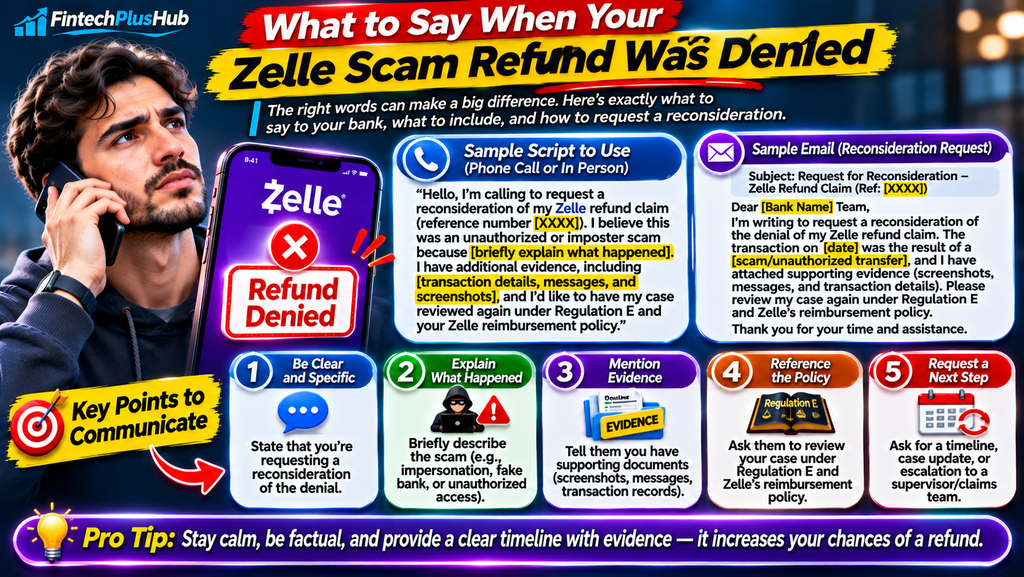
Here is an example you can adapt.
Sample Zelle Refund Reconsideration Request
Subject: Request for Review of Denied Zelle Fraud Claim
Dear Fraud Investigation Team,
I am requesting a review of the decision to deny my Zelle fraud claim.
The disputed transaction occurred on [date] for [amount], and my claim reference is [claim number].
I believe the original decision should be reconsidered because [briefly explain the specific factual issue].
The transaction occurred under the following circumstances:
[Explain who initiated the transfer, how the scam occurred, and when you reported it.]
I am submitting relevant supporting evidence, including transaction details and communications associated with the incident.
If this dispute is covered by Regulation E, I request a written explanation of the bank’s findings and copies of the documents relied upon in reaching its determination.
I would also appreciate confirmation of whether any applicable Zelle impostor-scam reimbursement policy was considered.
Please advise whether my claim can be reconsidered and whether additional documentation is required.
Thank you for reviewing my request.
Sincerely,
[Your Name]
Important: Only include statements that accurately reflect your experience. Do not claim unauthorized activity if you personally initiated the transfer.
5 Mistakes That Can Make Zelle Scam Refund Recovery Harder
Losing money is stressful enough.
Unfortunately, several common reactions can make the recovery process more complicated.
Mistake 1: Waiting Too Long to Report the Scam
Some people wait because they feel embarrassed or hope the recipient will return the money.
Others spend days trying to negotiate with the scammer.
During that time, the opportunity to investigate or recover funds may become more limited.
Report the incident immediately.
Mistake 2: Giving an Incomplete Explanation
A bank needs to understand the circumstances of the transaction.
Simply saying “I was scammed” may not explain whether the transfer was unauthorized, whether an impostor was involved, or which protections could apply.
Provide a clear sequence of events.
Mistake 3: Deleting Messages and Call Records
Suspicious texts may contain important evidence.
So can emails, usernames, phone numbers, transaction details, and bank correspondence.
Preserve relevant records before blocking suspicious contacts.
Do not respond to the scammer merely to gather more evidence.
Mistake 4: Assuming Every Zelle Payment Has Purchase Protection
Zelle is not the same as a credit card.
A legitimate credit card purchase may offer dispute rights that are not available for a Zelle payment you intentionally sent to a seller.
Zelle does not provide general purchase protection.
That is why sending money to unfamiliar sellers can be especially risky.
Mistake 5: Believing a Refund Is Guaranteed After Filing a Complaint
A complaint can help establish whether a bank followed applicable rules.
It cannot guarantee that an authorized payment will be recovered.
Likewise, an FTC or FBI fraud report is not a replacement for contacting your bank.
These processes serve different purposes.
Understanding that distinction can prevent further frustration.
Can You Actually Get Your Money Back From a Zelle Scam?
The answer depends on the circumstances.
Consider three hypothetical situations.

Scenario 1: A Criminal Takes Over Your Account
A criminal steals your login credentials and transfers $3,500.
You discover the transaction and immediately notify your bank.
Because someone else initiated the transfer without authorization, Regulation E protections may apply.
The bank must evaluate the claim under the relevant requirements.
Scenario 2: A Fake Bank Employee Tricks You
Someone claiming to work for your bank tells you to move $1,800 to protect your account.
You send the money yourself.
The transfer may be considered authorized under the relevant federal definition, but certain qualifying impostor scams can receive reimbursement under Zelle’s policies.
Eligibility depends on the specific facts and applicable policy.
Scenario 3: You Buy a Nonexistent Product
You send $600 to someone selling a smartphone through an online marketplace.
The seller vanishes.
Because you initiated the payment and Zelle does not provide general purchase protection, recovery may be difficult.
You should still report the incident and ask your bank about available recovery options.
The lesson isn’t that some victims deserve help more than others.
It’s that different payment circumstances can create different legal and contractual rights.
Understanding which category fits your situation helps you ask the right questions.
How to Avoid Another Zelle Scam
Recovering stolen money can be difficult.
Preventing another loss may be the most valuable step you take next.
Before sending money through Zelle, consider three questions:
1. Do I personally know and trust the recipient?
A familiar name or profile picture is not proof of identity.
2. Have I independently verified an unexpected payment request?
If someone claims to be your bank, end the conversation and contact your bank through an official channel.
3. Would I still send the money if I knew I might never get it back?
That question is especially important when buying something from a stranger.
Remember:
A legitimate bank will not ask you to move money through Zelle to a supposedly secure account as a fraud-prevention measure.
If someone tells you to make a transfer to protect your existing funds, stop and verify the situation independently.
The FTC has warned consumers about precisely this type of bank impersonation scam.
Protecting your money also means understanding the technology behind modern banking. Our guide to Visa AI Financial Assistant explores important banking security, financial privacy, and consumer protection considerations.
Zelle Scam Refund FAQs
Can I get a Zelle scam refund if I sent the money myself?
Possibly, but reimbursement is not guaranteed.
If you personally authorized a transfer to a scammer, the transaction generally does not qualify as an unauthorized transfer merely because you were deceived.
However, certain qualifying impostor scams may be reimbursable under Zelle’s policies.
Contact your bank to discuss your specific circumstances.
What if my bank denied my Zelle scam refund?
Request an explanation of the denial.
For a dispute covered by Regulation E, you can request the documents the bank relied upon when reaching its decision.
If you believe the bank made a factual mistake or failed to follow applicable requirements, ask about reconsideration and consider submitting a regulatory complaint.
Does Regulation E protect Zelle payments?
Regulation E can protect consumers against qualifying unauthorized electronic fund transfers involving Zelle.
However, it does not automatically require reimbursement for every payment that a consumer intentionally sends to a scammer.
The distinction depends on how the transaction occurred.
Can Zelle reverse a completed scam payment?
Completed payments to enrolled recipients generally cannot simply be canceled through the normal payment process.
Nevertheless, contact your financial institution immediately to ask whether any recovery or reimbursement options are available.
Will filing a CFPB complaint get my money back?
Not necessarily.
A CFPB complaint provides a formal channel for raising concerns about a financial institution.
It does not guarantee reimbursement or replace the applicable legal requirements.
How long should I wait before reporting a Zelle scam?
Do not wait.
Contact your bank as soon as you discover suspicious activity.
Reporting promptly can help preserve evidence, protect your remaining funds, and avoid missing applicable deadlines.
Does Zelle reimburse all bank impersonation scams?
No.
Zelle states that certain qualifying impostor scams may receive reimbursement.
That is not the same as guaranteeing reimbursement for every impersonation-related payment.
Ask your bank to explain the eligibility requirements relevant to your claim.
Final Thoughts: A Zelle Scam Refund Denial Isn’t Always the Final Answer
Getting scammed can make you question your judgment.
Getting rejected by your bank can make the experience even worse.

But the next decision should be based on facts, not panic.
Start by finding out who actually initiated the transfer.
Then document what happened.
Ask your bank which protections were considered.
If Regulation E applies, understand the investigation requirements and request the records supporting the bank’s decision.
If your payment involved an impostor scam, ask whether the transaction qualifies under Zelle’s reimbursement policies.
And if you believe the bank handled your dispute incorrectly, consider escalating the matter through the appropriate regulatory channels.
Not every Zelle scam ends with a refund.
But you should not have to guess why your claim was denied or which options remain available.
Your strongest next step isn’t another angry phone call. It’s a clear timeline, accurate evidence, and the right questions.
Your Next 10-Minute Action Plan
Before leaving this page, do five things:
- Find your original Zelle transaction confirmation.
- Save the bank’s refund denial.
- Write down exactly who initiated the payment.
- Organize any messages, emails, or call records associated with the scam.
- Contact your bank through an official channel and request clarification of the denial.
You may not recover your money today.
But you can make sure your next decision is informed.
And when your savings are at stake, that matters.
Editorial note: This article provides general consumer financial information for U.S. readers and is not individualized legal advice. Reimbursement eligibility depends on the transaction facts, applicable law, bank policies, and Zelle program requirements. Information reviewed October 28, 2026.
Official research sources: Consumer Financial Protection Bureau Regulation E guidance; CFPB Electronic Fund Transfers FAQs; Federal Trade Commission consumer scam-recovery guidance; Zelle’s official fraud-reporting information and reimbursement statements; Office of the Comptroller of the Currency consumer complaint resources.