
7 Costly BNPL Mistakes to Avoid in 2026
Buy Now, Pay Later can make a $200 purchase feel surprisingly cheap.
Instead of paying $200 today, you may see something like:
“Pay $50 today and the rest later.”
That sounds easier.
And sometimes, it is.
The problem starts when that $50 payment is not your only payment.
Maybe you already have $35 due for shoes, $60 for a phone, $25 for groceries, and another payment coming next week. Suddenly, several small payments have become a serious monthly expense.
That is where BNPL mistakes can quietly damage your budget.
Buy Now, Pay Later is no longer a small payment trend. The Consumer Financial Protection Bureau (CFPB) found that the BNPL market expanded substantially between 2019 and 2023. Moreover, Federal Reserve research published in August 2026 found that 16% of U.S. adults used BNPL in 2025.
Even more important, the Federal Reserve found that 21% of BNPL users experienced either an extra charge for paying late or an overdraft/non-sufficient-funds fee connected with BNPL use.
BNPL itself is not automatically bad.
The real danger is treating it like free money.
In this guide, we will look at seven costly BNPL mistakes, why they happen, and simple ways to avoid them without giving up BNPL completely.
According to the Federal Reserve’s latest research on Buy Now, Pay Later, BNPL has grown rapidly as consumers increasingly use it to split purchases into smaller payments. https://www.federalreserve.gov/publications/2026-august-consumer-community-context.htm?utm_source=chatgpt.com
What Is Buy Now, Pay Later?
Buy Now, Pay Later, or BNPL, is a type of short-term financing that allows you to buy something now and divide the cost into smaller payments.
A common arrangement is a pay-in-four plan.
For example, imagine you want a $400 laptop accessory bundle.
Instead of paying:
$400 today
you might pay:
$100 today + three additional $100 installments.
Many pay-in-four plans do not charge interest when payments are made according to the agreement.
That simplicity is exactly what makes BNPL attractive.
However, dividing a purchase into four pieces does not make the purchase cheaper.
You still spent $400.
That simple fact can get lost when checkout pages focus your attention on the smaller installment rather than the total price.
7 BNPL Mistakes That Can Hurt Your Finances
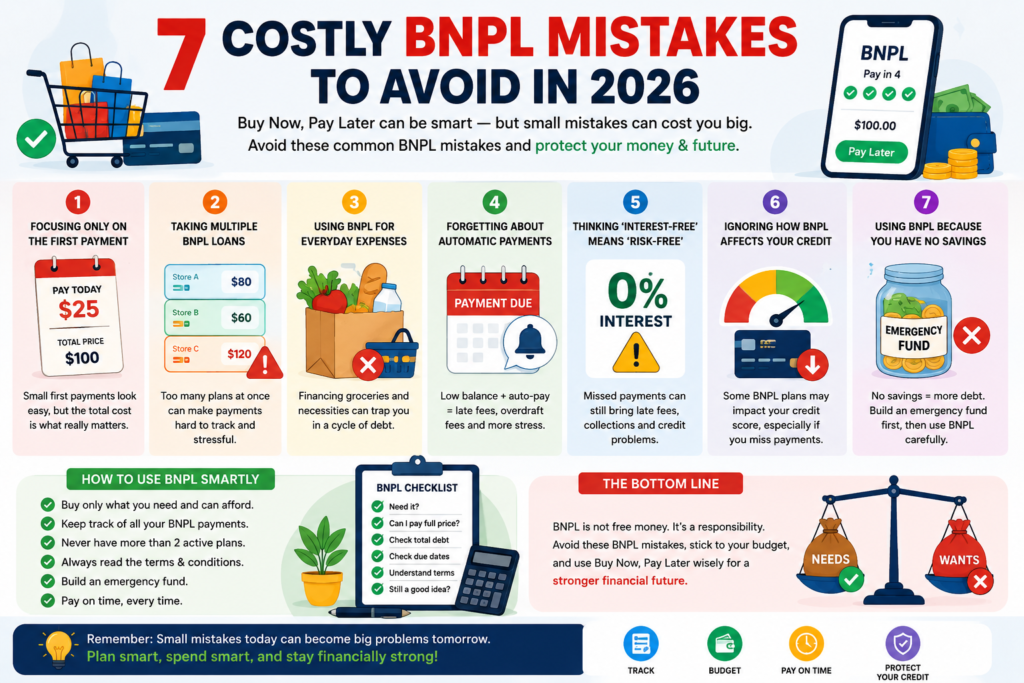
1. One of the Biggest BNPL Mistakes: Looking Only at the First Payment
Imagine you find a $600 product online.
Would you buy it if the checkout button said:
Pay $600?
Maybe not.
But what if it said:
Pay $150 today?
Suddenly, the purchase can feel much more affordable.
This is one of the easiest BNPL mistakes to make because your brain naturally focuses on the amount you need to pay right now.
But affordability should be based on the total purchase price, not the first installment.
The better approach
Before using BNPL, ask yourself one simple question:
“Would I still buy this if I had to pay the full price today?”
If the answer is no, give yourself 24 hours before completing the purchase.
Also calculate the full cost.
If you have:
- $75 remaining on one BNPL plan
- $160 remaining on another
- $220 remaining on a third
you do not have three “small payments.”
You have $455 of outstanding BNPL obligations.
Thinking in totals makes the financial decision much clearer.
2. Taking Multiple BNPL Loans at the Same Time
One BNPL plan may be manageable.
Five can become confusing.
Suppose you have these upcoming payments:
| Purchase | Next Payment |
|---|---|
| Phone | $80 |
| Clothes | $45 |
| Furniture | $120 |
| Electronics | $65 |
| Groceries | $40 |
| Total | $350 |
Individually, none looks frightening.
Together, you need $350.
This is not just a hypothetical problem.
CFPB research found that approximately 63% of BNPL borrowers in its 2022 study originated multiple simultaneous BNPL loans at some point during the year, while 33% borrowed from multiple BNPL lenders.
How to avoid this BNPL mistake
Create one note on your phone called:
My BNPL Payments
Write down:
Purchase | Total Remaining | Next Payment | Due Date
Update it every time you use BNPL.
Moreover, consider making a personal rule such as:
Never have more than two active BNPL purchases at once.
The exact number depends on your income and budget. The important part is having a limit before you start shopping.
3. Using BNPL for Groceries and Everyday Expenses
Using BNPL for an occasional planned purchase is one thing.
Depending on it to buy food is different.
If you finance this week’s groceries, you may still be paying for them when you need to buy next week’s groceries.
Then another installment gets added.
And another.
This can create a cycle where future income is constantly paying for past necessities.
Recent Federal Reserve data makes this especially important.
Among surveyed BNPL users who used BNPL for groceries or food delivery, 43% experienced either a late-payment charge or an overdraft/non-sufficient-funds fee associated with BNPL use. The comparable overall figure among BNPL users was 21%.
That does not mean BNPL caused every user’s broader financial problems. However, it is a useful warning sign: financing everyday necessities can be particularly risky when your budget is already tight.
If everyday expenses are becoming harder to manage, a smarter budget can help you see where your money is actually going. Our guide to [The Best AI Budgeting Apps 2026 That Actually Work] explains how budgeting tools can help track spending and build better money habits.
What should you do instead?
If you regularly need BNPL for groceries, pause new non-essential BNPL purchases.
Then look at your monthly cash flow:
Income – essential expenses – debt payments = money actually available
Check subscriptions, food delivery, shopping, bank fees and other expenses that can be reduced.
The problem may not be groceries themselves.
The problem may be that too much of your future income has already been committed.
4. Forgetting About Automatic BNPL Payments
Automatic payments are convenient until the money is not in your account.
Imagine your BNPL payment of $70 is scheduled for Monday.
You have $55 in your checking account.
You forgot about the payment.
Depending on your bank and the circumstances, the attempted payment could contribute to an overdraft or non-sufficient-funds fee.
The CFPB specifically warns consumers that banks may charge overdraft or NSF fees when automatic BNPL repayments hit an account without enough money. BNPL providers can also have their own late-payment policies.
The Federal Reserve’s 2025 survey data found that 11% of BNPL users had experienced an overdraft or NSF fee triggered by a BNPL payment. Among BNPL users who said they could cover less than $100 of an emergency using savings, the figure was 18%.
Simple solution
Do not rely entirely on your memory.
Set two reminders:
3 days before payment → Check account balance
1 day before payment → Confirm enough money is available
You can also keep BNPL payments coming from one account if that makes them easier to track.
A 30-second balance check can prevent a much more annoying financial problem.
5. Assuming “Interest-Free” Means “Risk-Free”
This is perhaps the most misleading mental shortcut around BNPL.
0% interest does not mean 0% risk.
Many BNPL products may offer interest-free installments, but missed payments can still create consequences.
Depending on the provider and product, those may include late fees, account restrictions, collections, or effects on your credit history if unpaid debt is eventually reported.
The CFPB says many BNPL providers charge late fees when payments are missed, and unpaid debt may ultimately be sent to a debt collector.
Therefore, do not ask only:
“Is this interest-free?”
Also ask:
“What happens if I cannot make the payment?”
Before accepting any plan, check:
- Payment dates
- Late-payment policy
- Automatic payment rules
- Refund process
- Whether the product involves a credit check
- Whether payment activity may be reported
Two products both labeled “Buy Now, Pay Later” can have different terms.
Read the actual agreement.
6. Ignoring How BNPL May Affect Your Credit
There is a lot of confusion about BNPL and credit scores.
The safest answer is:
It depends on the BNPL product, lender, reporting practices and scoring model.
The CFPB explains that many traditional pay-in-four products historically have not reported regular payment history to the major credit reporting companies. However, if unpaid debt reaches collections and is reported, it may hurt your credit. Some longer-term installment products can also involve hard credit inquiries and payment reporting.
The market is also changing.
Experian says BNPL information reported to it can appear on a consumer’s credit report, although existing traditional credit scores may not necessarily incorporate that information in the same way.
So do not use an old assumption such as:
“BNPL never affects credit.”
That statement is too broad.
Better rule
Before accepting a BNPL offer, look for answers to three questions:
- Will the lender perform a hard credit inquiry?
- Will this account or payment history be reported?
- What happens if I miss payments?
If the information is unclear, check the provider’s current terms before borrowing.
7. Using BNPL Because You Have No Emergency Savings
This is the most serious problem on this list.
Your car needs repair.
Your pet needs treatment.
Your refrigerator stops working.
You have no emergency fund, so BNPL becomes the emergency fund.
It may solve today’s problem.
But the bill moves into next month’s budget.
If another emergency happens before the first one is paid off, you now have two problems competing for the same future paycheck.
Federal Reserve data shows why financial buffers matter. Among BNPL users who could cover less than $100 of an emergency from savings, 18% reported an overdraft or NSF fee triggered by a BNPL payment, compared with 4% among those who could cover $2,000 or more.
That does not prove BNPL caused the lack of savings. Rather, it shows how much more vulnerable BNPL users can be when they have little financial cushion.
Start small
You do not need a $10,000 emergency fund tomorrow.
Try:
First target: $250
Then:
$500
Then:
$1,000
After that, work toward a larger emergency fund appropriate for your expenses and circumstances.
Even a small cash buffer can reduce the need to borrow for every unexpected bill.
How to Avoid BNPL Mistakes Before You Click “Buy”
Here is a simple test you can use before every BNPL purchase.
Ask yourself:
1. Do I actually need this?
Wanting something and needing something are different.
2. Could I pay the full price today?
If not, understand why.
3. How much BNPL debt do I already have?
Check every provider, not just the app you are currently using.
4. What will all my installments cost this month?
Add them together.
5. Is this purchase taking money away from rent, food, utilities, savings or existing debt?
If yes, the purchase probably needs to wait.
6. Do I know the late-payment and credit-reporting terms?
Never assume.
7. Would I still make this purchase tomorrow?
Waiting one day can kill an impulse purchase surprisingly fast.
BNPL vs Credit Card: Which Is Better?
Neither option is automatically better.
It depends on how you use it.
| Feature | BNPL | Credit Card |
|---|---|---|
| Payments | Usually fixed installments | Flexible monthly payment |
| Interest | Many pay-in-four plans offer 0% | Can be high if balance is carried |
| Overspending risk | High when multiple plans overlap | High when balances grow |
| Tracking | Can become difficult across providers | Usually centralized on one account |
| Credit impact | Depends on product/reporting | Commonly reported |
| Best use | Planned, affordable purchase | Planned spending paid responsibly |
The worst strategy is not necessarily choosing BNPL instead of a credit card.
It is borrowing without knowing how you will repay the purchase.
A financing tool cannot fix an unaffordable purchase.
A Simple BNPL Budget Rule
Here is a practical rule:
Treat every BNPL payment like debt the moment you make the purchase.
If you buy a $400 product through four $100 installments, record $400, not $100, in your personal debt tracker.
Then calculate:
Monthly income
– essential bills
– existing debt payments
– savings
– all BNPL installments
= money left for optional spending
For example:
Monthly take-home income: $3,500
Essential expenses: $2,100
Debt payments: $400
Savings: $300
BNPL payments: $250
Money remaining: $450
Now you have a much clearer picture of what you can actually afford.
When Can BNPL Make Sense?
Avoiding BNPL mistakes does not mean BNPL must never be used.
It can be manageable when:
- The purchase was already planned.
- The total price fits your budget.
- You understand all repayment terms.
- You have enough cash for upcoming installments.
- You are not stacking multiple plans.
- You are not sacrificing essential expenses.
- You have a system for tracking payments.
For example, imagine you need a $400 appliance.
You already have $600 available after essential expenses and emergency savings.
A legitimate 0% pay-in-four option could let you spread the cash flow while keeping the purchase affordable.
Compare that with buying the same $400 appliance when you have only $50 available and hoping your next paycheck covers everything.
The product is identical.
The financial situation is completely different.
What to Do If You Already Have Too Many BNPL Payments
Maybe you are reading this article because the problem has already started.
You have four or five plans.
Different due dates.
And your next paycheck already feels spent.
Do not solve that problem by adding another BNPL loan.
Instead:
Step 1: Stop new BNPL purchases temporarily.
Give yourself room to clear existing balances.
Step 2: List every outstanding balance.
Include the provider, remaining amount, next payment and due date.
Step 3: Protect essential expenses first.
Housing, utilities, basic food and other essential obligations need to be part of the plan.
Step 4: Check your payment accounts.
Make sure scheduled automatic payments will not unexpectedly hit an empty account.
Step 5: Contact the provider early if you expect trouble.
Do not simply ignore a payment. Check what assistance, rescheduling or other options the provider actually offers.
Step 6: Build a small emergency buffer after regaining control.
Otherwise, the next unexpected expense can restart the cycle.
Most importantly, do not feel tempted to hide the problem from yourself.
Numbers are easier to fix when you can see them.
Final Thoughts: BNPL Is Still Debt
The biggest misunderstanding about Buy Now, Pay Later comes from its convenience.
Four small buttons on a checkout page can make borrowing feel less serious than opening a traditional loan.
But the basic financial reality has not changed.
You are spending future money today.
That does not make BNPL bad.
It makes planning essential.
The most damaging BNPL mistakes usually happen when people focus only on the first payment, stack several plans, finance everyday expenses, forget automatic withdrawals or assume interest-free means consequence-free.
Therefore, before your next BNPL purchase, forget the tiny installment number for a moment.
Look at the full price.
Look at your total debt.
Look at your next paycheck.
Then ask:
“Will this purchase still fit comfortably into my life after the excitement of buying it is gone?”
If the answer is yes, you can make a much more informed decision.
If the answer is no, clicking “Pay Later” may simply mean “worry later.”
And that is one payment plan worth avoiding.
Frequently Asked Questions About BNPL Mistakes
What are the most common BNPL mistakes?
Common BNPL mistakes include focusing only on the first installment, opening several plans at once, forgetting automatic payments, financing everyday necessities and assuming all BNPL products work the same way.
Is Buy Now, Pay Later bad for your credit?
Not necessarily. The effect depends on the BNPL product, lender, reporting practices and scoring model. Some pay-in-four products may not affect traditional credit scores in the same way as conventional loans, while missed debts that reach collections can potentially damage credit. Always check the current terms before borrowing.
Is BNPL better than using a credit card?
Neither is automatically better. A 0% BNPL plan may be useful for an affordable planned purchase, while a credit card may offer different protections or benefits. Both can create financial problems when used to buy things you cannot afford.
How many BNPL plans are too many?
There is no universal safe number. If your existing installments are difficult to track or interfere with bills, savings or other debt payments, you already have too many for your current budget.
Should I use BNPL for groceries?
Occasional circumstances differ, but regularly financing groceries can signal a cash-flow problem. Because groceries repeat every week, new purchases can overlap with payments for previous ones. Review your budget before turning BNPL into a routine way to pay for essentials.
What should I do before using BNPL?
Check the full purchase price, your existing BNPL balances, upcoming due dates, available cash, late-payment terms and possible credit-reporting consequences. Most importantly, make sure repayment fits your budget before completing the purchase.