
AI can explain investing in seconds, build a budget, compare debt strategies, and answer money questions at 2 a.m.
That sounds great. However, there is one problem: AI can sound confident even when its answer is incomplete, outdated, or wrong.
That is why understanding AI financial advice risks matters in 2026.
Recent MIT Sloan research found that AI financial advice can move people toward more sensible saving, spending, and diversified investing behavior. However, the same research found important weaknesses, including difficulty adjusting spending after income shocks and limitations in portfolio rebalancing.
Moreover, the Consumer Financial Protection Bureau (CFPB) has highlighted risks such as incorrect calculations, incomplete assumptions, hallucinations, privacy problems, and a lack of fiduciary obligation in emerging AI-powered financial advice.
So, should you stop asking AI about money?
No.
Instead, you need to know what AI is good at, where it can fail, and how to check its answers before your money is at risk.
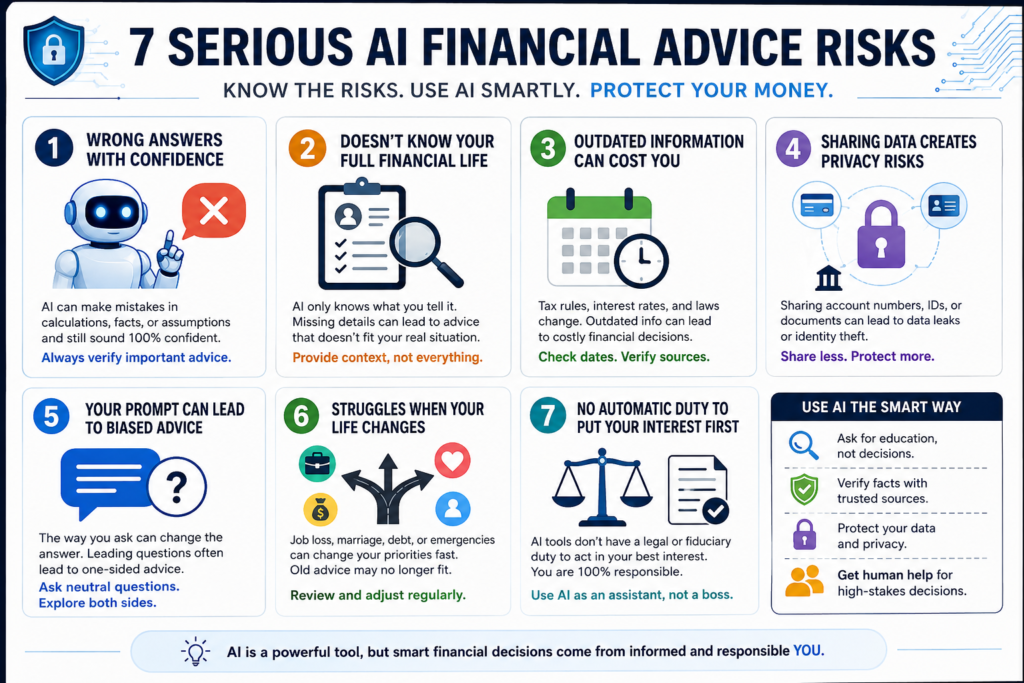
Here are seven serious AI financial advice risks—and what you can do about each one.
1. AI Can Give Wrong Financial Advice With Confidence
This is one of the biggest AI financial advice risks.
AI does not always say, “I don’t know.”
Instead, it may give you a polished answer even when important information is missing.
For example, AI could:
- make an incorrect calculation;
- misunderstand your financial situation;
- rely on a bad assumption;
- provide outdated information;
- invent a fact or source; or
- recommend something that does not fit your circumstances.
The CFPB has specifically warned about incorrect mathematical calculations, incomplete assumptions, incorrect advice, and AI hallucinations in emerging financial tools.
Moreover, MIT professor Andrew Lo has warned that AI can deliver both good and bad financial advice in a similarly convincing way.
If you’re already using AI to manage money, our guide to Best AI Finance Apps for Smarter Money in 2026 explains where these tools can actually help.
Here’s a simple example
Suppose you ask:
“I have $10,000. Should I invest it or pay off my debt?”
AI might suggest investing.
However, what if your credit-card debt charges 24% interest?
What if you have no emergency fund?
What if your job is unstable?
Suddenly, the answer could be completely different.
How to protect yourself
Use this simple rule:
Ask → Question → Verify → Decide
First, ask AI for possible options.
Then, ask what assumptions it made.
After that, verify important numbers and rules using reliable sources.
Finally, make the decision yourself.
The more money involved, the more important that verification becomes.
2. AI Doesn’t Know Your Whole Financial Life
Personal finance is personal for a reason.
Imagine two people earning $70,000 per year.
Person A has:
- no high-interest debt;
- six months of emergency savings;
- stable employment; and
- low monthly expenses.
Person B has:
- $25,000 in credit-card debt;
- no emergency savings;
- unstable income; and
- a family depending on that income.
Should they receive the same financial advice?
Of course not.
However, AI can only work with the information you give it.
The 2026 MIT Sloan study found that the quality of AI financial advice depends partly on the questions people ask. In its simulations, prompts written by people with greater financial literacy and previous AI experience produced better outcomes.
Recent (MIT salon research) https://mitsloan.mit.edu/press/half-americans-now-ask-ai-financial-advice-how-good-it?utm_source=chatgpt.com found that AI financial advice can move people toward more sensible saving, spending, and diversified investing behavior.
Therefore, a vague question often produces a vague—or potentially unsuitable—answer.
Don’t ask this:
“What should I do with $500?”
Ask this instead:
“I have $500 left each month after essential expenses. I have a three-month emergency fund and $4,000 of debt at 18% APR. Explain the possible priorities, risks, and trade-offs without choosing an investment for me.”
See the difference?
You are asking AI to help you think, rather than letting it make the decision.
3. AI Can Use Outdated Financial Information
Money rules change constantly.
For example:
- tax brackets change;
- retirement contribution limits change;
- interest rates move;
- government benefits change;
- lending rules can change;
- financial products change their fees;
- laws and regulations evolve.
Therefore, an answer that was correct last year might not be correct today.
This becomes especially important when asking AI about:
- taxes;
- retirement accounts;
- mortgages;
- Social Security;
- student loans;
- insurance;
- government benefits; or
- investment regulations.
The solution is surprisingly simple
Whenever you ask a time-sensitive financial question, add:
“What date is this information current as of, and which official source can I use to verify it?”
Then actually check the source.
For example, U.S. tax information should ultimately be checked against current IRS guidance—not just an AI-generated explanation.
Most importantly, never make a major tax, legal, or investment decision because one chatbot answer sounds convincing.
4. Sharing Financial Data With AI Can Create Privacy Risks
This risk is easy to underestimate.
You ask AI to analyze your finances.
Then you provide your salary.
Next comes your debt.
After that, maybe you upload a bank statement.
Before long, you may have shared far more information than the AI actually needed.
The CFPB has warned that some emerging AI-powered financial services rely on consumers providing access to sensitive financial information and that privacy breaches, data leaks, and poor data stewardship are potential risks.
Therefore, treat financial information carefully.
Never casually share:
- passwords;
- PIN numbers;
- full bank account numbers;
- full credit or debit card numbers;
- Social Security numbers;
- authentication codes;
- crypto recovery phrases;
- private keys; or
- unredacted financial documents.
Do this instead
You normally don’t need to identify yourself to get useful financial education.
Instead of uploading your entire bank statement, you could say:
“My monthly take-home income is about $4,500. Essential expenses are around $2,700, debt payments are $600, and I want to increase my emergency savings. Help me find areas I should review.”
You still give AI useful context.
However, you avoid exposing unnecessary sensitive information.
5. A Bad Prompt Can Lead to Bad Financial Advice
Here’s something many people miss:
The way you ask the question can change the answer.
For example:
“Why is Bitcoin a great investment?”
That question already pushes the conversation toward a positive answer.
Instead, ask:
“Explain the strongest arguments for and against adding Bitcoin to a diversified portfolio. Include volatility, downside risks, opportunity costs, and reasons not to invest.”
Much better.
The 2026 MIT Sloan research found that AI financial advice varied based on user prompts and characteristics. The researchers also found differences associated with financial literacy, prior AI experience, and gender in the prompts and resulting advice.
Moreover, a July 2026 Journal of Corporate Finance study comparing professional advisers with generative AI found that AI recommendations were affected by prompts and model family.
Use neutral prompts
Instead of:
“Tell me why I should buy this stock.”
Try:
“Give me five reasons this investment could succeed and five reasons it could fail. What risks might I be overlooking?”
In addition, ask:
“What evidence would prove your recommendation wrong?”
That one question can make your AI research much more useful.
6. AI May Struggle When Your Life Suddenly Changes
A financial plan isn’t permanent.
Imagine you have a stable income and are investing $1,000 every month.
Then you suddenly lose your job.
Should you blindly continue the same strategy?
Probably not.
Your emergency savings may suddenly become more important than investing.
Similarly, your financial priorities can change after:
- losing a job;
- getting married;
- having a child;
- moving countries;
- receiving an inheritance;
- starting a business;
- taking on major debt; or
- experiencing a large unexpected expense.
The 2026 MIT Sloan research found that AI generally produced sensible life-cycle financial guidance. However, it also struggled to adjust spending appropriately after income shocks and showed limitations around portfolio rebalancing and retirement drawdown.
Therefore, don’t treat an AI-generated financial plan as something you create once and follow forever.
Better approach
Whenever your income, expenses, family situation, debt, or financial goals change significantly:
Stop → Update your numbers → Reassess your priorities → Build a new plan.
Your financial plan should change when your life changes.
7. AI Has No Automatic Duty to Put Your Interests First
This point is extremely important.
A chatbot can give you financial information.
However, that does not automatically mean it has the same legal or professional responsibilities that may apply to certain regulated financial professionals.
The CFPB noted that emerging AI financial tools can involve an absence of fiduciary obligations, limited accountability when things go wrong, and insufficient disclaimers about their limitations.
That creates a simple problem.
If AI tells you to make a bad financial move and you lose money, you may not have the same protections or recourse you might expect in some regulated advisory relationships.
Therefore, the higher the stakes, the less sensible it is to rely on one AI answer.
Use AI as an assistant—not the boss
AI can help you:
- understand financial terminology;
- compare strategies;
- organize your budget;
- calculate scenarios;
- discover questions you should ask;
- understand potential risks; and
- prepare before meeting a professional.
However, it should not automatically control decisions involving your life savings.
What Is AI Financial Advice Actually Good For?
After reading about all these AI financial advice risks, you might be thinking:
“Then why should I use AI at all?”
Because AI can still be incredibly useful.
Moreover, choosing the right tool matters. Our The Best AI Finance Tools in 2026: Apps I (Tested) guide compares popular options for different financial tasks.
In fact, MIT Sloan’s 2026 research found that following AI guidance could move many users closer to standard economic recommendations around saving, spending, diversified equity participation, and maintaining savings buffers.
The key is choosing the right task.
| Generally Useful AI Tasks | Higher-Risk AI Tasks |
|---|---|
| Explaining financial terms | Picking individual stocks |
| Building a basic budget | Moving retirement savings |
| Comparing debt strategies | Making major tax decisions |
| Running savings calculations | Choosing complex insurance |
| Explaining investing basics | Making leveraged investments |
| Comparing financial scenarios | Taking a major loan |
| Preparing adviser questions | Replacing professional advice entirely |
Therefore, think of AI as a financial research assistant.
Not your personal money manager.
A Simple 5-Step Method to Use AI Financial Advice Safely
You don’t need to stop using AI.
Instead, change how you use it.
Step 1: Ask AI to Explain, Not Decide
Don’t start with:
“What stock should I buy?”
Instead, ask:
“Explain five common long-term investment options, including their potential returns, risks, fees, liquidity, and who they may or may not suit.”
Now you’re learning instead of blindly following instructions.
Step 2: Give Useful Context Without Sensitive Data
AI needs context.
However, it usually doesn’t need your identity.
Give approximate information about:
- income;
- expenses;
- debt;
- interest rates;
- savings;
- time horizon; and
- goals.
Avoid giving passwords, account numbers, identification numbers, or authentication information.
Step 3: Make AI Challenge Its Own Answer
This is one of my favorite ways to use AI for financial research.
After receiving an answer, ask:
“What assumptions did you make?”
Then ask:
“What are the strongest reasons I should NOT follow this strategy?”
Finally:
“What could make this advice wrong for someone in my situation?”
As a result, you’re less likely to accept the first answer simply because it sounds good.
Step 4: Verify the Important Facts
Before acting, verify anything that could materially affect your money.
Check:
- current tax rules;
- interest rates;
- fees;
- contribution limits;
- withdrawal penalties;
- regulations;
- loan terms; and
- investment details.
Whenever possible, use primary sources such as government agencies, regulators, banks, fund providers, or official company documentation.
AI can help you find what to check. It should not replace the checking.
Step 5: Know When You Need Human Expertise
Sometimes the smartest AI prompt is not enough.
Consider qualified professional help for complex or high-stakes situations involving:
- retirement planning;
- estate planning;
- complicated taxes;
- inheritance;
- major investment decisions;
- complex insurance;
- business finances; or
- major life changes.
Moreover, AI can still help before that meeting.
Ask it:
“Give me 10 important questions to ask a financial adviser about my retirement plan.”
Now AI is helping you become a better-informed client rather than trying to replace the professional.
AI vs Human Financial Adviser: Which Should You Trust?
There isn’t a simple winner.
AI has major advantages.
It can be:
- fast;
- inexpensive;
- available 24/7;
- easy to question repeatedly; and
- excellent at explaining difficult concepts.
Human advisers have different strengths.
Depending on their role and qualifications, they can understand complicated personal circumstances, ask follow-up questions, operate under professional or regulatory obligations, and apply judgment when situations don’t fit a simple formula.
Interestingly, research suggests neither side is automatically perfect.
A July 2026 study in the Journal of Corporate Finance found professional human advisers projected aspects of their own portfolios onto client recommendations. Meanwhile, the tested LLMs were generally more conservative, and their recommendations varied depending on prompts and model family.
Therefore, the smartest approach may often be:
AI for learning + reliable sources for verification + qualified humans for high-stakes judgment.
The 30-Second AI Financial Advice Safety Check
Before following any AI money advice, ask yourself five questions:
1. Does AI have enough information about my situation?
2. Could any facts, rates, laws, or limits in this answer be outdated?
3. Can I verify the important claims using a reliable primary source?
4. What happens financially if this advice is wrong?
5. Is this decision important enough to involve a qualified professional?
If you cannot confidently answer those questions, don’t move your money yet.
That’s probably the simplest way to reduce AI financial advice risks.
Final Verdict: Is AI Financial Advice Safe in 2026?
Yes—for the right tasks and with the right safeguards.
AI can be excellent for learning, budgeting, comparing options, understanding financial concepts, and exploring different scenarios.
Moreover, recent research suggests AI financial advice can sometimes push people toward sensible saving and investing behavior.
However, useful is not the same as trustworthy enough to follow blindly.
AI can still make incorrect calculations, hallucinate information, rely on incomplete assumptions, struggle with changing circumstances, and lack the accountability associated with regulated professional advice.
Therefore, remember one simple rule:
Use AI to understand your financial decisions—not to surrender them.
Ask better questions.
Protect your private information.
Challenge the first answer.
Verify important facts.
And, most importantly, slow down when real money is on the line.
That is how AI becomes a useful financial tool instead of an expensive mistake.
FAQs About AI Financial Advice Risks
Is AI financial advice reliable?
AI financial advice can be useful for general education, basic calculations, budgeting, and exploring financial options. However, it can also provide incorrect or incomplete information. Therefore, important financial advice should be independently verified before you act.
Can I use ChatGPT or another AI for financial advice?
You can use general-purpose AI tools to understand financial concepts, compare strategies, create sample budgets, and prepare questions. However, avoid treating a chatbot as a replacement for qualified professional advice when making high-stakes decisions.
What are the biggest AI financial advice risks?
Major risks include incorrect answers, outdated information, incomplete assumptions, privacy problems, prompt-related bias, poor adjustment to changing circumstances, and limited accountability.
Should I share my bank statement with AI?
Avoid sharing unnecessary sensitive financial information with general-purpose AI tools. Instead, remove identifying details or provide approximate figures when those are enough to answer your question.
Can AI replace a financial adviser?
AI can automate parts of financial education, research, and analysis. However, complex financial situations may require personal judgment, professional accountability, and knowledge of your complete circumstances.
How can I check whether AI financial advice is correct?
Check current facts against primary sources, verify calculations independently, ask AI to explain its assumptions, compare multiple reliable sources, and seek qualified professional advice when the financial consequences could be significant.