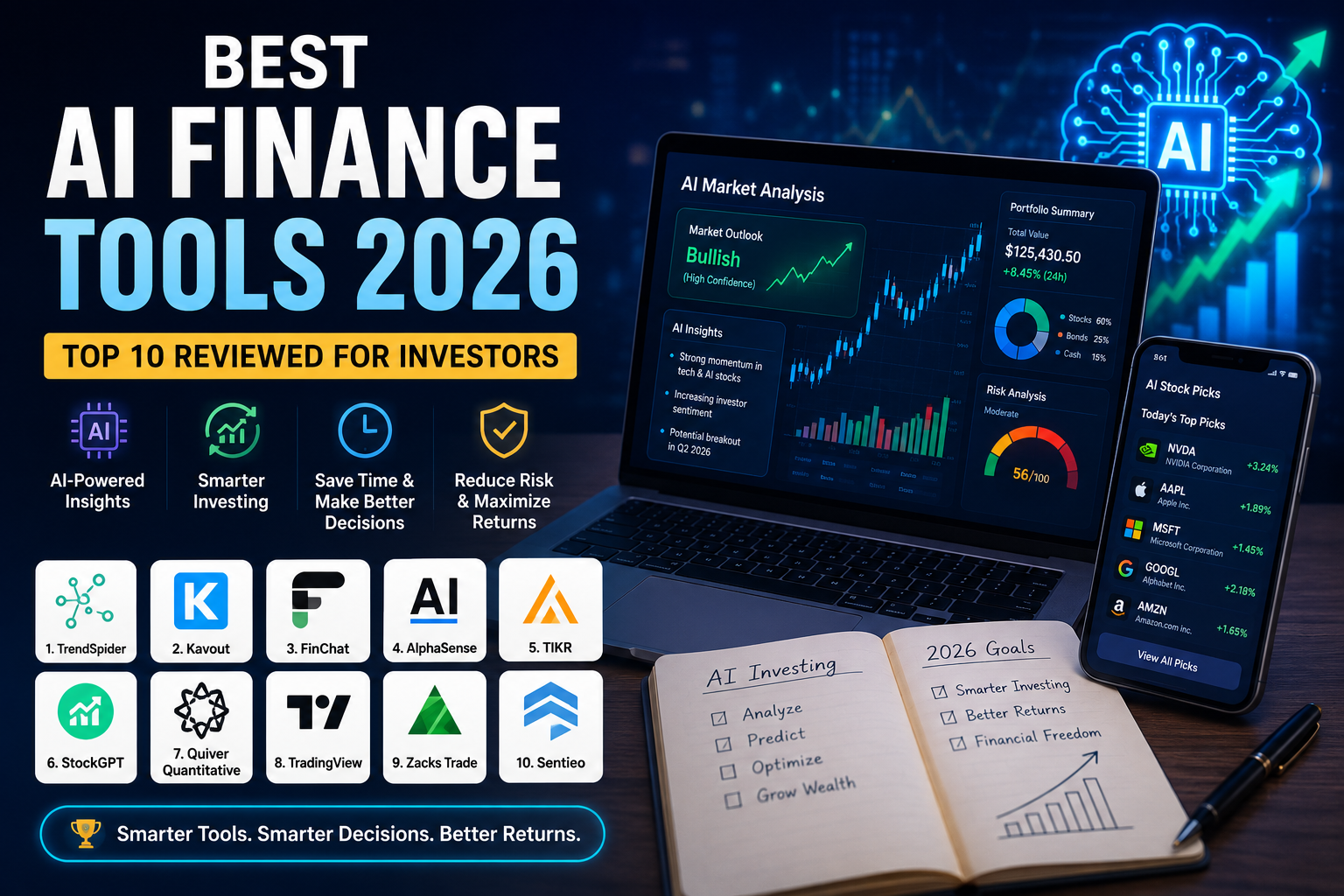
Best AI Finance Apps for Smarter Money in 2026
Let me be truly honest with you. I spent three years tracking my money in a notebook before I realized I was bleeding cash on subscriptions I forgot existed. If you are just starting your financial journey in the USA, UK, Canada, or Australia, you are probably feeling the same overwhelm. Inflation is biting, rent keeps climbing, and every “expert” tells you to budget — but nobody shows you how.
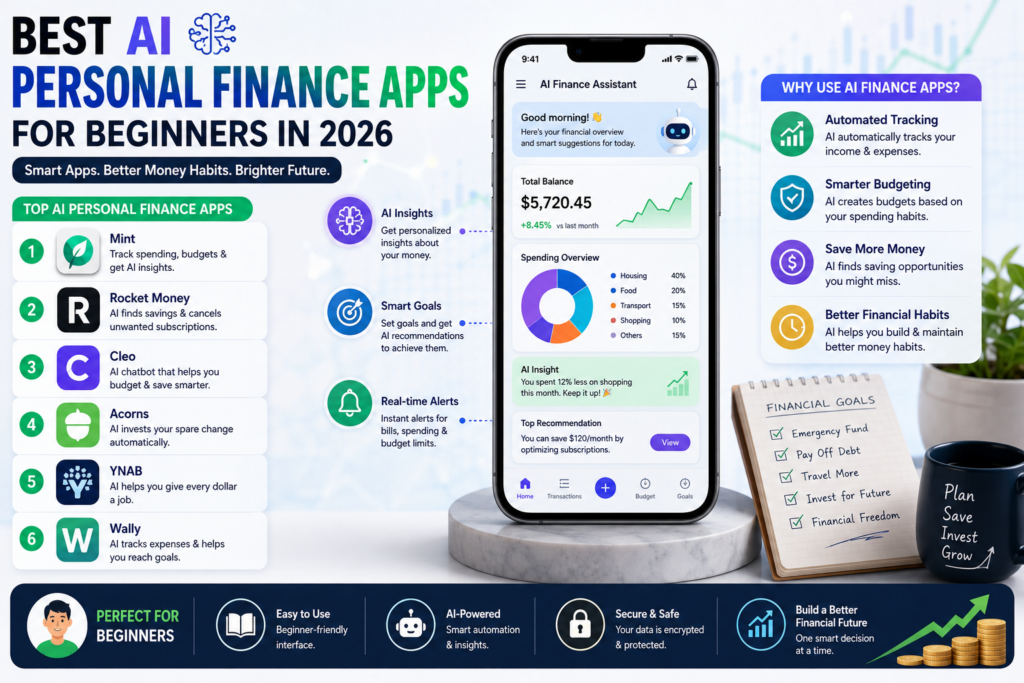
That is exactly why I tested the best AI finance apps for beginners over the past 30 days. Not the corporate tools designed for CFOs. Real apps that real people use to stop overspending, start saving, and finally understand where their money goes.
If you are new to investing and want to grow your money beyond just budgeting, you should also read our guide on 7 Powerful AI Investing Tools 2026 Every Investor Needs first. It pairs perfectly with the apps below.
The personal finance app market hit $2.04 billion in 2026, and AI is driving the biggest shift we have ever seen. Mint shut down in 2024, and 43 million Americans were suddenly stranded without a budgeting tool. That exodus created a wave of smarter, AI-powered alternatives that do not just track spending — they predict it, optimize it, and sometimes even stop you from making expensive mistakes before you make them.
In this guide, I will show you the best AI finance apps for beginners that actually work in 2026. No fluff, no sponsored placements, just honest reviews from someone who has been exactly where you are right now.
Why Beginners Need AI Finance Apps for Smarter Money
Here is a number that should wake you up: 78% of Americans live paycheck to paycheck in 2026. That is not a statistic — that is a reality for nearly 8 out of 10 people reading this. In the UK, Canada, and Australia, the picture is not much better. Rising costs, student debt, and unpredictable income have made manual budgeting nearly impossible for beginners.
The old way? Open a spreadsheet, categorize every transaction by hand, and hope you remember to check it before payday. The new way? AI apps that connect to your bank in 60 seconds, automatically sort every dollar, and send you a text that says, “Hey, you are about to overspend on takeout again.”
However, if your main goal is to control spending and build better financial habits, don’t miss our guide to the best The Best AI Budgeting Apps 2026 That Actually Work
McKinsey found that AI-powered finance tools can cut administrative money tasks by up to 60%. For beginners, that means less time stressing and more time actually building wealth. The best AI personal finance apps for beginners do not require accounting degrees. They require a phone and about 10 minutes of setup.
How I Tested These AI Finance Apps for Smarter Money
I am not a financial advisor. I am someone who has struggled with money, learned the hard way, and now uses these apps daily. Here is exactly how I tested each one:
- Setup time: Can a complete beginner connect their bank and start tracking in under 10 minutes?
- Real savings: Did the app actually help me spend less or save more in 30 days?
- AI quality: Is the automation smart, or does it miscategorize everything?
- Cost: Is the free version usable, or is it a trap to upgrade?
- Beginner-friendly: Does it explain why you should do something, or just throw numbers at you?
Every app below passed all five tests. Let us dive in.
Top 10 Best AI Finance Apps for Smarter Money
1. Monarch Money — Best Overall for Beginners
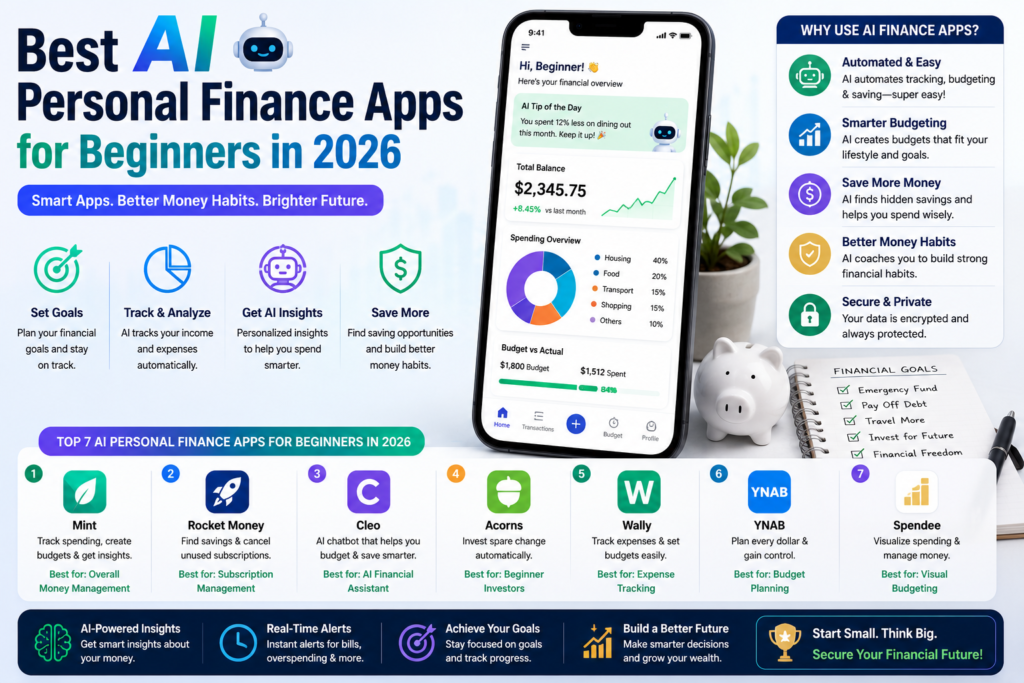
When Mint shut down in 2024, Monarch Money became the refuge for millions of stranded users. And honestly? It is better than Mint ever was. With 4.9 stars on the App Store and nearly 90,000 reviews, Monarch has built the most beginner-friendly AI dashboard on the market.
The AI automatically categorizes transactions from over 13,000 financial institutions, tracks your net worth across accounts, and recently added an AI Assistant powered by certified financial planner insights. You can ask natural questions like “Why did my grocery bill spike last month?” and get actual answers — not just charts.
I connected my checking, savings, and a small investment account in under 5 minutes. Within a week, the AI spotted a subscription I had forgotten about and helped me cancel it. That alone saved me $14.99 per month.
Pricing: $14.99/month or $99.99/year (often 50% off first year)
Best for: Beginners who want Mint replacement with couple-sharing
Downside: Bank sync issues can happen at scale; manual import is the fallback
2. YNAB (You Need A Budget) — Best for Debt Destroyers
If you are drowning in debt, YNAB is not just an app — it is a mindset shift. With 4.8 stars and nearly 100,000 reviews across platforms, YNAB uses zero-based budgeting, which means every single dollar gets a job before the month starts. The AI does not just track spending; it forces you to plan it.
YNAB’s recent updates include linked account status icons that flag sync issues in real time, plus a “For You” content feed that serves personalized tips based on your actual spending patterns. Their users report paying off debt 20-30% faster than with traditional budgeting.
I used YNAB for one month and the psychological shift was real. Seeing my money assigned to specific goals — not just floating in a checking account — made me pause before every impulse purchase.
Pricing: $14.99/month or $109/year
Best for: Beginners with debt who need discipline, not just tracking
Downside: Steeper learning curve; the methodology takes 2-3 weeks to click
3. Cleo — Best for Gen Z and Anxious Spenders
Cleo is the app that roasts you for buying too much coffee — and somehow you thank it for it. With 7 million users and a sassy AI chatbot that has handled over 74 million conversations, Cleo turns budgeting into a conversation instead of a chore.
Launched in February 2026, Cleo’s Autopilot feature is genuinely next-level. It auto-adjusts savings, blocks merchants you overspend at, and executes financial plans without you lifting a finger. A survey of 5,000 users found that 85% felt better about their finances within the first month.
Meanwhile, if you want AI to automate everyday money tasks, explore our review of the The Best AI Financial Agents 2026 for Smarter Finance
I asked Cleo, “How much can I spend this weekend?” and it analyzed my bills, income, and goals in real time. The answer was specific, not vague. That is the power of modern AI personal finance apps for beginners.
Pricing: Free basics; premium tiers $2.99–$14.99/month
Best for: Young beginners, gig workers, anyone who hates traditional budgeting
Downside: Cash advance features can be tempting; avoid if you lack self-control
4. Copilot Money — Best for Apple Users
If you live inside the Apple ecosystem, Copilot Money is the most beautiful AI personal finance app for beginners you will find. With 4.8 stars and 27,000+ reviews, plus an Apple Design Award nomination, this app makes tracking money feel… enjoyable?
The AI learns your spending patterns for 95%+ categorization accuracy and auto-adjusts your budget categories based on actual behavior. When you underspend on groceries, it rolls the surplus into savings goals automatically. After Mint’s shutdown, Copilot exploded to over 100,000 subscribers.
I loved the “To Review” queue — it flags unusual transactions and lets you categorize them with one tap. No more scrolling through 50 transactions wondering what that $4.67 charge was.
Pricing: $13/month or $95/year
Best for: iPhone/Mac users who want premium design + AI automation
Downside: No Android app yet; web app launched December 2025 but mobile is still Apple-only
5. Rocket Money — Best for Subscription Killers
Rocket Money has one superpower: finding and canceling subscriptions you forgot about. With 10 million+ users and 125,000+ Google Play reviews, this app has saved users over $2.5 billion collectively. That is not a typo.
The AI scans every linked account, identifies recurring charges, and shows you exactly how much you are bleeding monthly. Their concierge service will even call companies and negotiate lower rates for you — taking 35-60% of first-year savings as a fee, but only if they succeed.
I found three subscriptions totaling $47 per month that I had completely forgotten. One was for a meditation app I had not opened in 8 months. Rocket Money canceled all three in under 10 minutes.
Pricing: Free tracking; premium “pay what you want” $6–$14/month
Best for: Beginners who know they have subscription bloat but do not know where
Downside: Negotiation fees can add up; focus is narrow compared to full budgeting apps
6. Empower Personal Dashboard — Best Free Option
Empower is completely free. Not “free trial” free. Actually free. With 18 million+ users and $1.4 trillion in tracked retirement plan assets, Empower offers the most robust free dashboard for beginners who want net worth tracking without paying a dime.
The AI analyzes your linked accounts and provides retirement projections, investment allocation advice, and spending trends. While it lacks the granular budgeting of YNAB or Monarch, it excels at the big picture. If you are a beginner who just wants to see everything in one place, Empower is unbeatable.
Pricing: Completely free
Best for: Beginners who want investment + net worth tracking without subscriptions
Downside: No advanced budgeting features; pushes paid advisory services occasionally
7. PocketGuard — Best for “Safe to Spend” Simplicity
PocketGuard answers the one question every beginner asks: “How much can I safely spend today?” After connecting your accounts, the AI calculates your income, bills, goals, and ongoing spending — then shows you a single number. That is it. No complex categories, no guilt trips.
PocketGuard earned TIME’s Best Financial Services 2026 recognition and holds 4.6 stars across app stores. The “Last Month’s Budget Review” feature retroactively analyzes where you went wrong, and transaction rules let you automate categorization for recurring purchases.
I tested it during a tight month. Seeing “$23 safe to spend” stopped me from a $40 impulse buy. That is exactly what beginners need — guardrails, not spreadsheets.
Pricing: Free; Plus at $12.99/month or $74.99/year
Best for: Overspenders who need simple, hard limits
Downside: Less flexible than Monarch or YNAB for detailed planning
8. Bright Money — Best for Debt Payoff Automation
Bright Money uses 34 algorithms to auto-optimize your debt payments. It analyzes your cash flow, interest rates, and income patterns — then withdraws the optimal amount to pay down high-interest debt first. Users report cutting debt up to 3x faster than manual methods.
With 4.8 stars on the App Store and a focus on indebted beginners, Bright is one of the few AI personal finance apps for beginners that actually does the work for you. You set it up once, and the AI handles the rest.
Pricing: Around $10/month
Best for: Beginners with credit card debt who want automation
Downside: Cash advance features exist; stay focused on debt payoff only
9. Goodbudget — Best for Envelope Method Beginners
Goodbudget brings the classic envelope budgeting system into the digital age. You allocate cash to virtual envelopes — groceries, rent, fun — and when an envelope is empty, you stop spending. The recent premium upgrade adds auto-sync, but the free version works perfectly for beginners learning discipline.
With 4.6 stars and 13,000+ App Store reviews, Goodbudget is perfect for couples and beginners who need visual spending limits. The AI is minimal, but the methodology is proven.
In addition, investors looking to grow their wealth should also check out the 7 Powerful AI Investing Tools 2026 Every Investor Needs.
Pricing: Free; Premium $10/month or $80/year
Best for: Beginners who need visual, hands-on budgeting
Downside: Manual entry in free version; less automated than Monarch or Copilot
10. EveryDollar — Best for Coaching and Roadmaps
Ramsey Solutions relaunched EveryDollar in January 2026 with a powerful new feature: the margin finder. In just 15 minutes, it uncovers an average of $3,015 in hidden spending that most beginners never notice. Add live coaching and personalized debt-payoff roadmaps, and you have a beginner tool that feels like having a financial advisor in your pocket.
Pricing: Free; Premium $17.99/month or $79.99/year
Best for: Beginners who want guided coaching + budgeting
Downside: Premium is pricier than competitors; Ramsey methodology is opinionated
Which AI Finance App for Smarter Money Should You Choose?
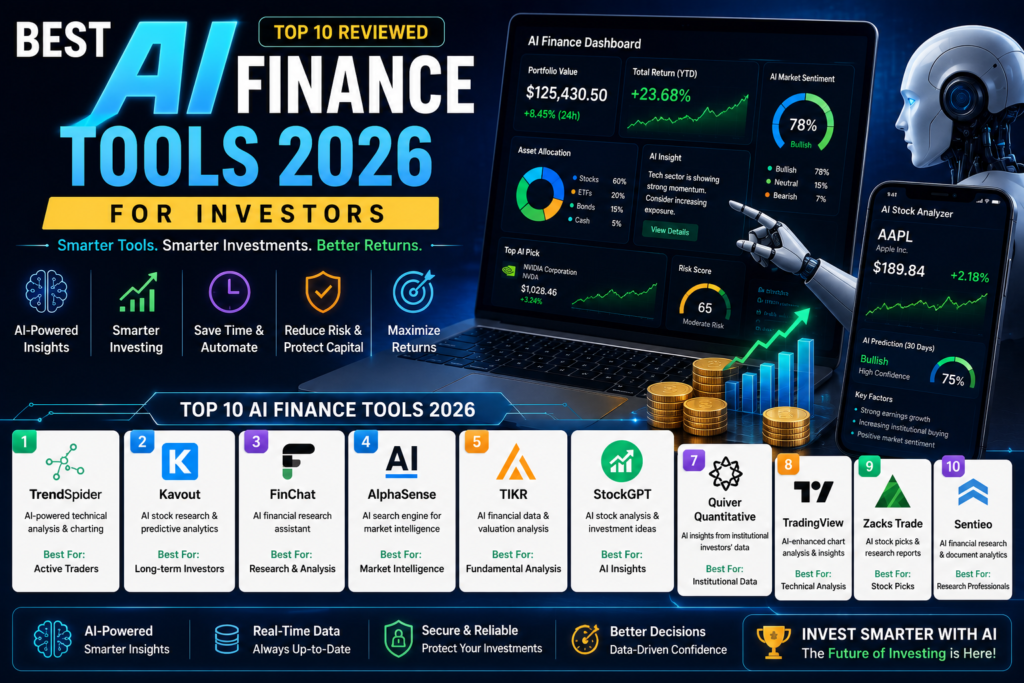
Here is my honest breakdown based on where you are right now:
If you are completely new to budgeting and want the easiest start, download Monarch Money. It is the closest thing to a “set it and forget it” system that actually works.
If you are in debt and need a psychological reset, YNAB will change how you think about money. The first month feels weird. By month three, you will be obsessed.
If you hate budgeting and just want an AI assistant to handle it, Cleo’s Autopilot is the future. It literally manages your money while you sleep.
If you suspect subscriptions are eating your paycheck, run Rocket Money for one week. The results will shock you.
If you want everything free, start with Empower. You can always upgrade later.
The Hidden Truth About AI Finance Apps for Smarter Money
Here is what nobody tells you: AI is not perfect. These apps can miscategorize transactions, miss duplicate charges, and occasionally give advice that does not fit your situation. Wall Street Prep testing found that even the best AI finance tools still need human oversight on complex decisions.
The best AI personal finance apps for beginners are not replacements for financial literacy — they are accelerators. Use them to see patterns, automate boring tasks, and build habits. But always double-check tax-related categorizations, and never let an app auto-invest money you cannot afford to lose.
The Future: Your Money Will Manage Itself
By 2027, agentic AI will move from “advice” to “action.” Imagine an app that pays your bills, rebalances your portfolio, switches you to a cheaper phone plan, and deposits spare change into a high-yield account — all without you opening the app. That is where we are headed.
Gartner named agentic AI the top emerging technology for 2026, and 44% of finance teams are already using autonomous workflows. For personal finance, that means beginners in 2026 are getting in at the perfect time — right before the technology becomes truly invisible.
Final Thoughts
I have used notebooks, spreadsheets, and now AI apps. The difference is not even close. The best AI personal finance apps for beginners do not just show you where your money went — they help you decide where it should go next.
My current stack? Monarch Money for daily tracking, Rocket Money for subscription hunting, and Empower for net worth overview. Total cost: $8.33 per month. Time saved: roughly 5 hours per week. That is a trade I will take every single time.
If you are ready to stop guessing and start growing, pick one app from this list today. Not tomorrow. Today. Download it, connect one bank account, and let the AI show you what you have been missing.
What is your biggest money struggle right now? Drop a comment below and let me know which of these best AI personal finance apps for beginners you are trying first. And if you want to go deeper, check out our guide to AI investing for beginners and our breakdown of passive income ideas that actually work in 2026.
Disclaimer: This article is for informational purposes only and does not constitute financial advice. Always consult a qualified financial advisor before making major financial decisions.