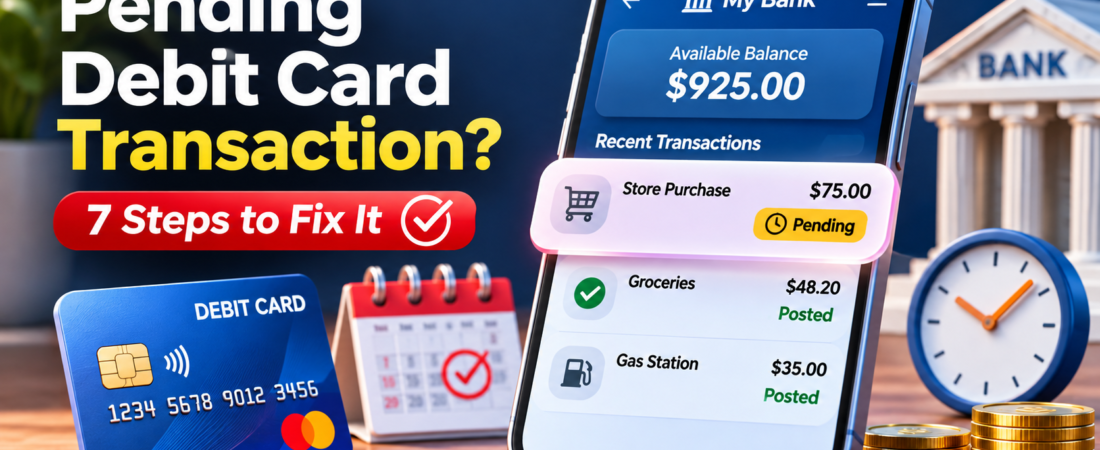
Pending Debit Card Transaction? 7 Steps to Fix It
Updated: October 25, 2026
You open your banking app to check your balance and notice something confusing.
A payment you made yesterday still says “Pending.”
Your available balance is lower, but the transaction hasn’t officially cleared.
Now you’re wondering: Is my money gone? Did the payment fail? Will I get charged twice?
If you’re dealing with a pending debit card transaction, understanding how the payment process works can save you unnecessary stress.
Quick answer: A pending debit card transaction is a payment that your bank has authorized but that the merchant hasn’t fully completed. Many debit card purchases post within one to three business days, although some transactions can take longer.
The important thing is knowing when to wait, when to contact the merchant, and when to call your bank.
This guide explains seven practical steps to understand and resolve pending debit card charges.
What Is a Pending Debit Card Transaction?
A pending debit card transaction is a purchase that has been authorized but hasn’t finished processing.
When you use your debit card, the merchant typically requests authorization from your bank.
The bank checks whether your account can cover the transaction and may temporarily reserve the required funds.
However, the merchant still needs to submit the final payment for settlement.
Until that process is complete, the charge may appear as pending.

Example: A $75 Debit Card Purchase
Imagine you have $1,000 in your checking account.
You buy groceries worth $75.
Your banking app might display:
| Account Detail | Amount |
|---|---|
| Current balance | $1,000 |
| Pending transaction | -$75 |
| Available balance | $925 |
Although the transaction hasn’t fully posted, your bank has already reserved $75.
This means you generally have only $925 available for additional purchases.
Once the merchant completes the transaction, the pending charge normally changes to a posted transaction.
Important: A pending payment does not automatically mean something went wrong.
In most cases, it is simply part of the normal card payment process.
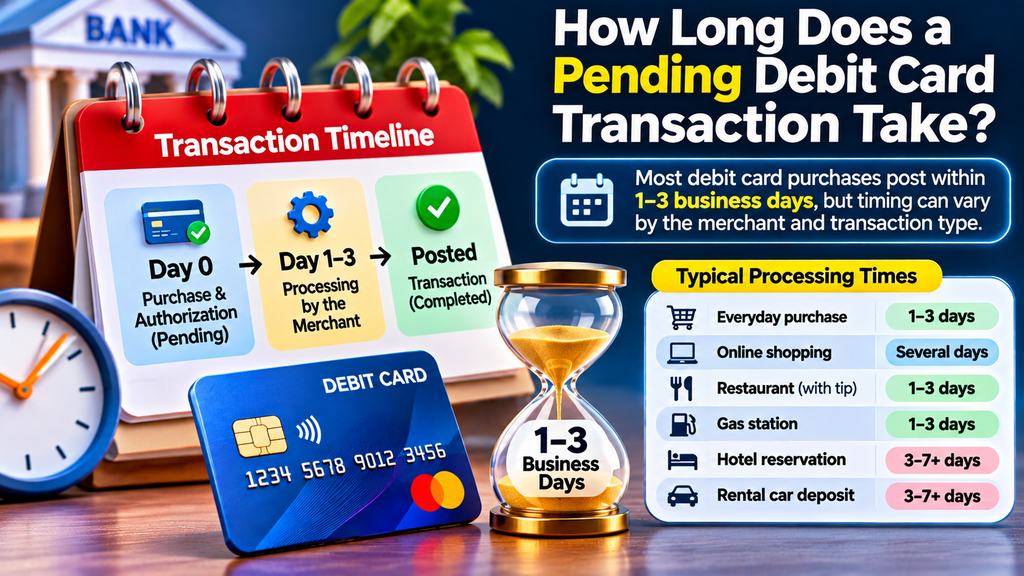
How Long Does a Pending Debit Card Transaction Take?
One of the most common questions is how long a pending debit card transaction takes to clear.
According to Wells Fargo’s debit card guidance, purchases generally post within one to three days, although processing time can vary.
Capital One also explains that pending transactions may take several days and occasionally longer, depending on the transaction and financial institution.
Typical Processing Times
| Transaction Type | What to Expect |
|---|---|
| Everyday retail purchase | Often 1–3 business days |
| Online shopping | Usually several business days |
| Restaurant transaction | May take additional time for tips |
| Gas station purchase | Temporary authorization may differ from final cost |
| Hotel reservation | Holds may last longer than ordinary purchases |
| Rental car deposit | Extended holds may apply |
| Canceled purchase | Hold may disappear without a posted charge |
These are general examples, not guaranteed deadlines.
Each bank and merchant may use different processing rules.
Do Weekends Affect Pending Transactions?
Yes, weekends and bank holidays can affect some payment processing timelines.
For example, a transaction initiated late Friday may not settle until the following week.
However, modern payment networks do not all operate on identical schedules.
Always check your bank’s specific transaction policies.
7 Smart Steps to Resolve a Pending Debit Card Transaction
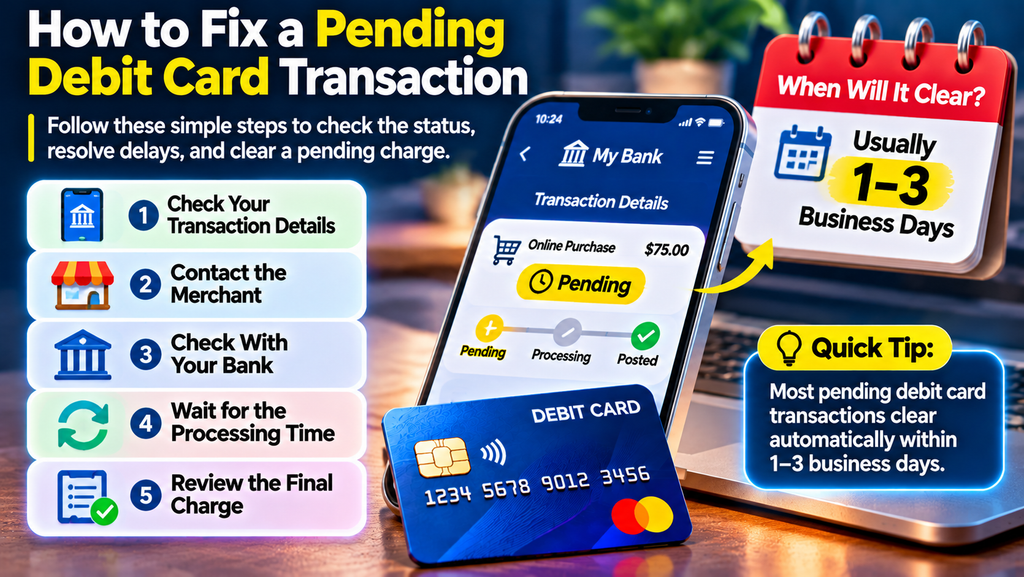
Step 1: Check Your Pending Debit Card Transaction Details
The first step is to review the transaction carefully.
Open your mobile banking app and find the pending charge.
Check the merchant name, transaction amount, date, and payment method.
Sometimes the merchant’s displayed name differs from the store where you made the purchase.
For example, an online retailer might use a separate company to process its payments.
Before assuming the transaction is suspicious, compare the amount with your recent purchases.
What to do: Save a screenshot of the transaction details if something looks incorrect.
Step 2: Understand Why Your Debit Card Transaction Is Pending
There are several reasons a debit card purchase might remain pending.

The merchant may not have submitted the final charge.
A restaurant might be waiting to include a tip.
A hotel may have placed an authorization hold for potential additional expenses.
A gas station might temporarily reserve more than the final fuel purchase amount.
These situations are not necessarily signs of fraud.
For example, imagine buying $35 worth of gas.
A gas station might initially authorize a larger amount and then replace it with the actual purchase total.
Your available balance may temporarily reflect the authorization amount.
What to do: Identify the type of purchase before deciding whether the delay is unusual.
Step 3: Wait for Normal Processing When Appropriate
Not every pending debit card transaction requires immediate action.
If you recognize the purchase, the amount looks correct, and the transaction is still within your bank’s normal processing period, waiting may be reasonable.
However, do not assume that every pending transaction will disappear after exactly three days.
Some authorizations remain longer.
Also, avoid spending money simply because a pending charge disappears.
A merchant may still submit a valid transaction afterward.
What to do: Review your available balance and monitor the transaction until it posts or the authorization is released.
Step 4: Contact the Merchant About the Pending Charge
If the transaction seems incorrect, contact the business that initiated it.
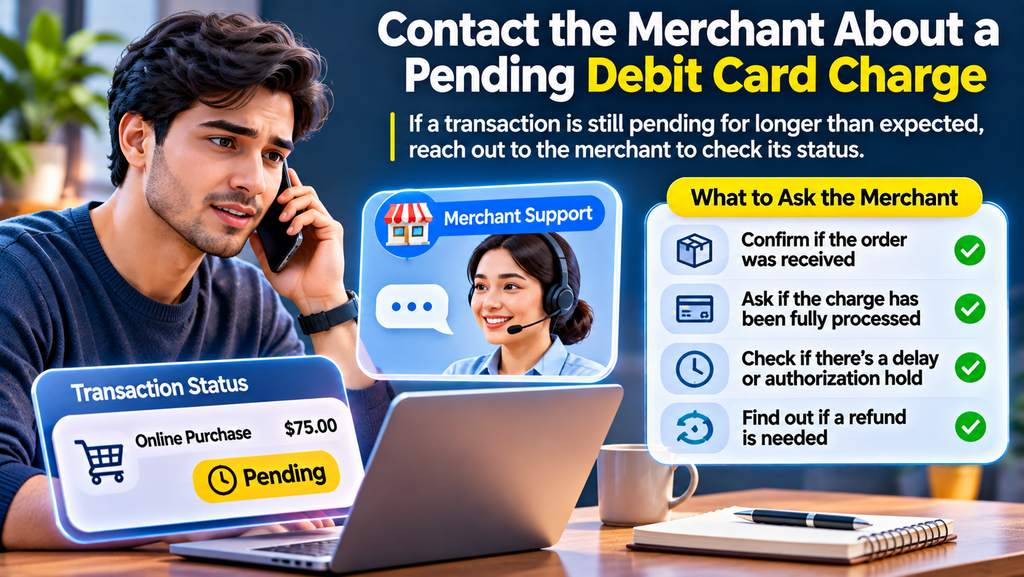
The merchant may be able to explain why the authorization remains active.
If your purchase was canceled, ask whether the merchant has released or reversed the authorization.
Suppose you ordered a $120 product online but canceled the order immediately.
The store confirms the cancellation.
However, your bank still shows a pending $120 charge.
In this situation, the merchant may have voided the payment, but the bank’s authorization hold might not have disappeared yet.
Ask the merchant:
- Has the transaction been finalized?
- Was the authorization canceled?
- Can you provide confirmation of the reversal?
- When should the authorization hold be released?
Keep any written confirmation.
Step 5: Ask Your Bank About the Pending Debit Card Transaction
If the merchant cannot resolve the issue, contact your bank.
Explain the situation and provide the transaction details.
Your bank may be able to tell you whether the charge is an authorization hold or a fully processed payment.
You can ask:
“Can you confirm why this debit card transaction is still pending and whether the authorization can be released?”
Be aware that banks cannot always remove a pending charge immediately.
Some require the merchant to cancel the authorization or the hold to expire.
What to do: Ask about your bank’s specific policy rather than assuming that all banks process pending transactions identically.
Step 6: Report Unauthorized Pending Debit Card Charges
A pending charge you do not recognize deserves immediate attention.
First, check whether the transaction belongs to a family member or an authorized account user.
If you still do not recognize it, contact your bank promptly. If you receive a suspicious banking notification, learn how to spot a fake bank alert before responding or sharing personal information.
Do not wait for a suspicious transaction to post before reporting possible unauthorized activity.
Under the Electronic Fund Transfer Act and Regulation E, consumers may have important protections against unauthorized electronic transfers.
The CFPB explains that reporting unauthorized transactions promptly is essential because liability and investigation procedures can depend on when the consumer notifies the financial institution.
If your debit card was lost or stolen, tell your bank immediately.
If your banking app allows you to temporarily lock the card, that may help prevent additional transactions.
However, locking a card generally does not cancel transactions that have already been authorized.
What to do: Contact your bank using the official number on your card or its website.
Step 7: Prevent Future Debit Card Payment Problems
Although you cannot eliminate every pending transaction, you can reduce confusion and avoid certain financial problems.
Start by enabling transaction notifications.
Most major banking apps offer alerts when a debit card purchase occurs.
Review your available balance before making large payments.
Be particularly careful when using debit cards for hotels, rental cars, and gas station purchases.
These transactions may involve temporary authorization holds.
If you are booking a hotel, ask whether it requires a security deposit or additional authorization.
You should also review your bank statements regularly.
What to do: Set up transaction alerts and maintain enough available funds for essential expenses.
Can You Cancel a Pending Debit Card Transaction?
Sometimes, but the options depend on the merchant, bank, and transaction type.
If you authorized the purchase and then changed your mind, contacting the merchant is usually the first step. If the charge is part of a recurring subscription, our guide on how to stop automatic payments explains how to cancel unwanted withdrawals and prevent future charges.
The merchant may be able to cancel the transaction before it settles.
However, there is no guarantee that a pending authorization can be canceled immediately.
Some banks cannot remove an authorization simply because the customer requests it.
If the payment is unauthorized, contact your bank immediately instead of waiting for the merchant to respond.
Pending vs. Posted Transactions
| Feature | Pending Transaction | Posted Transaction |
|---|---|---|
| Processing status | Not fully settled | Completed |
| Available balance | Often affected | Generally already reflected |
| Amount | May change | Usually finalized |
| Cancellation | May require merchant action | Usually requires refund or dispute |
| Bank dispute options | Depend on bank and situation | Formal dispute options may apply |
The distinction matters because banks may handle pending charges differently from completed payments.
Why Did My Pending Debit Card Transaction Disappear?
You check your bank account one morning and notice that yesterday’s pending charge has vanished.
Does that mean you received free money?
Usually not.
There are several possible explanations.
The merchant may have canceled the authorization.
The hold may have expired.
The original pending charge may have been replaced with a completed transaction.
Or the merchant might submit the payment later.
Example: A Canceled Hotel Booking
Imagine a hotel places a $200 authorization hold on your debit card.
You cancel your reservation within the hotel’s permitted cancellation period.
The hotel releases the hold.
A few days later, the pending transaction disappears from your banking app.
Your available balance increases again.
In this example, the change may reflect the release of the authorization.
However, the outcome depends on the hotel’s cancellation terms and the bank’s processing rules.
Key takeaway: A disappeared pending charge does not always mean the merchant has permanently waived payment.
Why Is My Available Balance Lower Than My Current Balance?
This is one of the most confusing parts of debit card banking.
Your current balance and available balance may differ because of pending authorizations and other account activity.
For example:
| Account Activity | Amount |
|---|---|
| Current balance | $1,500 |
| Pending grocery purchase | -$125 |
| Pending hotel authorization | -$300 |
| Available balance | $1,075 |
In this example, $425 is temporarily unavailable because of pending transactions.
Although your current balance shows $1,500, you should not assume the full amount is available for spending.
The available balance is generally more useful when deciding whether you can afford another purchase.
What If a Pending Debit Card Transaction Is Taking Too Long?
If your transaction remains pending beyond the bank’s stated processing period, investigate.
Start by reviewing the transaction date.
Consider whether weekends, holidays, or merchant-specific holds could explain the delay.
Next, contact the merchant.
Ask whether the transaction was completed, canceled, or reversed.
If the merchant confirms a cancellation but the money remains unavailable, contact your bank.
Provide the merchant’s confirmation if requested.
Avoid filing a fraud claim for a legitimate purchase simply because its processing is slow.
However, if the payment is unauthorized, report it promptly.
Can a Pending Debit Card Transaction Cause an Overdraft?
It is possible for account activity to create overdraft problems, depending on the financial institution’s policies.
Pending transactions reduce your available balance, but the amount that eventually posts may differ from the original authorization.
Consider a restaurant purchase.
You pay $40 for dinner and add an $8 tip.
The pending authorization might initially show $40, while the final transaction posts for $48.
If your remaining funds are limited, that difference can matter.
Your bank’s overdraft rules determine whether a fee or other consequence applies.
For certain ATM and one-time debit card transactions, federal rules generally require consumers to affirmatively opt in before banks may charge overdraft fees.
But those rules do not cover every transaction type.
Review your bank’s overdraft disclosures to understand your options.
Frequently Asked Questions
How long do pending debit card transactions take?
Many everyday debit card purchases post within one to three business days. However, certain transactions and authorization holds can take longer depending on the merchant and bank.
Can I cancel a pending debit card transaction?
You may be able to request cancellation through the merchant. However, whether the authorization can be reversed immediately depends on the transaction and financial institution.
Why is my debit card transaction pending for five days?
The merchant may not have completed settlement, or your bank may still be holding the authorization. Contact the merchant or bank if the delay exceeds the expected processing period.
Will a pending transaction eventually go through?
Many pending transactions eventually post, but not all do. Some are canceled, reversed, or allowed to expire.
Can I spend money from a pending transaction?
Money reserved by a pending debit card authorization is generally excluded from your available balance. Do not assume those funds are available for new purchases.
What happens if a pending debit card charge disappears?
The authorization may have expired, been reversed, or been replaced by a posted charge. Check your transaction history before assuming the payment was canceled.
Can my bank cancel a pending transaction?
Some banks can help with certain pending charges, but they may require merchant action or additional processing time. If the transaction is unauthorized, notify the bank immediately.
Final Thoughts
A pending debit card transaction can be frustrating, especially when your available balance is lower than expected.
Fortunately, most ordinary pending transactions are simply part of the payment processing system.
The best approach is to understand the charge before taking action.
Check the transaction details, review your bank’s normal processing period, and contact the merchant when appropriate.
If the transaction looks unauthorized, report it to your bank promptly.
Most importantly, monitor your available balance rather than assuming that every dollar shown in your current balance is ready to spend.
Understanding how pending transactions work can help you avoid payment confusion, protect your account, and make better financial decisions.
Disclaimer: This article provides general financial education for U.S. consumers. Processing times, account policies, fees, and dispute procedures vary by financial institution and transaction type.