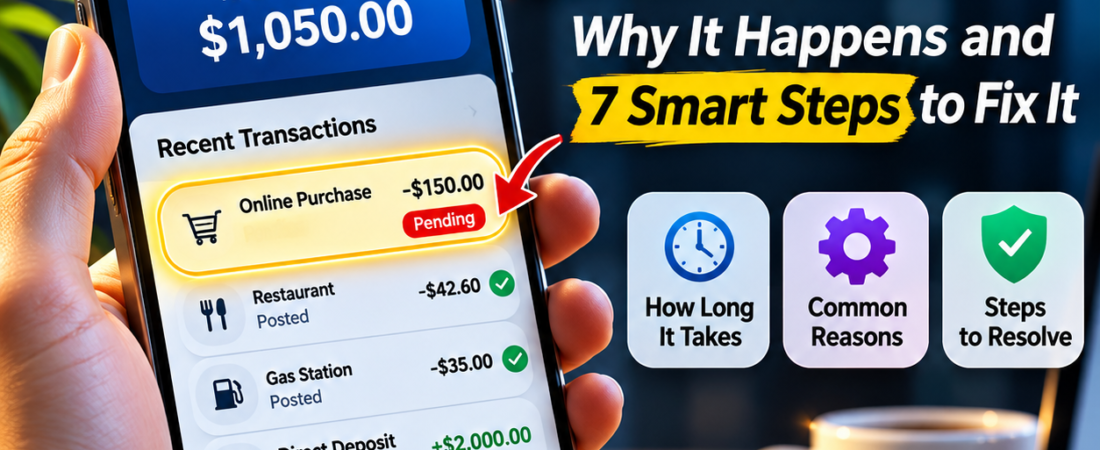
Pending Transaction: Why It Happens and 7 Smart Steps to Fix It
You check your banking app after buying groceries, ordering something online, or paying for gas. The payment appears, but instead of showing as completed, it shows as a pending transaction.
Your available balance may already be lower. The merchant might say the payment went through. Yet your bank still hasn’t finalized it.
So, is your money gone? Should you wait, contact the merchant, or call your bank?
A pending transaction is a payment that has been authorized but hasn’t finished processing. Most everyday card purchases clear within a few business days. However, some transactions take longer depending on the merchant, payment method, and bank.
Here’s how to figure out what’s happening and what to do next.
What Is a Pending Transaction?
A pending transaction is a card payment or other account activity that has not yet been fully posted to your account.

When you make a debit or credit card purchase, several things may happen:
- The merchant requests payment authorization.
- Your card issuer checks whether to approve the transaction.
- The bank or card issuer temporarily reserves the amount.
- The merchant submits the finalized charge.
- The transaction posts to your account.
The important distinction is that authorization and final settlement are not the same thing.
For example, suppose you spend $85 at a store using your debit card. Your banking app may immediately show an $85 pending charge, reducing your available balance even though the transaction hasn’t posted.
That doesn’t automatically mean something is wrong.
How Long Does a Pending Transaction Take?
For many ordinary credit card purchases, a pending transaction clears within approximately three to five business days, according to Chase.
Some charges settle faster, while certain merchant holds can last longer.
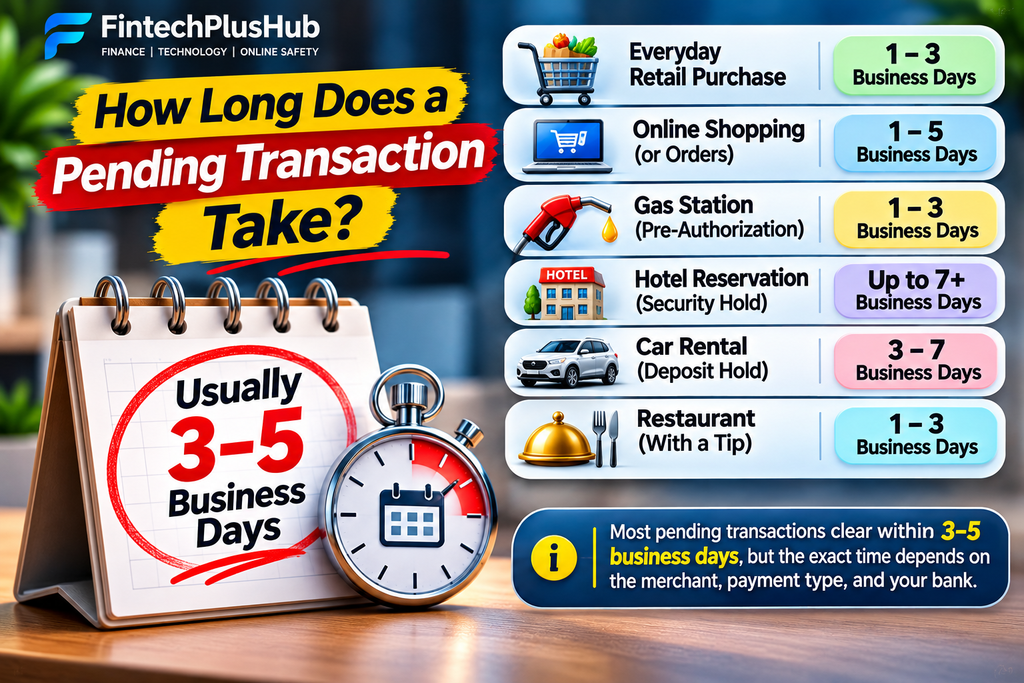
| Transaction type | What to expect |
|---|---|
| Everyday retail purchase | Often a few business days |
| Online shopping | May remain pending until the merchant processes or ships the order |
| Gas station | May involve a temporary authorization larger than the final purchase |
| Hotel reservation | May include a security or incidental-expense hold |
| Car rental | May involve a deposit or temporary authorization |
| Restaurant | Final amount may change when a tip is added |
These are general patterns, not guaranteed deadlines.
Weekends, bank holidays, merchant processing schedules, and card-network rules can affect the timing.
If the transaction has remained pending longer than expected, the next step depends on whether you recognize the charge.
According to Chase’s guidance on pending transactions, many credit card purchases take around three to five business days to post, although processing times can vary by merchant and transaction type.
Why Is My Pending Transaction Taking So Long?
Several situations can explain the delay.
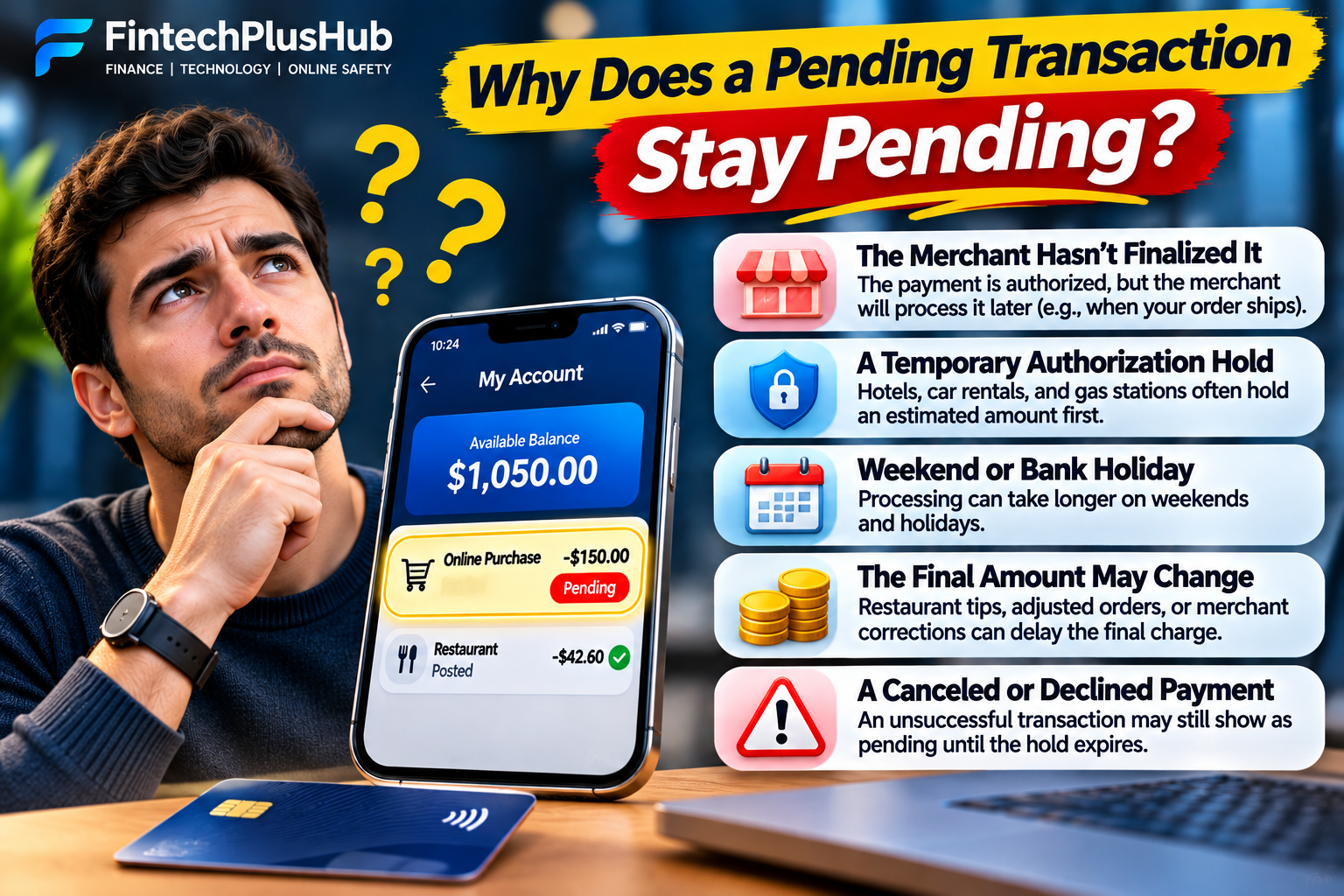
1. The Merchant Hasn’t Finalized the Payment
An approved card payment isn’t always immediately submitted for final settlement.
An online retailer, for example, might authorize your card when you order but complete the payment when your item ships.
2. A Temporary Authorization Hold Was Placed
Hotels, rental car companies, and gas stations sometimes authorize an estimated amount before the final total is known.
Suppose you buy $35 worth of gas but initially see a larger temporary hold. The final transaction may eventually post for $35, while the unused authorization is released.
3. The Purchase Happened Near a Weekend or Holiday
A transaction made late Friday may not finish processing on the same schedule as one made early Monday.
4. The Final Amount Is Different
Restaurant tips, adjusted orders, and merchant corrections can change the final posted amount.
5. The Payment Was Canceled or Declined
Sometimes an unsuccessful transaction still produces a temporary authorization.
That hold may remain visible until it expires or is released.
6. The Merchant Submitted the Charge Late
A merchant may delay completing the payment, leaving the original authorization pending longer than expected.
7. There May Be an Error or Unauthorized Activity
A charge you don’t recognize deserves immediate attention, even if it’s still pending.
Don’t assume every unfamiliar pending transaction is harmless.
Pending Transaction: 7 Smart Steps to Fix It

Step 1: Check the Transaction Details
Open your banking app and review:
- Merchant name
- Transaction date
- Pending amount
- Card or account used
- Any related completed transactions
Merchant names sometimes differ from the business names customers recognize.
Check your receipts and recent purchases before concluding that the charge is fraudulent.
Step 2: Compare Your Available and Current Balances
Your available balance may account for pending debit card transactions before those charges officially post.
For example:
Illustrative example
- Current balance: $1,200
- Pending debit card purchase: $150
- Available balance: $1,050
Depending on your bank, the displayed balances may differ.
Avoid spending money that is temporarily unavailable simply because the charge hasn’t posted.
Creating a realistic monthly budget can help you track upcoming payments and avoid spending money that is temporarily unavailable.
Step 3: Allow Normal Processing Time
If you recognize the purchase and it has only been pending for a day or two, waiting may be the appropriate action.
Check the merchant’s receipt and your bank’s guidance about typical processing times.
However, don’t wait if you suspect fraud.
Step 4: Contact the Merchant
For a legitimate charge that is incorrect, duplicated, or unusually delayed, contact the business first.
Ask:
- Has the payment been finalized?
- Was the order canceled?
- Is this a temporary authorization?
- Can the unused authorization be released?
- When should the final amount appear?
Keep the order number and any written response.
A merchant may be able to correct an issue more quickly than your bank can.
Step 5: Contact Your Bank When Necessary
If the merchant cannot explain the charge, contact your bank or card issuer.
Explain the amount, date, merchant name, and why you’re concerned.
Ask whether the transaction is an authorization hold, a posted charge, or an error.
Important: Many credit card issuers require a charge to post before opening a standard dispute. Debit card procedures can differ, and some banks allow customers to report pending debit card problems by phone.
Step 6: Report Suspicious Transactions Immediately
If you did not authorize the payment, contact your bank or card issuer immediately through its official app, website, or the number printed on your card.
Ask whether the card should be locked or replaced.
Don’t wait for an unfamiliar transaction to post before reporting suspected fraud.
U.S. consumer protections for unauthorized debit card transfers depend partly on how quickly you report the problem.
If you receive an unexpected payment notification, knowing how to spot a fake bank alert can help you avoid phishing scams and protect your banking information.
Step 7: Keep Records and Follow Up
Save relevant receipts, merchant messages, and any bank case number.
Check whether the pending charge:
- Posts correctly
- Disappears without posting
- Changes to the expected final amount
- Remains unresolved beyond the expected timeframe
If the charge posts incorrectly, follow your bank’s dispute procedure promptly.
Can You Cancel a Pending Transaction?
Usually, you cannot simply press a button in your banking app to cancel an authorized card payment.
For a legitimate purchase, the merchant is often the best first contact.
The merchant may be able to void an authorization or cancel an order, depending on its processing status.
If the charge has already posted, you may need a refund or formal dispute.
For suspected unauthorized activity, contact the bank immediately rather than waiting for the merchant.
What Happens If a Pending Transaction Disappears?
A pending charge disappearing does not always mean the purchase was free or permanently canceled.
Several outcomes are possible:
The authorization expired. The merchant didn’t finalize the payment within the applicable period, so the temporary hold was released.
The transaction posted under a different entry. The final payment may appear separately from the original pending authorization.
The merchant canceled the payment. The charge may never settle.
The merchant may still submit a valid payment. A released authorization doesn’t necessarily eliminate your obligation to pay for something you purchased.
Before spending the released funds, verify the final payment status with the merchant or your bank.
Pending Transaction vs. Posted Transaction

| Feature | Pending transaction | Posted transaction |
|---|---|---|
| Processing status | Not fully finalized | Completed and recorded |
| Amount | May change | Generally finalized |
| Available balance | May be affected | Reflected according to bank accounting |
| Cancellation | Often requires merchant involvement | Usually requires refund or dispute |
| Dispute options | Depend on issuer and transaction type | Standard dispute procedures generally available |
Understanding this difference can help prevent unnecessary disputes and accidental overspending.
Understanding the difference between pending and posted charges can also help you manage your credit card spending and avoid unnecessary credit card fees.
What If You See Two Charges for One Purchase?
Suppose you paid $60 for an online order and your account shows:
- $60 pending
- $60 posted
This doesn’t necessarily mean you’ve been charged twice.
The pending authorization may disappear after the finalized charge posts.
However, if two separate $60 transactions both post, contact the merchant and ask for an explanation or correction.
If the problem isn’t resolved, contact your bank about its dispute process.
When Should You Be Concerned About a Pending Transaction?
Pay closer attention when:
- You don’t recognize the merchant or purchase.
- Multiple unexpected authorizations appear.
- The pending amount is significantly different from the expected purchase.
- A canceled order remains unresolved longer than your bank’s stated timeframe.
- The merchant confirms a payment error.
- The charge eventually posts twice.
A normal processing delay is usually different from an unauthorized payment. The correct response depends on which situation you’re facing.
If you regularly access online banking through Chrome, reviewing your Chrome security settings can help reduce your exposure to malicious websites and phishing attempts.
Frequently Asked Questions
Why is my pending transaction not going through?
The merchant may not have submitted the final payment, the authorization may be awaiting settlement, or the transaction may have been canceled. Check with the merchant and bank if the delay exceeds their expected processing timeframe.
How long can a pending transaction stay on my debit card?
It depends on the merchant, bank, transaction type, and authorization rules. Ordinary purchases often settle within a few business days, while certain travel-related holds may last longer.
Does a pending transaction mean the money has already been taken?
Not necessarily. A debit card authorization can reduce your available balance before the transaction officially posts. On a credit card, it may reduce your available credit.
Can a pending transaction be refunded?
A merchant may be able to void an authorization or release a hold. Once the transaction posts, a refund is generally handled separately.
Will a pending transaction disappear if I lock my card?
Not necessarily. Locking a card generally helps restrict new activity but may not cancel previously authorized transactions.
Can I dispute a pending transaction?
It depends on your bank and whether it’s a debit or credit card charge. Many issuers require credit card transactions to post before a standard dispute, but suspected fraud should always be reported immediately.
Final Thoughts
A pending transaction is usually a normal part of card payment processing, not proof that something has gone wrong.
The smartest approach is to identify the charge, understand whether it’s an authorization hold, and give legitimate payments reasonable time to settle.
If the amount is incorrect, contact the merchant. If the transaction is unauthorized, contact your bank immediately.
The key is knowing when to wait—and when to act.