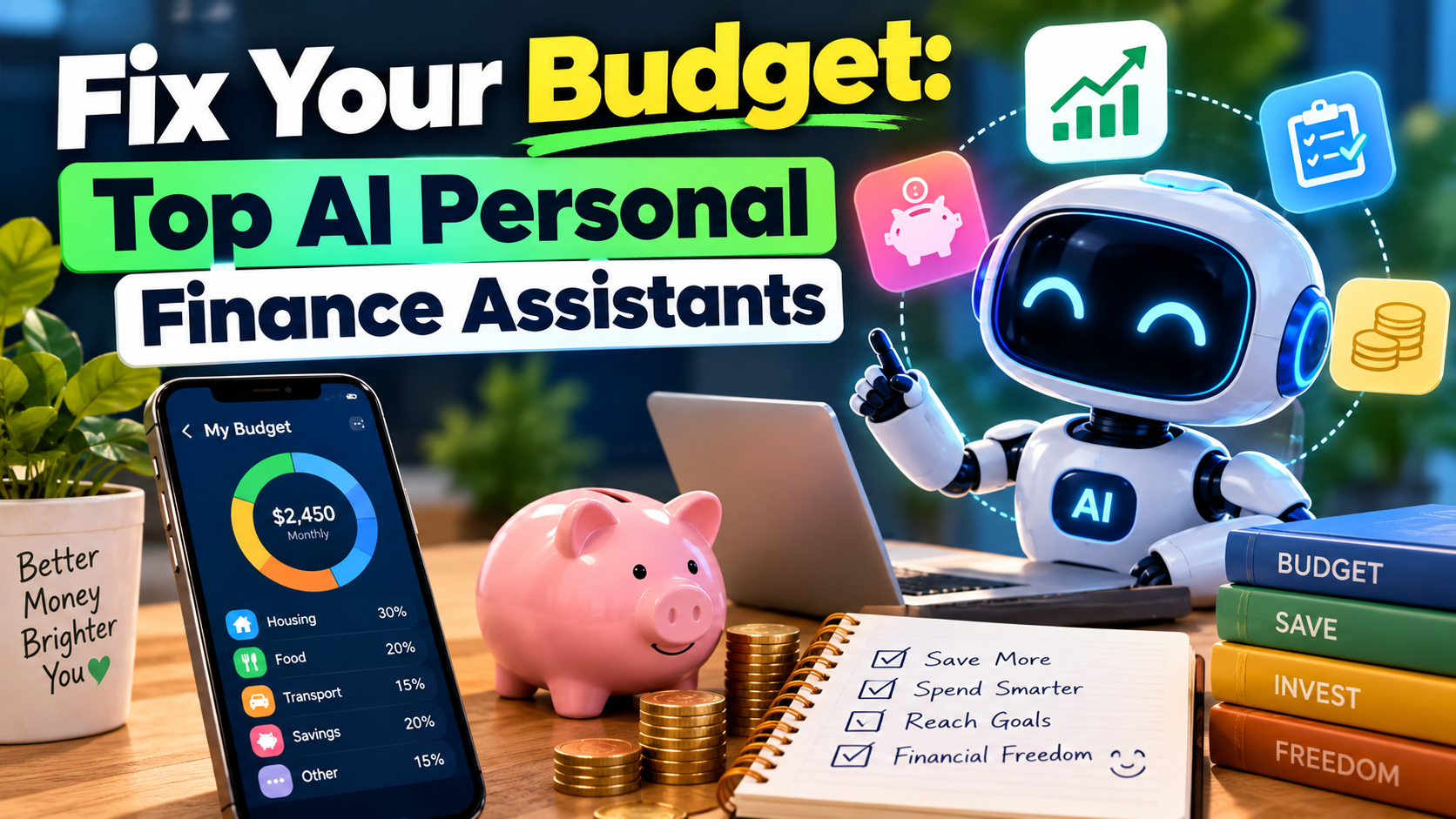
AI Personal Finance Assistants: Can They Actually Fix Your Budgeting Mistakes?
Introduction
Let’s be completely honest for a second. We have all tried to start a budget. You sit down on a Sunday afternoon, brew a fresh cup of coffee, open a brand-new Excel spreadsheet, and meticulously type out your financial goals. For the first two weeks, you feel like a Wall Street genius.
However, by week three, life happens. You forget to log that quick Starbucks run, your Netflix subscription renews unexpectedly, and suddenly, your flawless spreadsheet is a chaotic mess. You abandon it, promising to start over next month.
If this cycle sounds painfully familiar, you are not alone. In practical terms, traditional budgeting is exhausting. It requires constant manual input, extreme discipline, and a lot of math—things most of us don’t have the time or energy for after a long day at work.
This is exactly where AI personal finance assistants step in. Unlike passive spreadsheets, these smart algorithms actively learn your spending habits, predict your future bills, and gently (or sometimes brutally) nudge you away from bad financial decisions. But can a machine actually fix your ingrained budgeting mistakes?
Let’s break down exactly how artificial intelligence is changing personal finance for everyday people in the US, UK, and Canada, and how you can use it to finally get your money under control.

The Real Problem with Traditional Budgeting
Before we dive into the AI solutions, we need to understand why traditional methods fail 80% of the time. The fundamental flaw of manual budgeting is that it is backward-looking. You are essentially doing a post-mortem on money you have already spent.
When you look at your bank statement at the end of the month and realize you spent $400 on dining out, the damage is already done. Moreover, human beings are incredibly prone to “optimism bias.” When we set budgets, we imagine a perfect version of ourselves who never gets a flat tire, never buys a last-minute birthday gift, and never craves takeout on a rainy Tuesday.
AI personal finance assistants flip this model upside down. Instead of just telling you what you did wrong last month, they operate in real time to prevent you from making mistakes today.
5 Ways AI Personal Finance Assistants Actually Fix Your Budgeting Mistakes
So, how exactly does the technology work? Here is a step-by-step look at how integrating an AI assistant into your financial life solves the most common money traps.
1. Eliminating the “Late Fee” Trap with Predictive Alerts
One of the most frustrating ways to lose money is paying late fees or overdraft charges. Usually, this happens not because you are broke, but because you simply lost track of a billing cycle.
AI budgeting tools securely connect to your bank accounts using enterprise-grade encrypted networks like Plaid. By analyzing your past transaction history, the AI learns your exact billing schedule. If your electricity bill is usually pulled on the 14th of the month, but your checking account balance is running dangerously low on the 12th, the AI will send a push notification to your phone.
The AI fix: It warns you before the overdraft happens, allowing you to transfer funds in time. It removes human forgetfulness from the equation entirely.
2. Automating Your Savings Without You Even Noticing
The classic rule of wealth building is to “pay yourself first.” However, most people pay their bills, spend money on their lifestyle, and promise to save whatever is left over. Spoiler alert: there is rarely anything left over.
AI personal finance assistants use complex algorithms to analyze your daily cash flow. They calculate exactly how much money you can afford to save on any given day without impacting your ability to pay rent or buy groceries.
The AI fix: Apps like Cleo or Plum will automatically move small, safe amounts (like $3 or $12) from your checking to your savings account several times a week. By the end of the month, you have saved a significant amount without ever feeling the financial pinch.
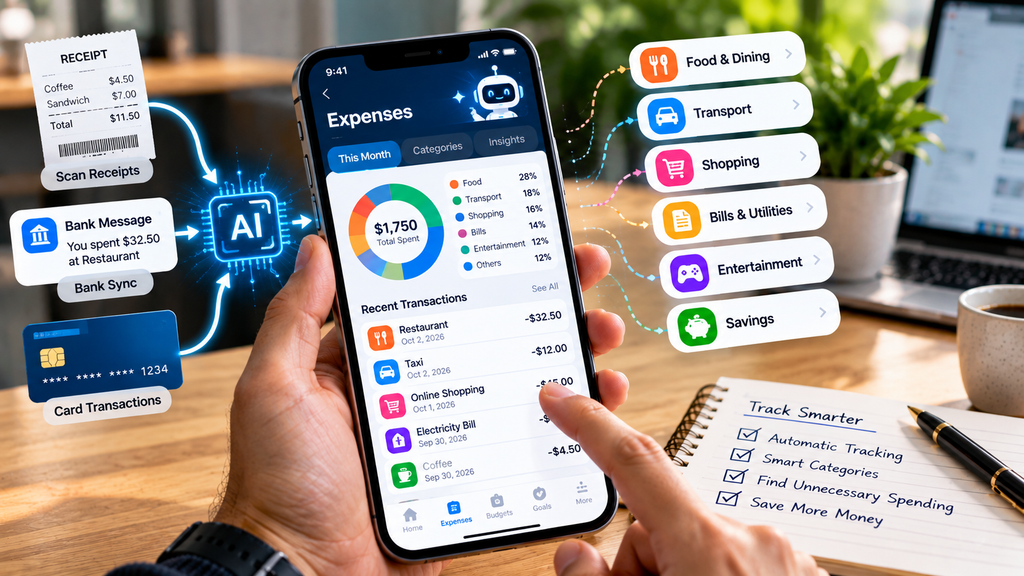
3. Categorizing Expenses Accurately (Goodbye, Spreadsheet Chaos)
A clear picture of where your money goes is still the foundation of a useful budget, and the https://www.consumerfinance.gov/archive/blog/track-your-spending-with-this-easy-tool/?utm_source=chatgpt.com can help you review your spending before deciding what needs to change.
If you have ever used an older budgeting app, you know the frustration of seeing a transaction labeled as “SQ* MERCHANT 8921” and having no idea what you bought.
Modern AI finance tools use machine learning to decode these cryptic bank line items. The AI knows that “SQ* MERCHANT” was actually the local indie coffee shop down the street. It automatically categorizes the purchase under “Dining & Coffee” with terrifying accuracy.
The AI fix: You no longer have to spend your weekends categorizing receipts. The AI builds a perfect, visually appealing pie chart of your spending habits in real time, allowing you to instantly see if you are going overboard on online shopping.

4. Calling Out Bad Spending Habits (Without the Guilt)
Human financial advisors are great, but admitting to another human that you spent $200 on video games or shoes this week can feel embarrassing. AI has no judgment, but it is programmed to hold you accountable.
Some of the best AI personal finance assistants allow you to customize their “personality.” If you are about to impulse-buy something on Amazon, the AI can intervene. It will analyze your monthly budget and send a message like, “You have already spent $150 on shopping this month. If you buy this, you will have to cut back on groceries. Are you sure?”
The AI fix: By interrupting the “impulse buy” loop with hard data, AI introduces a moment of friction that saves you from emotional spending.
5. Adapting to Irregular Income (Perfect for Freelancers)
Traditional budgets are designed for people with standard 9-to-5 jobs and identical bi-weekly paychecks. But in today’s gig economy across North America and the UK, millions of people have fluctuating incomes.
If you are a freelancer, contractor, or commission-based worker, budgeting is notoriously difficult. AI thrives on finding patterns in chaos.
The AI fix: An AI personal finance assistant can calculate your average income over a 12-month period, identify your baseline survival expenses, and dynamically adjust your discretionary spending limits based on whether you are having a high-earning month or a slow one.
Top AI Personal Finance Assistants to Try in 2026
If you are ready to fire your spreadsheet and hire an algorithm, here are a few of the top-rated tools dominating the market right now:
AI personal finance assistants are becoming more capable, and tools such as the Visa AI Financial Assistant show how AI could increasingly help consumers understand spending and make everyday financial decisions.
- Cleo: Designed for Gen Z and Millennials, Cleo operates like a chatbot in your messaging app. It is famous for its “Roast Mode,” where the AI will literally make fun of your terrible spending habits to shock you into saving money. It is highly effective and engaging.
- Monarch Money: Built by the former product manager of Mint, this is a premium, comprehensive dashboard. It is fantastic for couples who want to sync their finances and use AI to forecast their net worth years into the future.
- Rocket Money (formerly Truebill): While great at budgeting, its AI shines at hunting down forgotten subscriptions. The AI will scan your statements, find that gym membership you haven’t used in eight months, and even cancel it on your behalf.
However… The Drawbacks You Need to Know
While AI personal finance assistants are revolutionary, they are not a magic wand. Moreover, you must consider the privacy implications.
To work effectively, these apps require read-only access to your bank accounts. While reputable companies use bank-level encryption and do not store your actual login credentials, you are still handing over your financial data to a third party. Always read the privacy policy to ensure the app is not selling your spending data to advertisers.
Furthermore, AI can only guide you; it cannot force you to put your credit card away. If the AI tells you that you cannot afford a vacation, but you book the flight anyway, the algorithm cannot save you from the resulting debt. The technology provides the roadmap, but you still have to drive the car.
Final Thoughts

So, can AI personal finance assistants actually fix your budgeting mistakes? The short answer is yes. By removing the manual labor of data entry, eliminating late fees through predictive alerts, and automating your savings, AI bridges the gap between your financial goals and your actual human behavior.
We live in a world where algorithms are designed to make us spend money—from targeted Instagram ads to seamless Apple Pay checkouts. Practically speaking, it only makes sense to arm yourself with an algorithm designed to help you keep your money.
AI can help you control a budget, but it can also influence how you spend, especially as AI shopping agents become more involved in product discovery and purchasing decisions.
If you have failed at budgeting before, do not blame yourself. Blame the outdated tools you were using. Take an hour this week to download one of the AI finance apps mentioned above, securely link your accounts, and let the artificial intelligence do the heavy lifting. Your future bank account will thank you.